Early Termination of Probation
An Early Termination of Probation document is a formal legal instrument prepared for submission to a court, petitioning for the premature conclusion of a period of court-ordered supervision.
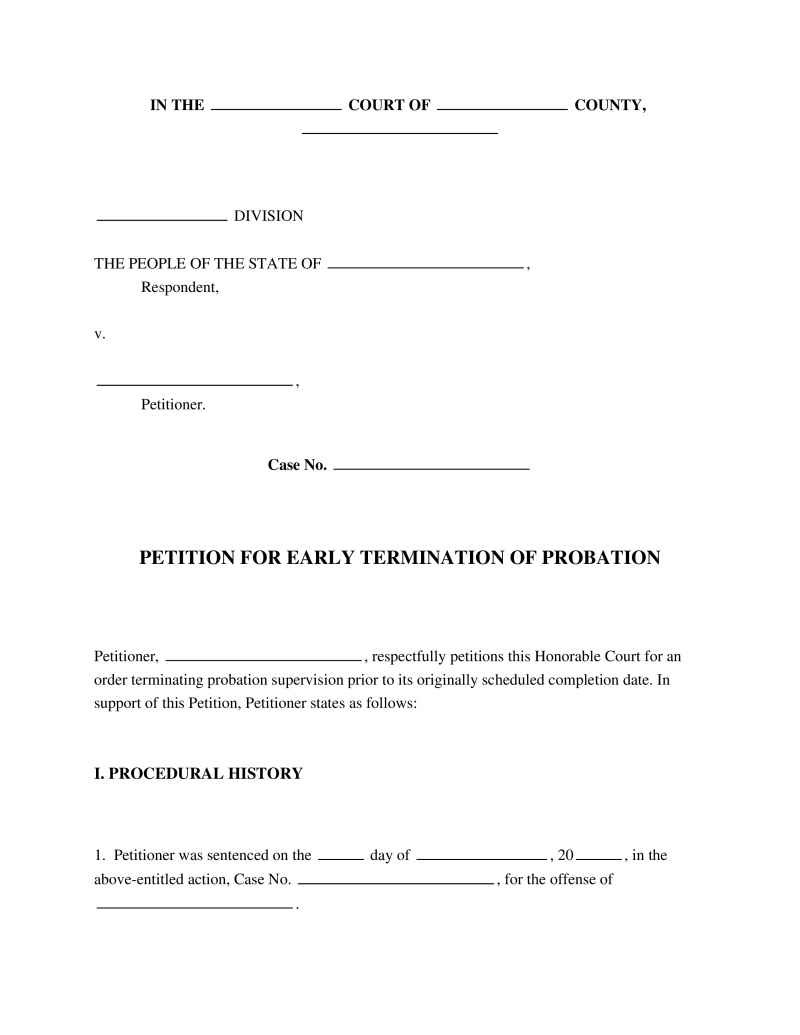
Filing Party Role
Select the party on whose behalf this motion is being filed.
Enter the name of the law firm representing the probationer, if any.
Enter the name of the agency or department for the probation officer, if applicable.
Table of Contents
What is Early Termination of Probation?
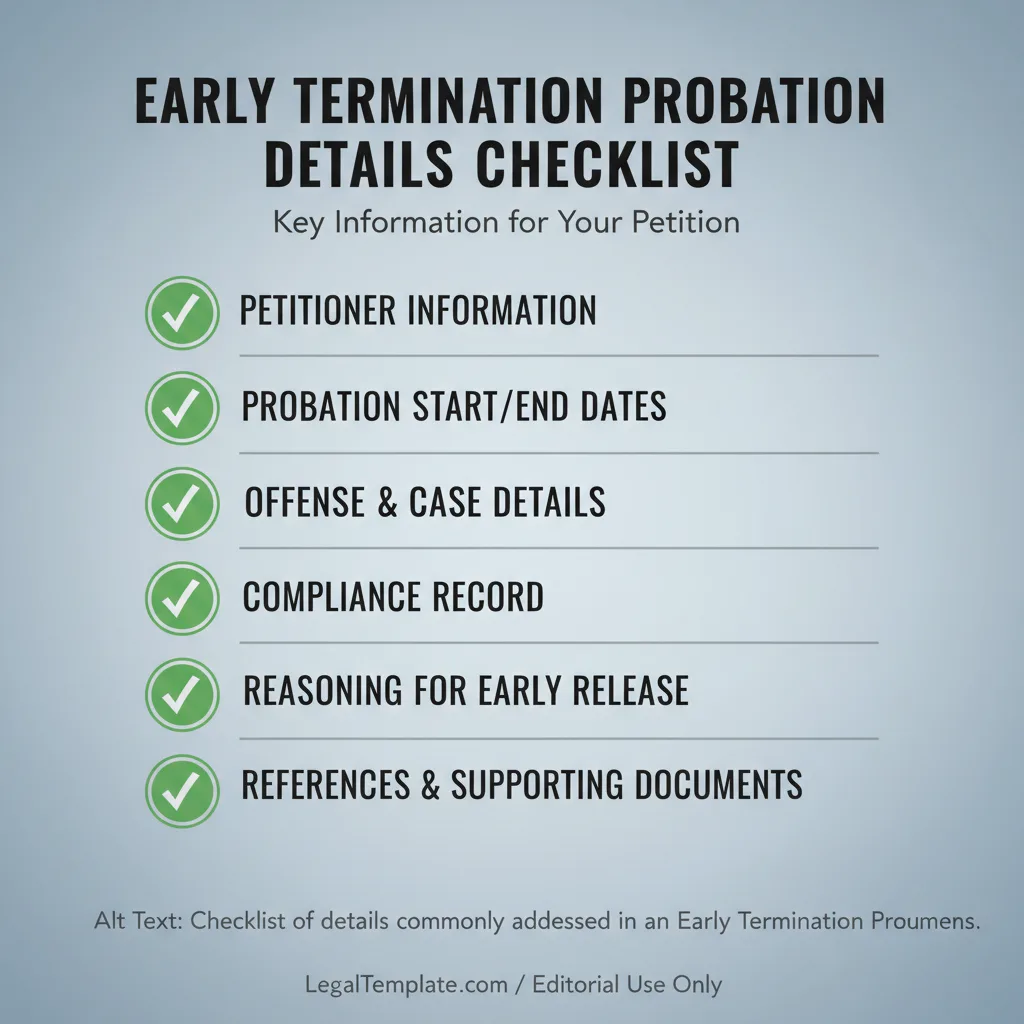
Early termination of probation refers to the process by which an individual's court-ordered supervision period is concluded before its originally scheduled end date. This legal mechanism allows probationers who have demonstrated consistent compliance with their conditions and a commitment to rehabilitation to be released from supervision. Its purpose is to reward positive behavior, reduce the burden on correctional systems, and facilitate a quicker reintegration of individuals into society, provided they no longer pose a risk to public safety.
Eligibility Criteria for Early Termination
Eligibility for early termination of probation is determined by specific criteria, which can vary significantly between jurisdictions. Generally, courts and probation departments look for a sustained period of good conduct and adherence to all imposed conditions.
- Completion of Supervision Term - Many jurisdictions require a significant portion of the original probation term to have been successfully completed. For instance, in Oregon, at least one year of supervision must be completed for eligibility (Source 2). Nebraska law allows for an application after three-quarters of the imposed sentence is served (Nebraska Rev. Stat. § 6-1903) (Source 4). Rhode Island requires individuals to have been on probation for at least three years (Rhode Island Rule 35(c)) (Source 1).
- Compliance with Conditions - Consistent adherence to all probation terms is paramount. This includes attending required meetings, completing community service, participating in counseling, and refraining from new criminal activity (Source 2). Rhode Island specifically requires completion of all probation terms, including counseling, community service, restitution, and fines (Rhode Island Rule 35(c)) (Source 1).
- Absence of Major Violations - A clean record during the supervision period is critical. Rhode Island stipulates no major violations in the past three years (Rhode Island Rule 35(c)) (Source 1), while Nebraska requires no major violations during the preceding six months (Nebraska Rev. Stat. § 6-1903) (Source 4).
- Payment of Fines and Restitution - All financial obligations, such as fines, court costs, and restitution to victims, must typically be fulfilled (Source 1, Source 4).
- Demonstrated Rehabilitation - Probationers must show progress towards their reentry goals and a reduced risk to the community (Source 2, Source 3).
- Nature of Original Offense - Some offenses may preclude early termination. In Oregon, individuals convicted of violent crimes, sex offenses, or terrorism are not eligible for early termination of supervision (Source 2).
The Application Process
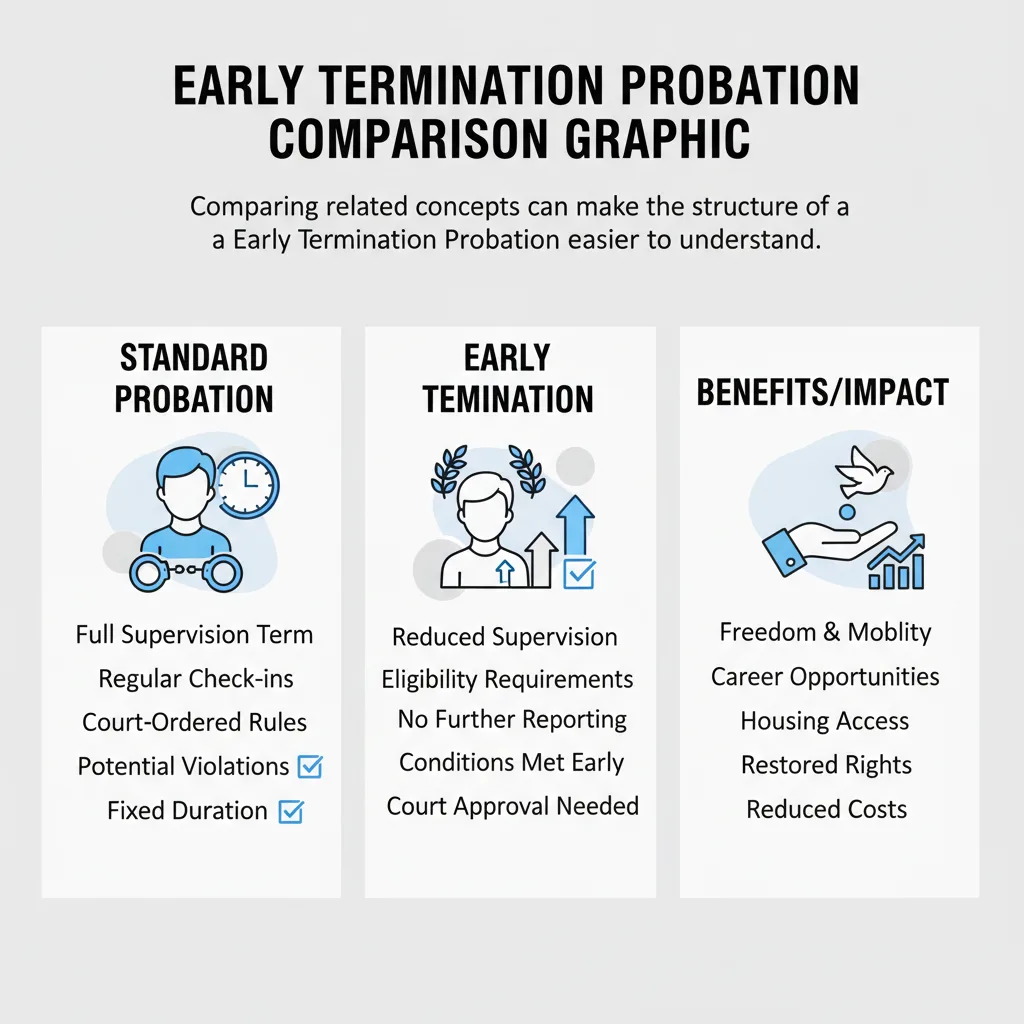
The process for seeking early termination of probation usually involves a formal application to the supervising court. This application can be initiated by the probationer, their legal counsel, or in some instances, by the probation officer themselves.
- Initiation of Request - A probationer or their attorney typically files a motion with the court that imposed the original sentence. In Nebraska, probation officers are authorized to submit an application for early discharge (Nebraska Rev. Stat. § 6-1903) (Source 4).
- Review by Probation Department - Upon receipt of a request, the probation department often reviews the probationer's record, including compliance history, completion of conditions, and risk assessment.
- Recommendation to the Court - Based on their review, the probation department may provide a recommendation to the court. Kentucky law provides for the department to establish procedures for recommending early termination to the court (Kentucky Rev. Stat. Ann. § 439.552) (Source 5).
- Judicial Review and Hearing - The court then evaluates the application, the probation department's recommendation, and any arguments from the parties. A hearing may be scheduled to allow the probationer to present their case and for the court to make an informed decision.
Factors Considered by the Courts
When deciding whether to grant early termination of probation, courts consider a range of factors to ensure that public safety is maintained and that the individual has genuinely reformed. These considerations go beyond mere technical compliance.
- Supervision Time Imposed and Served - The total length of the original probation term and the amount of time successfully served are key factors (Source 3).
- Compliance Record - The court assesses the probationer's history of adhering to all conditions, including reporting requirements, program attendance, and financial obligations (Source 2).
- Progress Toward Rehabilitation - Evidence of personal growth, stable employment, educational achievement, and positive community engagement demonstrates a reduced risk (Source 2).
- Risk to Community Safety - The court evaluates whether early termination would pose a threat to public safety. Federal courts, for instance, consider whether shortening supervision terms endangers the community (Source 3).
- Nature and Seriousness of Original Offense - While not always an automatic disqualifier, the gravity of the initial crime can influence the court's decision, especially for violent crimes or sex offenses (Source 2).
- District of Case Closure - In federal cases, the specific district where the case was closed can also influence early termination decisions (Source 3).
Jurisdictional Approaches to Early Termination
The authority and specific procedures for early termination of probation vary between federal and state systems, reflecting different legislative frameworks and judicial discretion.
Federal Supervision
Federal courts possess the authority to grant early termination of supervision under specific circumstances. The federal system emphasizes that early termination can shorten supervision terms without endangering public safety, considering factors such as the supervision time initially imposed and the district where the case was closed (Source 3).
State-Specific Regulations
Many states have codified their own rules and statutes governing early discharge from probation, each with unique requirements:
- Rhode Island Rule 35(c) - This rule outlines criteria for early termination, requiring individuals to have served at least three years on probation, have no major violations in the past three years, and have completed all probation terms including counseling, community service, restitution, and fines (Source 1).
- Oregon Federal Supervision - For individuals under federal supervision in Oregon, eligibility requires completion of at least one year of supervision, compliance with conditions, and progress towards reentry goals. Notably, those convicted of violent crimes, sex offenses, or terrorism are generally not eligible (Source 2).
- Nebraska Rev. Stat. § 6-1903 - Nebraska law allows probation officers to submit an application for early discharge after three-quarters of the imposed sentence is served, provided there have been no major violations in the preceding six months and all conditions, including fees and restitution, have been met (Source 4).
- Kentucky Rev. Stat. Ann. § 439.552 - This statute directs the department, in consultation with the Supreme Court, to establish administrative regulations for procedures to recommend early termination of probation for supervised individuals who have fulfilled their terms (Source 5).
Frequently Asked Questions
Sources
- Early Termination From Probation Rule 35(c) - Provides criteria and process for early termination of probation in Rhode Island under Rule 35(c).
- Early Termination of Supervision - Outlines eligibility and factors considered for early termination of supervision in Oregon.
- Early Termination: Shortening Federal Supervision Terms Without Endangering Public Safety - Discusses federal court authority and considerations for early termination of supervision.
- § 6-1903. Early discharge from probation. - Details Nebraska's procedures for early discharge from probation under § 6-1903.
- 439.552 Early termination of probation -- Administrative regulations. - Establishes procedures for early termination of probation in Kentucky under KRS 439.552.
Not the form you're looking for?
Try our legal document generator to create a custom document
Disclaimer: The templates available on this website are provided for general informational purposes only and do not constitute legal advice. They are not intended to be, and should not be interpreted as, compliant with any specific legal, regulatory, or privacy requirements. These templates are not a replacement for professional legal guidance and should not be relied upon for any particular matter or circumstance. Users are strongly encouraged to seek advice from a qualified attorney licensed in their jurisdiction before using, modifying, or relying on any template.
All templates are provided on an "as is," "with all faults," and "as available" basis. The provider disclaims any and all warranties of any kind, whether express, implied, statutory, or otherwise, including without limitation warranties of merchantability, fitness for a particular purpose, title, or non-infringement.
LegalTemplates.com makes no guarantees or representations regarding the accuracy, completeness, expected outcomes, or reliability of the materials contained in these templates or any materials referenced or linked from them.