Petition for Dissolution of Marriage
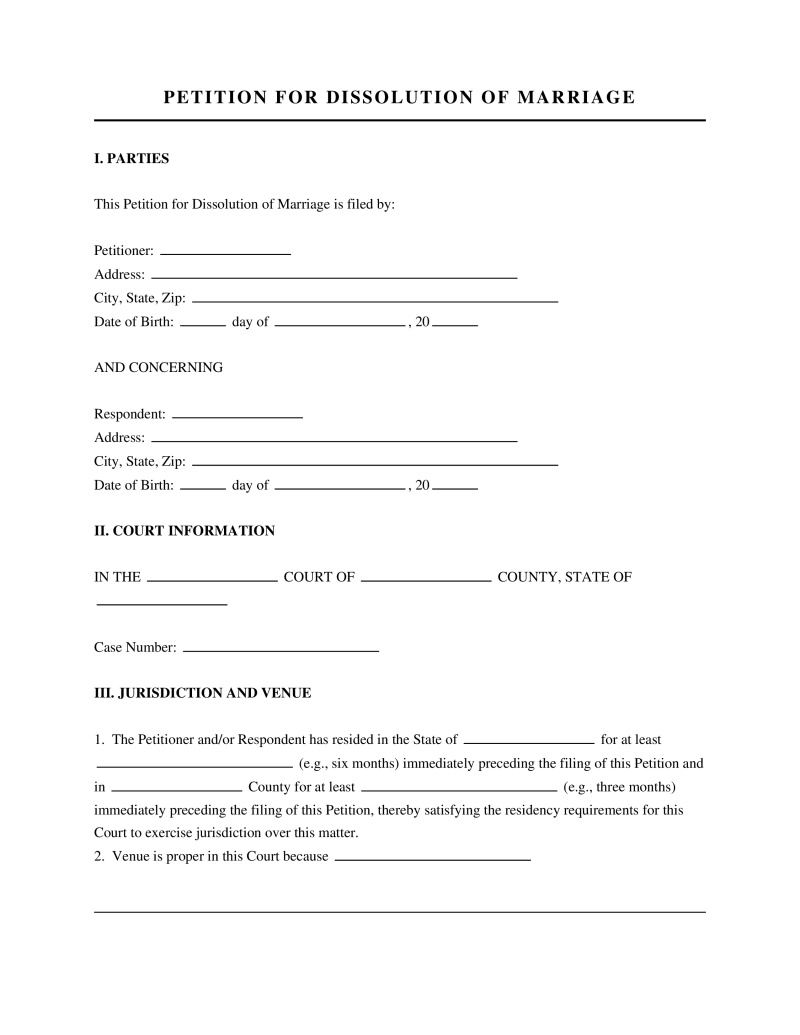
A Petition for Dissolution of Marriage is a legal document formally initiating divorce proceedings and requesting judicial termination of a marital union.
Petitioner Residency State
Select the state where the Petitioner has established legal residence. This may affect court jurisdiction and eligibility.
Table of Contents
What is a Petition for Dissolution of Marriage?
A Petition for Dissolution of Marriage is the foundational legal document that initiates the process of formally ending a marriage or civil union in a court of law. It serves as a formal request to the court, outlining the petitioner's desire to terminate the marital relationship and seeking judicial resolution of all related matters. This document is typically filed by one spouse, known as the petitioner, against the other spouse, referred to as the respondent, to legally dissolve the marriage and address issues such as property division, spousal support, child custody, and child support.
Legal Requirements and Grounds for Dissolution
To file a Petition for Dissolution of Marriage, specific legal requirements must be met, which vary by jurisdiction but generally include:
- Residency Requirements - Most states mandate that at least one spouse must have resided in the state for a specified period (e.g., six months to one year) and in a particular county for a shorter duration (e.g., three months) before filing. This ensures the court has proper jurisdiction over the case.
- Grounds for Dissolution - Jurisdictions typically recognize either "no-fault" or "fault-based" grounds, or a combination of both. No-fault grounds, such as "irreconcilable differences" or "irretrievable breakdown of the marriage," do not require proof of wrongdoing by either party. Fault-based grounds, like adultery, abandonment, or extreme cruelty, require the petitioner to prove specific misconduct.
- Separation Periods - In some states, particularly those with no-fault divorce, a period of physical separation may be a prerequisite for filing or finalizing a dissolution of marriage, demonstrating that the parties have lived apart for a certain duration without cohabitation.
- Jurisdiction Over Children - If minor children are involved, the court must have jurisdiction over the children, typically established by the Uniform Child Custody Jurisdiction and Enforcement Act (UCCJEA) as adopted by individual states, which prioritizes the "home state" of the child.
Jurisdictional Considerations
Establishing proper jurisdiction is a critical initial step in any dissolution proceeding. The court must have the authority to hear the case, which primarily involves both subject matter jurisdiction and personal jurisdiction over the parties. Subject matter jurisdiction pertains to the court's power to rule on the type of case presented, in this instance, a marital dissolution.
Personal jurisdiction over both spouses is necessary to make binding decisions regarding financial matters, such as property division and spousal support. This is typically achieved through proper service of the Petition for Dissolution of Marriage. If one spouse resides in a different state, specific rules for interstate service of process must be followed, often involving the Uniform Interstate Family Support Act (UIFSA) for child support matters. Venue, which refers to the appropriate geographic location of the court, is usually determined by the county where one or both parties reside or where the cause of action arose.
How to File a Petition for Dissolution of Marriage
The process of initiating a dissolution of marriage involves several distinct procedural steps to ensure legal compliance and proper notification of all parties.
- Drafting the Petition - This initial step involves preparing the formal document that outlines the petitioner's request for dissolution. The Petition for Dissolution of Marriage must include essential information such as the names and addresses of both spouses, the date and place of marriage, the names and birthdates of any minor children, the grounds for dissolution, and the specific relief sought, including requests for property division, spousal support, child custody, and child support. Accuracy and completeness are crucial to avoid delays.
- Filing with the Court - Once drafted, the petition and any required accompanying documents, such as a summons or financial declarations, must be filed with the clerk of the appropriate court. This typically involves paying a filing fee, although fee waivers may be available for individuals who meet certain income criteria. The court clerk will assign a case number and officially open the dissolution case.
- Serving the Respondent - After filing, the respondent must be formally notified of the lawsuit through a process called "service of process." This usually involves arranging for a sheriff, process server, or authorized private individual to personally deliver copies of the filed Petition for Dissolution of Marriage and summons to the respondent. Proper service is a fundamental due process requirement, ensuring the respondent has legal notice and an opportunity to respond.
- Respondent's Response - Upon receiving the served documents, the respondent typically has a specified period (e.g., 20 or 30 days) to file a formal response with the court. This response, often called an "Answer" or "Response to Petition," indicates whether the respondent agrees or disagrees with the allegations and requests in the petition and may include counter-requests. If no response is filed, the petitioner may be able to seek a default judgment.
Required Elements
A Petition for Dissolution of Marriage must contain specific information to be legally sufficient and accepted by the court. These elements ensure that the court has all necessary details to proceed with the case and address all relevant issues:
- Identification of Parties - Full legal names, dates of birth, and current addresses of both the petitioner and the respondent.
- Marriage Details - The date and location where the marriage or civil union took place.
- Residency Statement - A declaration that at least one party meets the state and county residency requirements for filing.
- Grounds for Dissolution - A clear statement of the legal grounds upon which the dissolution is sought, whether no-fault (e.g., irreconcilable differences) or fault-based (e.g., adultery).
- Information Regarding Children - Full names and dates of birth of any minor children of the marriage, and a statement regarding their current living arrangements and proposed custody schedule.
- Property and Debt Disclosure - An initial statement regarding the existence of community or marital property and debts, with a request for equitable distribution.
- Request for Spousal Support (Alimony) - A statement indicating whether either party is seeking spousal support and the basis for such a request.
- Request for Child Support - A statement requesting an order for child support in accordance with state guidelines.
- Signature and Date - The dated signature of the petitioner, and often their attorney, affirming the truthfulness of the information presented.
Rights and Obligations of Parties Involved
During the dissolution process, both parties have certain rights and obligations that govern their conduct and ensure a fair legal proceeding. These are designed to protect the interests of both spouses and any minor children involved.
Key rights and obligations include:
- Right to Legal Representation - Both the petitioner and respondent have the right to retain legal counsel to represent their interests throughout the dissolution proceedings.
- Obligation of Full Financial Disclosure - Parties are typically required to provide full and honest disclosure of all assets, debts, income, and expenses. This often involves completing detailed financial affidavits and exchanging documentation like bank statements, tax returns, and pay stubs. Failure to disclose can lead to severe penalties or reopening of the case (e.g., as per state family law rules derived from principles like the Uniform Marriage and Divorce Act).
- Right to Discovery - Both parties have the right to request and obtain information from the other party through formal discovery methods, such as interrogatories (written questions), requests for production of documents, and depositions (out-of-court sworn testimony).
- Obligation to Obey Court Orders - From the moment the petition is filed, and especially after any temporary orders are issued, both parties are obligated to comply with all court directives, including those related to child custody, visitation, financial support, and restrictions on asset dissipation.
- Right to Participate in Mediation/Settlement - Parties have the right to engage in alternative dispute resolution methods, such as mediation, to reach mutually agreeable settlements on various issues, which can often streamline the process and reduce conflict.
Applicable Federal and State Laws
The Petition for Dissolution of Marriage and the subsequent proceedings are governed by a complex interplay of state and, to a lesser extent, federal laws. While dissolution is primarily a state-level matter, certain federal statutes may impact specific aspects, particularly related to financial enforcement or military families.
Federal Statutes
Several federal laws and principles may indirectly influence or interact with state dissolution proceedings:
- Full Faith and Credit Clause - This constitutional provision requires states to respect the "public acts, records, and judicial proceedings of every other state" (U.S. Constitution, Article IV, Section 1). This means a valid dissolution order from one state is generally enforceable in another.
- Uniformed Services Former Spouses' Protection Act (USFSPA) - This federal law allows state courts to treat military retired pay as marital property subject to division in a divorce (10 U.S.C. § 1408). It also provides a mechanism for former spouses to receive direct payment of their share of retired pay and access to military healthcare and commissary privileges under certain conditions.
- Employee Retirement Income Security Act (ERISA) - While generally protecting retirement benefits, ERISA allows for the division of certain retirement plans through a Qualified Domestic Relations Order (QDRO) in dissolution cases, allowing a former spouse to receive a portion of the other spouse's retirement benefits (29 U.S.C. § 1056(d)(3)).
- Federal Debt Collection Procedures Act - While not directly governing dissolution, this act can impact how federal debts are handled in a divorce, as federal agencies generally are not bound by state court property division orders regarding federal obligations (28 U.S.C. § 3001 et seq.).
State Laws and Requirements
State laws are the primary legal framework for dissolution of marriage, encompassing a wide range of statutes and judicial precedents:
- State Family Codes/Domestic Relations Statutes - Each state has comprehensive laws governing marriage, divorce, child custody, child support, spousal support, and property division. These statutes define residency requirements, grounds for dissolution, and the factors courts consider when making decisions (e.g., California Family Code, New York Domestic Relations Law, Florida Statutes Chapter 61).
- Uniform Marriage and Divorce Act (UMDA) - While not adopted universally, many states have incorporated principles from the UMDA, a model act that promotes no-fault divorce, equitable distribution of property, and a "best interests of the child" standard for custody decisions.
- Uniform Child Custody Jurisdiction and Enforcement Act (UCCJEA) - Adopted by nearly all states, the UCCJEA determines which state has jurisdiction to make initial and modify child custody orders, prioritizing the child's "home state" to prevent jurisdictional conflicts and forum shopping.
- Uniform Interstate Family Support Act (UIFSA) - Also widely adopted, UIFSA provides mechanisms for establishing, enforcing, and modifying child support and spousal support orders across state lines, ensuring that support obligations can be pursued even if a parent moves to a different state.
- Equitable Distribution or Community Property Laws - States follow either equitable distribution (property divided fairly, but not necessarily equally) or community property (property acquired during marriage is owned equally by both spouses) principles for dividing marital assets and debts (e.g., Texas Family Code for community property, New Jersey Statutes for equitable distribution).
Penalties for non-compliance with court orders in dissolution cases can be significant. Failure to adhere to discovery requests, temporary orders, or final judgments can result in sanctions, including fines, attorney's fees, contempt of court charges (which can lead to jail time in extreme cases), or adverse rulings against the non-compliant party. For instance, deliberately hiding assets can lead to the court awarding the hidden assets entirely to the other spouse or imposing monetary penalties.
Frequently Asked Questions
Petition for Dissolution of Marriage Sample
Not the form you're looking for?
Try our legal document generator to create a custom document
Disclaimer: The templates available on this website are provided for general informational purposes only and do not constitute legal advice. They are not intended to be, and should not be interpreted as, compliant with any specific legal, regulatory, or privacy requirements. These templates are not a replacement for professional legal guidance and should not be relied upon for any particular matter or circumstance. Users are strongly encouraged to seek advice from a qualified attorney licensed in their jurisdiction before using, modifying, or relying on any template.
All templates are provided on an "as is," "with all faults," and "as available" basis. The provider disclaims any and all warranties of any kind, whether express, implied, statutory, or otherwise, including without limitation warranties of merchantability, fitness for a particular purpose, title, or non-infringement.
LegalTemplates.com makes no guarantees or representations regarding the accuracy, completeness, expected outcomes, or reliability of the materials contained in these templates or any materials referenced or linked from them.