Motion to Change Venue
A Motion to Change Venue is a formal legal application submitted to a court, requesting the transfer of a case from one judicial district or geographical location to another.
Venue Reason Type
Select the main reason you are seeking to move the case to a different venue.
Provide details if your reason does not fit the listed options.
Table of Contents
What is a Motion to Change Venue?
A Motion to Change Venue is a formal legal request submitted to a court, asking that a trial or legal proceeding be moved from its current location to a different court in another judicial district or county. This request is typically made by a party who believes they cannot receive a fair and impartial trial in the current jurisdiction, or for reasons relating to the convenience of parties and witnesses. The purpose of such a motion is to ensure justice and uphold due process by relocating the case to a more suitable forum.
Grounds for a Change of Venue
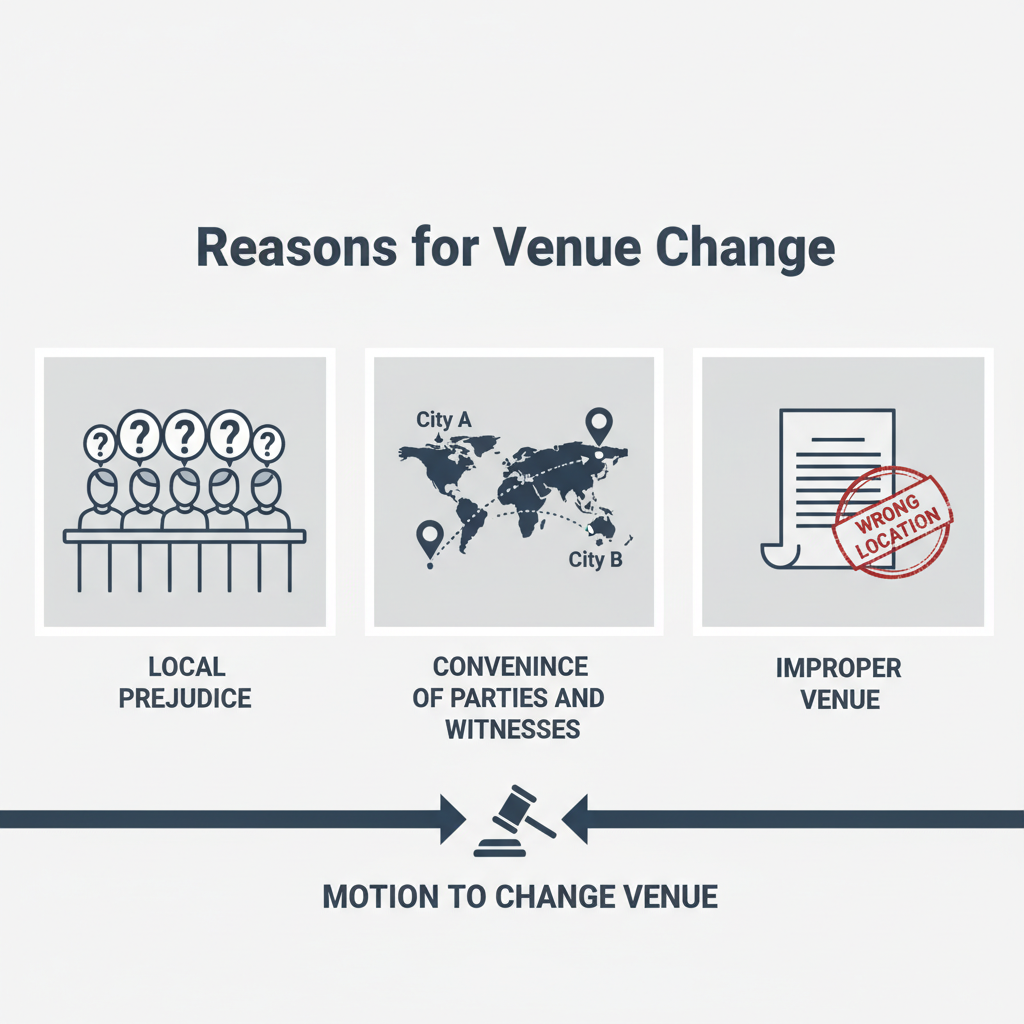
Parties file a Motion to Change Venue for various reasons, primarily when they believe the current location compromises the fairness or efficiency of the judicial process. Common grounds for requesting a change of venue include:
- Local Prejudice - If there is significant local prejudice or animosity against a party, or widespread public sentiment regarding the case, it may be impossible to select an impartial jury or receive a fair hearing. In criminal cases, a court must transfer the proceeding if the defendant cannot obtain a fair and impartial trial due to prejudice in the county (G.S. 15A-957). Similarly, in civil cases, a party may move for a change of venue if they believe they cannot receive a fair trial due to undue influence or animosity in the county (Florida Statutes § 47.101).
- Convenience of Parties and Witnesses - When the majority of witnesses, evidence, or parties reside in a different jurisdiction, moving the case can significantly reduce travel burdens, costs, and time for all involved. This ground often focuses on practical considerations to facilitate the litigation process.
- Improper Venue - If the initial court where the case was filed does not meet the legal requirements for proper venue, a party may move to transfer the case to the correct jurisdiction. Venue rules dictate the appropriate geographical location for a lawsuit based on factors like where the cause of action arose or where the defendants reside.
- Interests of Justice - In some instances, a change of venue may be necessary to serve the broader interests of justice, even if other specific grounds are not explicitly met. This can be a catch-all category for unique circumstances where maintaining the current venue would be fundamentally unfair or impractical.
Civil vs. Criminal Contexts
The application and considerations for a Motion to Change Venue can differ between civil and criminal proceedings due to their distinct objectives and constitutional protections.
Criminal Cases
In criminal cases, the primary concern for a change of venue often revolves around the defendant's constitutional right to a fair trial by an impartial jury. Extensive pretrial publicity, community bias, or a highly publicized crime can make it challenging to seat an unbiased jury. For example, North Carolina law mandates a transfer if the court determines that the defendant cannot obtain a fair and impartial trial in the current county due to prejudice (G.S. 15A-957). Courts may consider factors such as media saturation, public opinion polls, and the difficulty in jury selection when evaluating such motions.
Civil Cases
In civil litigation, while fairness remains a consideration, convenience and the proper application of venue rules often play a more prominent role. Parties might seek a change of venue to a location where witnesses are more accessible, evidence is more readily available, or where a more efficient resolution is anticipated. Florida law, for instance, allows a party to apply for a change of venue if they believe they cannot receive a fair trial in the current court due to undue influence or animosity in the county (Florida Statutes § 47.101). The focus in civil cases frequently balances the interests of all parties and the efficient administration of justice.
Filing the Motion
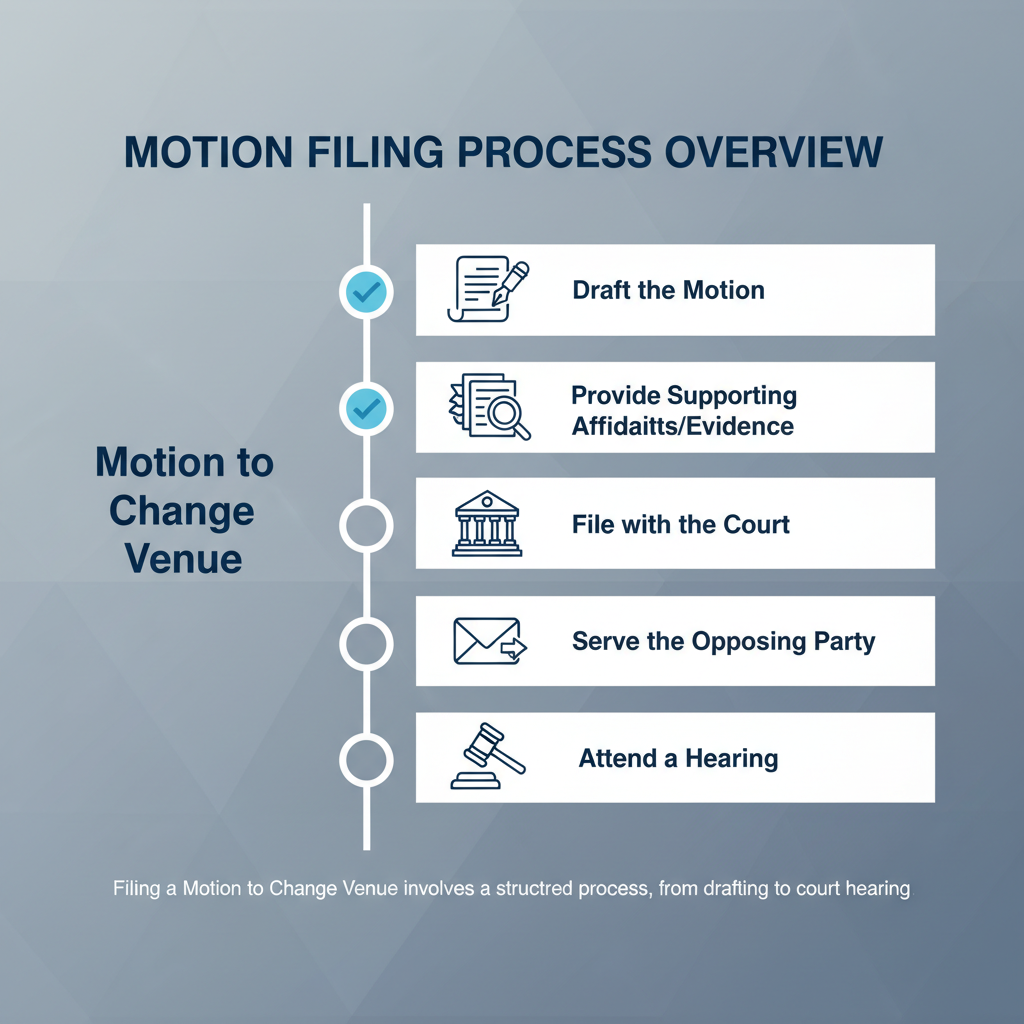
The process of filing a Motion to Change Venue typically involves several procedural steps, which can vary slightly depending on the specific jurisdiction and court rules. Generally, the moving party must:
- Draft the Motion - Prepare a formal written request outlining the specific grounds for the venue change and providing legal arguments and supporting facts. This document must clearly articulate why the current venue is inappropriate or prejudicial.
- Provide Supporting Affidavits or Evidence - Attach sworn statements (affidavits) from individuals who can attest to the facts supporting the motion, such as local prejudice or witness inconvenience. Evidence like news articles, survey results, or witness lists may also be included.
- File with the Court - Submit the completed motion and all supporting documents to the clerk of the court where the case is currently pending. Courts often provide specific forms for this purpose; for example, the Utah State Courts offer forms such as 1130FAC, 1111FA, and 1131FA for the moving party, and 1104FA for the opposing party. Similarly, the Colorado Judicial Branch provides official form JDF 1323 for filing a motion to change venue.
- Serve the Opposing Party - Ensure that all other parties involved in the case receive a copy of the motion in accordance with court rules. This typically involves formal legal service to provide notice and an opportunity to respond.
- Attend a Hearing - The court will usually schedule a hearing where both sides can present their arguments for or against the venue change. The judge will consider the arguments and evidence before making a decision.
Court's Discretion and Decision
When a Motion to Change Venue is filed, the court evaluates the arguments and evidence presented by both parties. Judges typically have significant discretion in deciding whether to grant or deny such a motion. The moving party bears the burden of proving that a change of venue is necessary and appropriate under the applicable legal standards.
The court will consider factors such as the strength of the evidence of prejudice, the convenience of the parties and witnesses, the location where the cause of action arose, and the overall interests of justice. The decision to grant a change of venue is not taken lightly, as it can impact the efficiency and cost of litigation. If the motion is granted, the case will be transferred to the new jurisdiction, and all subsequent proceedings will take place in the designated court.
Frequently Asked Questions
Sources
- Motion for Change of Venue - Provides forms and procedures for filing a motion to change venue in Utah.
- Motion for Change of Venue Pursuant to Colorado Rules of Civil Procedure 98 (c)(1) and 98 (e) - Provides the official form for filing a motion to change venue in Colorado.
- G.S. 15A-957. Motion for change of venue. - North Carolina statute detailing the procedure for filing a motion for change of venue in criminal cases.
- Chapter 47 Section 101 - 2024 Florida Statutes - Florida statute outlining the application process for a change of venue in civil cases.
Not the form you're looking for?
Try our legal document generator to create a custom document
Ask about a Motion to Change Venue
Example questions:
Disclaimer: The templates available on this website are provided for general informational purposes only and do not constitute legal advice. They are not intended to be, and should not be interpreted as, compliant with any specific legal, regulatory, or privacy requirements. These templates are not a replacement for professional legal guidance and should not be relied upon for any particular matter or circumstance. Users are strongly encouraged to seek advice from a qualified attorney licensed in their jurisdiction before using, modifying, or relying on any template.
All templates are provided on an "as is," "with all faults," and "as available" basis. The provider disclaims any and all warranties of any kind, whether express, implied, statutory, or otherwise, including without limitation warranties of merchantability, fitness for a particular purpose, title, or non-infringement.
LegalTemplates.com makes no guarantees or representations regarding the accuracy, completeness, expected outcomes, or reliability of the materials contained in these templates or any materials referenced or linked from them.