Preservation of Evidence Letter
A Preservation of Evidence Letter is a formal legal communication issued to an opposing party or potential litigant, demanding the safeguarding of relevant information and materials that could be pertinent to a pending or anticipated legal dispute.
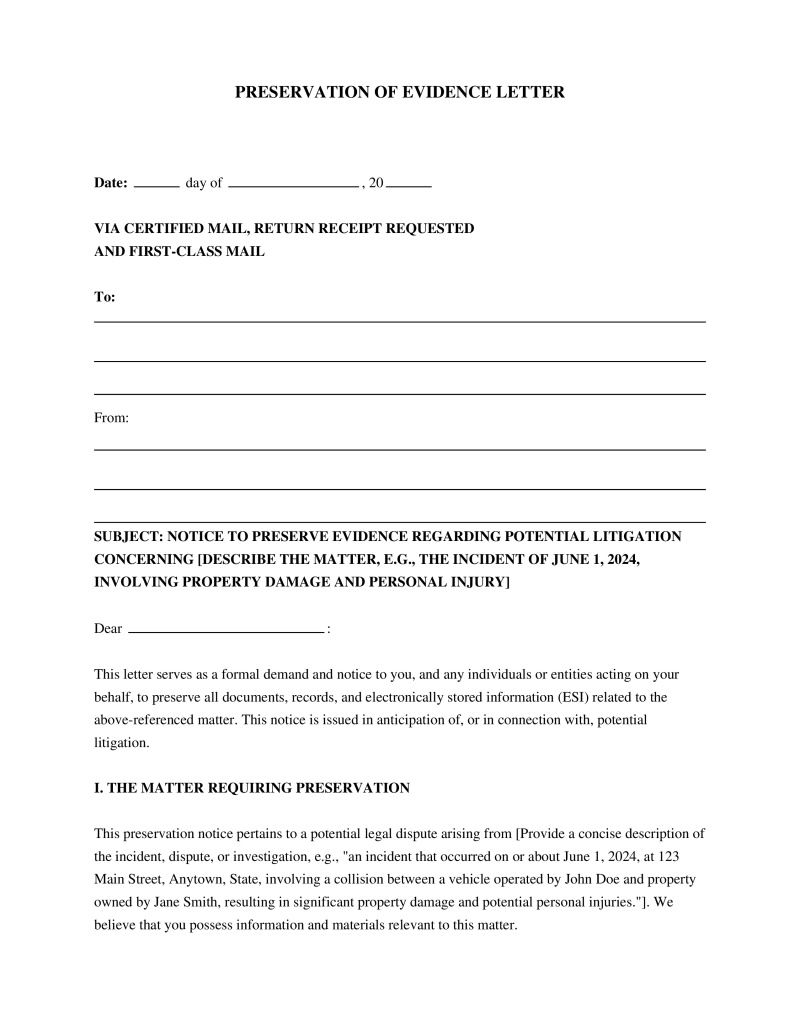
Recipient Type
Select whether the recipient is an individual, a business entity, or a government agency.
Enter the complete legal name of the recipient.
Enter the complete mailing address for the recipient.
If sending to a business or agency, enter the name of the individual to whom the letter should be addressed.
Table of Contents
What is a Preservation of Evidence Letter?
A Preservation of Evidence Letter, often referred to as a “litigation hold” letter, is a formal written communication sent to an individual or entity requesting them to preserve specific evidence relevant to a potential or ongoing legal dispute. Its primary purpose is to prevent the destruction, alteration, or concealment of information or physical items that may be crucial for future legal proceedings. This letter serves as a formal notification, establishing a duty to preserve evidence once litigation is reasonably foreseeable.
Purpose and Importance
The core purpose of a Preservation of Evidence Letter is to mitigate the risk of spoliation, which is the destruction or significant alteration of evidence. By formally notifying a party of their obligation to retain relevant materials, the letter helps ensure that evidence remains available and untampered for discovery and presentation in court. This proactive measure is critical for maintaining the integrity of the legal process and ensuring a fair resolution based on complete information.
Key Elements of a Preservation Letter
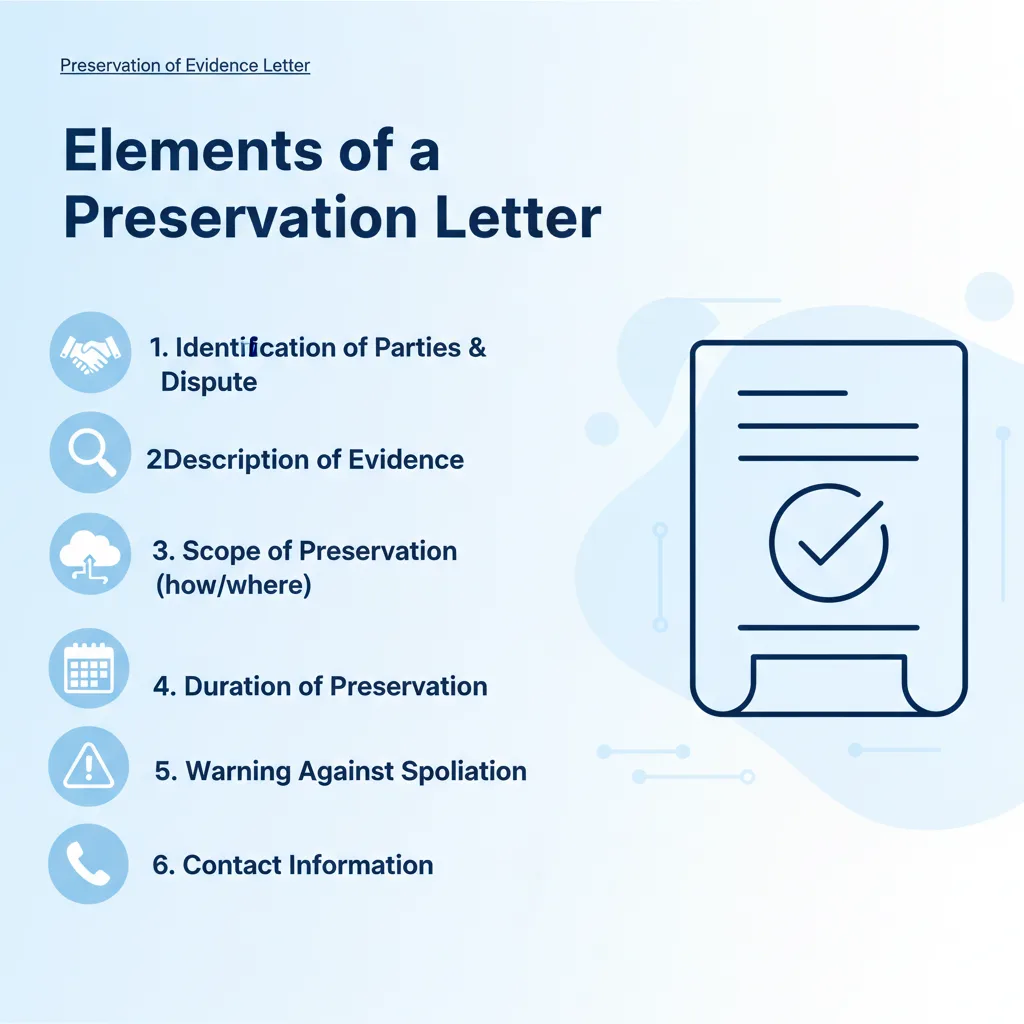
An effective Preservation of Evidence Letter typically includes several critical components to clearly communicate the preservation obligation and its scope:
- Identification of Parties and Dispute - Clearly names the sender, the recipient, and briefly describes the nature of the anticipated or pending legal dispute.
- Identification of Evidence to be Preserved - Provides a specific, yet broad enough, description of the documents, data, or physical items that must be preserved. This often includes date ranges and relevant keywords.
- Scope of Preservation - Details how the evidence should be preserved, including formats (e.g., native file format for electronic data), locations (e.g., servers, personal devices, physical storage), and who is responsible.
- Duration of Preservation - Specifies the period for which the evidence must be retained, typically until the resolution of the legal matter.
- Warning Against Spoliation - Informs the recipient of the potential legal consequences, such as adverse inferences or sanctions, for failing to preserve the identified evidence.
- Contact Information - Provides contact details for the sending party's legal counsel for any questions or clarifications.
When is a Preservation Letter Used?
Preservation of Evidence Letters are typically issued at the earliest stages of a legal matter, often before a formal lawsuit has been filed. They are commonly used in situations where there is a reasonable anticipation of litigation, an ongoing investigation, or when a party believes that critical evidence might be at risk of being lost or destroyed.
- Anticipated Litigation - Sent when a party believes a lawsuit is likely to be filed, even if no formal complaint has been served.
- Government Investigations - Issued by government agencies to individuals or corporations under investigation to preserve records relevant to potential enforcement actions.
- Pre-Litigation Discovery - Used to secure evidence during preliminary inquiries or negotiations before formal discovery procedures begin.
- Specific Statutory Requirements - In certain contexts, statutes may mandate preservation, such as requests for electronic communication preservation.
Legal Basis and Authority
While a Preservation of Evidence Letter itself is not a court order, it establishes a duty to preserve evidence based on common law principles and, in some cases, specific statutes. The duty to preserve arises when litigation is reasonably foreseeable, meaning a party knows or reasonably should know that evidence may be relevant to anticipated litigation.
Federal Statutes
Specific federal law addresses the preservation of certain types of evidence:
- Electronic Communications Preservation - Authorizes a governmental entity to request a provider of electronic communication service or remote computing service to preserve records and other evidence in its possession for a period of up to 90 days, which can be extended (18 U.S.C. § 2703(f)).
Common Law Duty
Beyond specific statutes, the common law duty to preserve evidence is a fundamental aspect of civil procedure. This duty applies to any individual or entity that has control over potentially relevant evidence once litigation is reasonably foreseeable. Failure to adhere to this duty can lead to severe sanctions from the court.
Scope and Types of Evidence
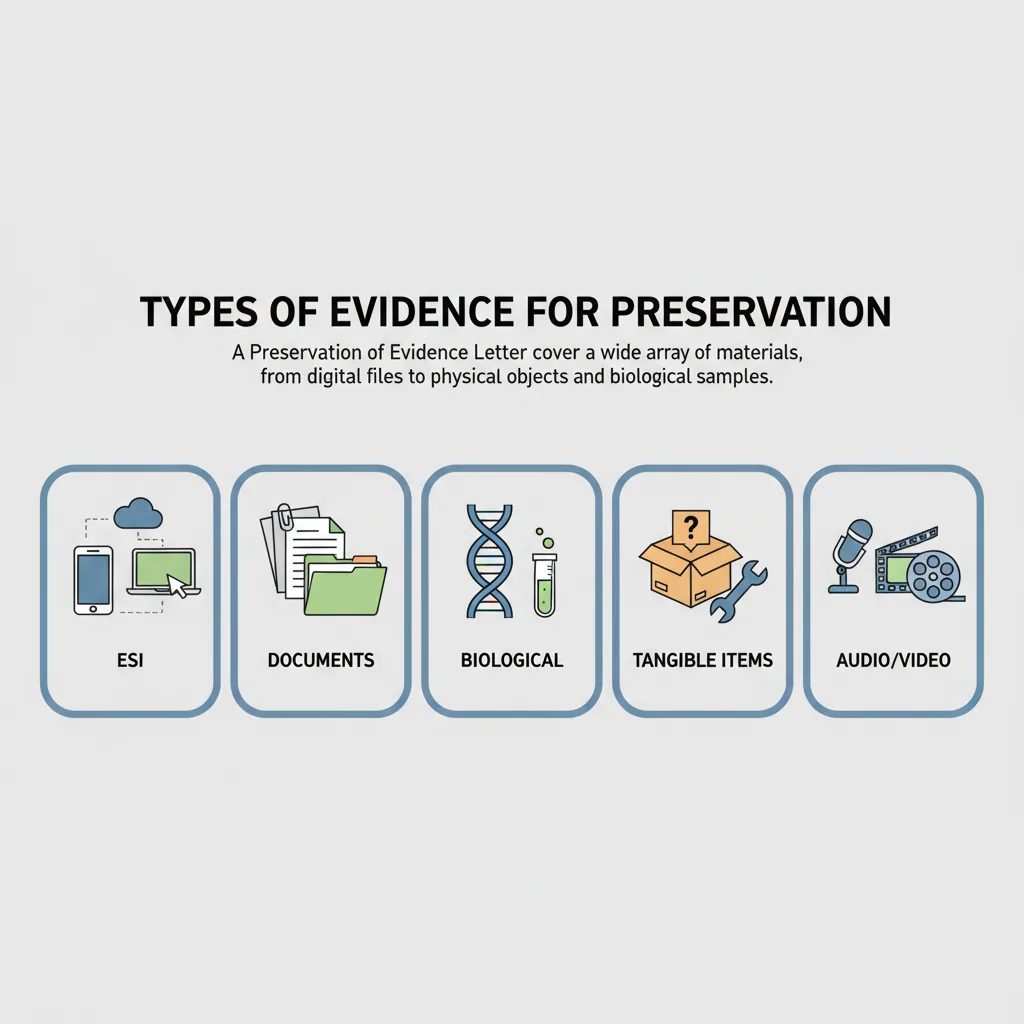
The scope of evidence covered by a preservation letter is broad and can encompass virtually any information or physical item relevant to a potential legal dispute. The letter typically instructs recipients to preserve all forms of information, regardless of format or location.
- Electronic Stored Information (ESI) - Includes emails, text messages, voicemails, documents (word processing files, spreadsheets, presentations), databases, social media posts, website content, metadata, and data from mobile devices and cloud storage (Source 2).
- Physical Documents - Encompasses paper records, contracts, invoices, memos, reports, notes, and any other hardcopy materials.
- Biological Evidence - Refers to samples such as DNA, blood, semen, saliva, tissue, hair, and other bodily fluids, which require specific handling and storage protocols to maintain integrity (Source 1).
- Tangible Items - Includes products, equipment, machinery, vehicles, tools, and any other physical objects that may be relevant to the facts of the case.
- Audio and Video Recordings - Covers surveillance footage, interview recordings, voicemails, and other multimedia files.
Preservation Letter vs. Court Order
It is important to distinguish a Preservation of Evidence Letter from a court-issued preservation order. While both aim to prevent spoliation, their authority and enforcement mechanisms differ significantly:
- Preservation of Evidence Letter - This is a communication sent by one party (or their legal counsel) to another, notifying them of their legal duty to preserve evidence. It relies on the recipient's understanding of their legal obligations and the potential consequences of spoliation. It does not carry the direct coercive power of a court order.
- Court Preservation Order - This is a directive issued by a judge that legally compels a party to preserve specific evidence. It is enforceable through the court's contempt powers, meaning non-compliance can result in immediate sanctions, fines, or even imprisonment (Source 3). Court orders are typically sought when there is a concern that a preservation letter alone may not be sufficient or when a party is unwilling to comply voluntarily.
Consequences of Non-Preservation (Spoliation)
Failure to preserve evidence after receiving a Preservation of Evidence Letter, or when the duty to preserve has otherwise arisen, can lead to severe legal consequences for the offending party. This act of spoliation can significantly damage a party's case and result in various judicial sanctions:
- Adverse Inference Instruction - The court may instruct the jury that the destroyed or altered evidence would have been unfavorable to the party who failed to preserve it.
- Monetary Sanctions - Fines may be imposed to compensate the aggrieved party for costs incurred due to the spoliation, such as expenses for forensic recovery or additional discovery.
- Exclusion of Evidence - The spoliating party may be prohibited from introducing certain evidence or arguments related to the destroyed materials.
- Dismissal or Default Judgment - In extreme cases of willful or egregious spoliation, the court may dismiss the spoliating party's claims or enter a default judgment against them.
Frequently Asked Questions
Sources
- Biological Evidence Preservation Handbook: Best Practices for Evidence Handlers - Guidance on preserving biological evidence, including sample preservation letters.
- Sample Language for Preservation Request Letters Under 18 U.S.C. § 2703(f) - Provides sample language for preservation request letters under 18 U.S.C. § 2703(f).
- Preservation Order - Sample preservation order from a federal court case.
Not the form you're looking for?
Try our legal document generator to create a custom document
Disclaimer: The templates available on this website are provided for general informational purposes only and do not constitute legal advice. They are not intended to be, and should not be interpreted as, compliant with any specific legal, regulatory, or privacy requirements. These templates are not a replacement for professional legal guidance and should not be relied upon for any particular matter or circumstance. Users are strongly encouraged to seek advice from a qualified attorney licensed in their jurisdiction before using, modifying, or relying on any template.
All templates are provided on an "as is," "with all faults," and "as available" basis. The provider disclaims any and all warranties of any kind, whether express, implied, statutory, or otherwise, including without limitation warranties of merchantability, fitness for a particular purpose, title, or non-infringement.
LegalTemplates.com makes no guarantees or representations regarding the accuracy, completeness, expected outcomes, or reliability of the materials contained in these templates or any materials referenced or linked from them.