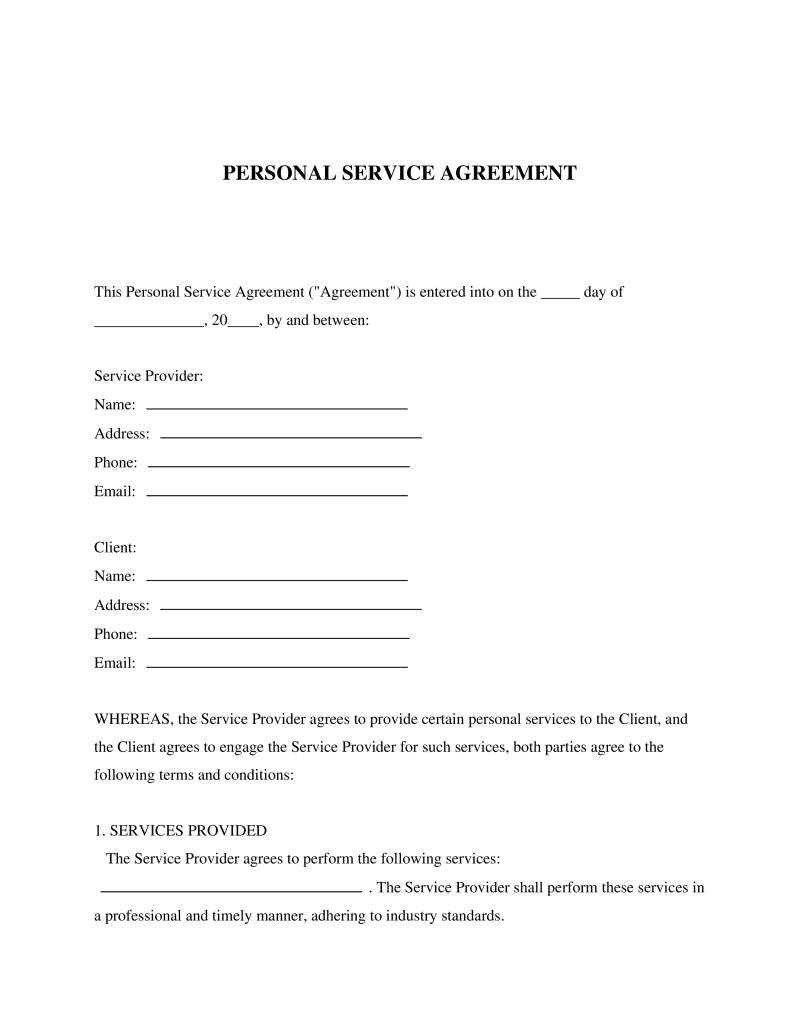
Personal Service Agreement
A Personal Service Agreement is a legal contract that outlines the terms of service between an individual and a service provider.
Is New Or Renewal
Select whether this agreement is new or a renewal of a previous arrangement.
Table of Contents
What is a Personal Service Agreement?
A Personal Service Agreement is a legally binding contract that outlines the terms and conditions under which individualized services are to be provided by one party to another. These agreements are fundamental in ensuring clarity and understanding between the service provider and the client, detailing the specific services to be rendered, compensation, duration, and obligations of both parties. Typically utilized by freelancers, consultants, and various professionals, this document serves as a protective measure to mitigate risks, prevent misunderstandings, and foster a transparent working relationship.
Key Features
Important Provisions
- Scope of Services: A detailed description of the services to be provided under the agreement.
- Compensation and Payment Terms: How much and when the service provider will be compensated.
- Term and Termination: The duration of the agreement and conditions under which it can be terminated early by either party.
- Confidentiality Clause: Obligations related to non-disclosure of proprietary information.
Pros and Cons
Pros
- +Establishes a formal relationship between the service provider and the client, adding legal validity.
- +Reduces ambiguity by detailing every aspect of the service arrangement, from tasks to timelines.
- +Protects both parties' interests through clearly defined terms for payment and deliverables.
- +Facilitates dispute resolution by providing a reference point for agreed-upon terms and conditions.
- +Enhances professionalism and credibility of the service provider in front of clients.
Cons
- -May require negotiations to reach an agreement on all terms, potentially delaying service commencement.
- -Involves legal complexities that might necessitate professional legal assistance for drafting or review.
- -Could lead to rigidity in service provision, limiting flexibility in responding to unforeseen circumstances.
Common Uses
- Engagement of freelance professionals for project-based work.
- Contracting consultants to provide expert advice or services in a specific field.
- Hiring individual contractors for tasks ranging from creative endeavors to technical support.
- Establishing ongoing service provision relationships with personal trainers, coaches, or mentors.
- Securing customized services from individuals with specialized skills not available within hiring entities.
Frequently Asked Questions
Not the form you're looking for?
Try our legal document generator to create a custom document
Disclaimer: The templates available on this website are provided for general informational purposes only and do not constitute legal advice. They are not intended to be, and should not be interpreted as, compliant with any specific legal, regulatory, or privacy requirements. These templates are not a replacement for professional legal guidance and should not be relied upon for any particular matter or circumstance. Users are strongly encouraged to seek advice from a qualified attorney licensed in their jurisdiction before using, modifying, or relying on any template.
All templates are provided on an "as is," "with all faults," and "as available" basis. The provider disclaims any and all warranties of any kind, whether express, implied, statutory, or otherwise, including without limitation warranties of merchantability, fitness for a particular purpose, title, or non-infringement.
LegalTemplates.com makes no guarantees or representations regarding the accuracy, completeness, expected outcomes, or reliability of the materials contained in these templates or any materials referenced or linked from them.