Motion To Quash Subpoena
A Motion To Quash Subpoena is a formal legal application presented to a court, seeking to invalidate or set aside a previously issued subpoena.
Subpoena Type
Select the type of subpoena you want to challenge: either a Subpoena to Appear/Testify, which requires someone to come and give their testimony, or a Subpoena for Documents/Records, which demands specific documents or records. Make sure to choose the option that matches the subpoena you received, as this will guide the legal process for your request to quash it. Choosing the wrong type could affect your case, so be accurate.
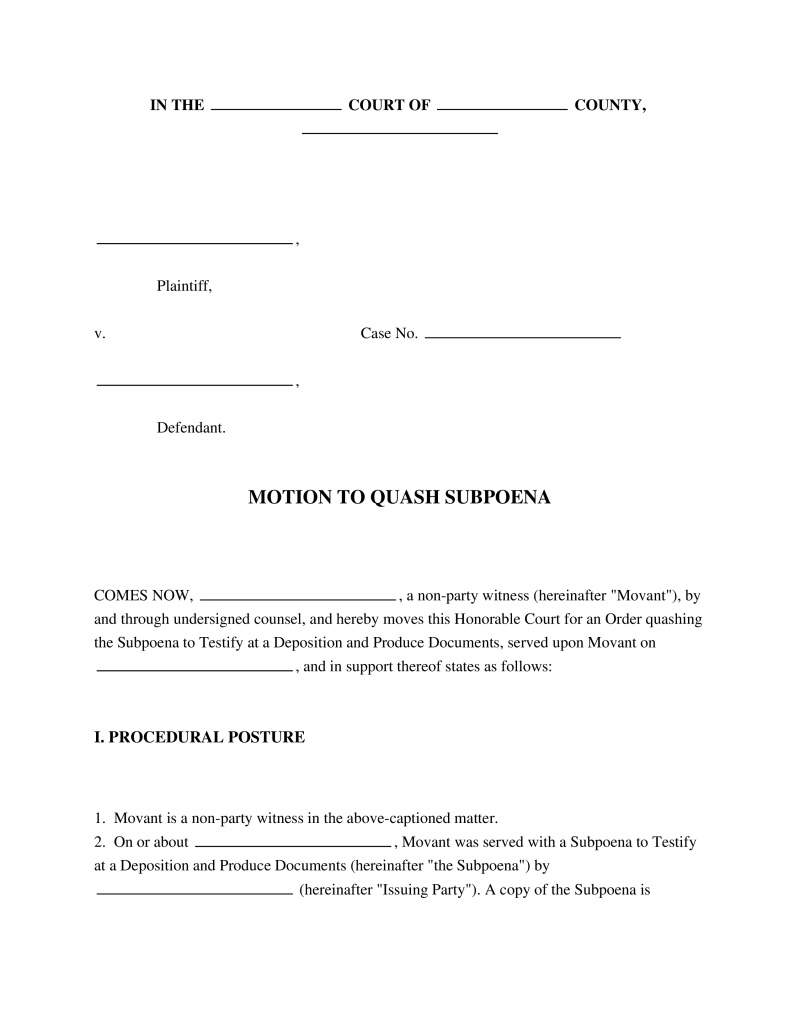
Table of Contents
What is a Motion To Quash Subpoena?
A motion to quash a subpoena is a formal request made to a court seeking to invalidate or nullify a subpoena. This legal maneuver is typically employed by the recipient of a subpoena, or an affected third party, who believes the subpoena is improper, unduly burdensome, or seeks information protected by privilege. Its primary purpose is to prevent the enforcement of a subpoena, thereby excusing the recipient from the obligation to produce documents, provide testimony, or appear in court as commanded.
Legal Requirements and Grounds for Quashing
The ability to challenge a subpoena through a motion to quash is a fundamental aspect of civil and criminal procedure, designed to protect individuals and entities from unreasonable demands. Courts generally consider several factors when evaluating such a motion:
- Undue Burden or Expense - The subpoena demands the production of a vast quantity of documents or requires extensive travel, creating an unreasonable hardship on the recipient.
- Privileged Information - The subpoena seeks information protected by legal privilege, such as attorney-client privilege, work product doctrine, spousal privilege, or doctor-patient privilege.
- Irrelevance to the Case - The information requested by the subpoena has no apparent relevance to the claims or defenses in the underlying legal action.
- Lack of Proper Service - The subpoena was not served on the recipient in accordance with the rules of civil procedure, rendering it invalid.
- Lack of Subject Matter Jurisdiction - The issuing court lacks the authority to compel the recipient to comply with the subpoena.
- Trade Secrets or Confidential Commercial Information - The subpoena seeks proprietary business information, the disclosure of which could cause significant competitive harm.
- Privacy Concerns - The subpoena intrudes upon an individual's right to privacy, particularly concerning sensitive personal information like medical records or financial data.
- Vagueness or Ambiguity - The subpoena's demands are unclear, making it difficult for the recipient to ascertain precisely what is being sought.
How to File a Motion To Quash Subpoena
Filing a motion to quash involves several critical steps that must be followed precisely according to court rules:
- Review the Subpoena Thoroughly - Carefully examine the subpoena to understand its scope, the requested information or testimony, and the deadline for compliance. Identify specific grounds for challenging it, such as undue burden, privilege, or irrelevance, which will form the basis of the motion. Note the issuing court and the case number.
- Draft the Motion to Quash - Prepare a formal written motion addressed to the court that issued the subpoena. This document must clearly state the relief requested (to quash or modify the subpoena) and provide a detailed explanation of the legal and factual grounds supporting the request. Include a memorandum of points and authorities, citing relevant statutes, rules of procedure, and case law.
- Prepare a Supporting Declaration or Affidavit - Attach a sworn statement from the subpoena recipient or a knowledgeable individual explaining the burden, privilege, or other issues. For example, if arguing undue burden, the declaration might detail the time, cost, and resources required to comply. If asserting privilege, it should describe the nature of the privileged information without revealing its content.
- File the Motion with the Court - Submit the completed motion, supporting declaration, and any other required documents to the clerk of the court that issued the subpoena. Ensure all filing fees are paid and that the documents conform to local court rules regarding formatting and submission. Obtain a file-stamped copy for your records.
- Serve the Motion on All Parties - Provide a copy of the filed motion to quash to all attorneys of record in the underlying case, including the party who issued the subpoena. Service must be accomplished in accordance with the rules of civil procedure, typically by mail, personal delivery, or electronic service, and proof of service must be filed with the court.
- Attend the Hearing (if scheduled) - The court may schedule a hearing to consider the arguments presented in the motion. Be prepared to present your case orally, answer the judge's questions, and respond to arguments from the opposing party. If the court grants the motion, the subpoena will be quashed or modified as specified in the court's order.
Rights and Obligations of Parties Involved
Various parties hold specific rights and obligations when a subpoena is issued and subsequently challenged:
- Subpoena Recipient - The individual or entity served with the subpoena has the right to seek protection from unreasonable or improper demands by filing a motion to quash or modify. They are obligated to respond to the subpoena, either by complying with its terms or by formally challenging it, to avoid potential sanctions for non-compliance. They also have an obligation to preserve any potentially relevant evidence while the motion is pending.
- Issuing Party - The party who issued the subpoena has the right to seek discovery of information relevant to their case. They are obligated to ensure the subpoena is properly issued, served, and does not impose an undue burden or seek privileged information. If a motion to quash is filed, they have the right to oppose it and present arguments supporting the subpoena's validity and necessity.
- Court - The court's primary obligation is to ensure that discovery is conducted fairly and in accordance with legal principles. It has the authority to grant, deny, or modify a motion to quash, balancing the needs of discovery against the protection of individuals from oppressive or improper demands. The court can also impose sanctions for abuse of the subpoena process.
- Affected Third Parties - Individuals or entities whose privacy or other rights might be affected by the subpoena, even if they are not the direct recipient, may have standing to file their own motion to quash or intervene in the existing motion. For example, a patient whose medical records are sought through a subpoena served on their doctor may seek to protect their privacy interests.
Applicable Federal and State Laws
The legal framework for motions to quash subpoenas is primarily governed by rules of civil procedure and various privacy statutes:
Federal Statutes and Rules
At the federal level, the process is primarily dictated by the Federal Rules of Civil Procedure and specific privacy laws:
- Federal Rules of Civil Procedure Rule 45 (Subpoena) - Governs the issuance, service, and enforcement of subpoenas in federal court. It explicitly provides for the court's power to quash or modify a subpoena that fails to allow a reasonable time for compliance, requires a person to travel too far, requires disclosure of privileged or protected matter, or subjects a person to undue burden (Fed. R. Civ. P. 45).
- Health Insurance Portability and Accountability Act (HIPAA) - Establishes national standards for the protection of certain health information. It generally requires a court order, a subpoena accompanied by a satisfactory assurance that reasonable efforts have been made to notify the individual or secure a qualified protective order, or patient authorization before protected health information can be disclosed in response to a subpoena (45 CFR § 164.512(e)).
- Stored Communications Act (SCA) - Protects the privacy of electronic communications and records held by internet service providers (ISPs) and other service providers. It generally requires a warrant, court order, or subpoena with specific conditions to compel disclosure of electronic communications or subscriber information (18 U.S.C. §§ 2701 et seq.).
State Laws and Requirements
State-specific rules often mirror federal provisions but may include unique aspects:
- State Rules of Civil Procedure - Nearly all states have rules of civil procedure that largely parallel Federal Rule 45, outlining the grounds for issuing, serving, and quashing subpoenas within their respective jurisdictions (e.g., California Code of Civil Procedure § 1987.1, New York Civil Practice Law and Rules § 2304).
- State Medical Privacy Laws - Many states have laws that provide additional protections for medical information beyond HIPAA, or specific procedures that must be followed to obtain medical records via subpoena (e.g., California Confidentiality of Medical Information Act, Cal. Civ. Code § 56 et seq.).
- Trade Secret Acts - Most states have adopted versions of the Uniform Trade Secrets Act (UTSA), which provides legal mechanisms to protect proprietary business information. Courts may quash or modify subpoenas that seek to compel disclosure of trade secrets without adequate protective measures (e.g., Uniform Trade Secrets Act, adopted by most states).
Penalties for Non-Compliance
Failure to comply with a valid subpoena without successfully quashing it can lead to serious consequences:
- Contempt of Court - A court can find the non-compliant party in contempt, which may result in fines, daily penalties, or even incarceration until compliance is achieved.
- Monetary Sanctions - The non-compliant party may be ordered to pay the expenses, including attorney's fees, incurred by the issuing party in seeking compliance.
- Adverse Inference - In some cases, the court may instruct the jury to infer that the withheld evidence would have been unfavorable to the non-compliant party.
- Dismissal or Default Judgment - In extreme cases, particularly if the non-compliant party is also a litigant, the court may dismiss their claims or enter a default judgment against them.
Frequently Asked Questions
Motion to Quash Subpoena Example
Not the form you're looking for?
Try our legal document generator to create a custom document
Ask about a Motion To Quash Subpoena
Example questions:
Disclaimer: The templates available on this website are provided for general informational purposes only and do not constitute legal advice. They are not intended to be, and should not be interpreted as, compliant with any specific legal, regulatory, or privacy requirements. These templates are not a replacement for professional legal guidance and should not be relied upon for any particular matter or circumstance. Users are strongly encouraged to seek advice from a qualified attorney licensed in their jurisdiction before using, modifying, or relying on any template.
All templates are provided on an "as is," "with all faults," and "as available" basis. The provider disclaims any and all warranties of any kind, whether express, implied, statutory, or otherwise, including without limitation warranties of merchantability, fitness for a particular purpose, title, or non-infringement.
LegalTemplates.com makes no guarantees or representations regarding the accuracy, completeness, expected outcomes, or reliability of the materials contained in these templates or any materials referenced or linked from them.