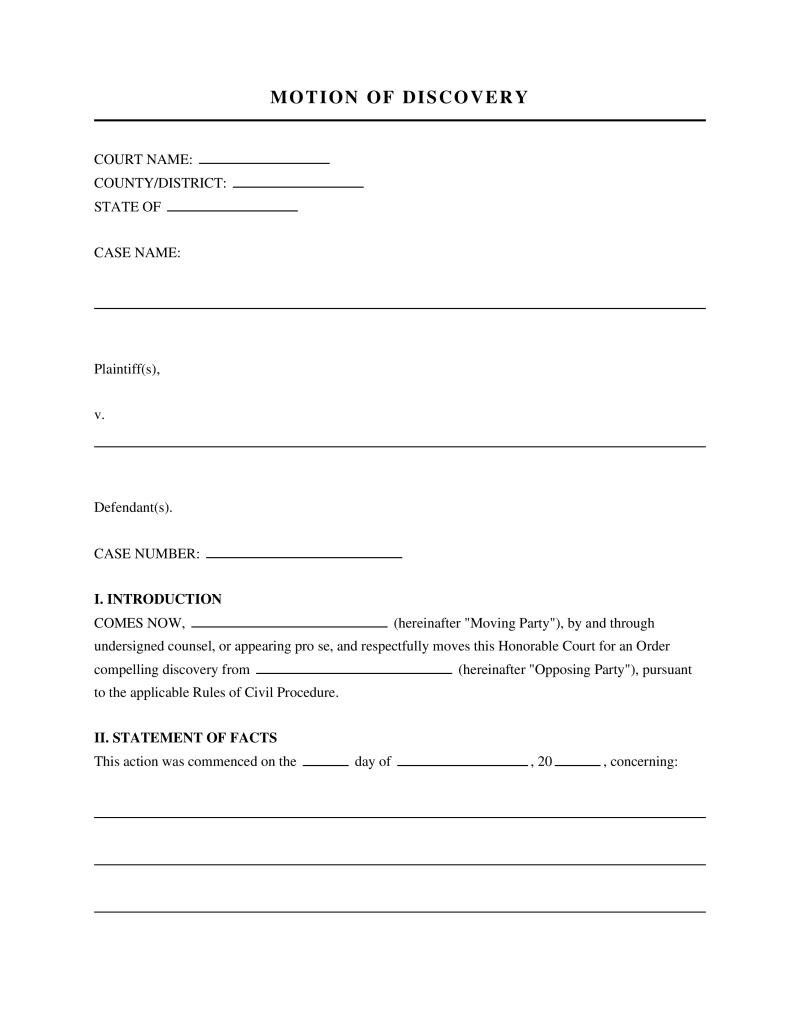
Motion of Discovery
A Motion of Discovery is a formal legal application filed in a lawsuit by one party seeking to obtain information or evidence from another party.
Discovery Case Type
Select whether this is a civil or criminal case. This will tailor the discovery request options.
Table of Contents
What is a Motion of Discovery?
A motion of discovery refers to a formal request filed with a court by a party in a legal proceeding to address issues arising during the discovery phase. Discovery is the pre-trial process through which each party can obtain evidence and information from the other party or non-parties relevant to the case. When disputes arise concerning the scope, production, or protection of discoverable information, a party may file a motion, such as a motion to compel discovery or a motion for a protective order, to seek the court's intervention and resolution. These motions are crucial for ensuring that parties adhere to the rules of civil procedure and that the discovery process unfolds fairly and efficiently.
Purpose and Scope of Discovery
The primary purpose of discovery in civil litigation is to allow parties to gather information and evidence necessary to prepare for trial, clarify issues, and potentially facilitate settlement. It aims to prevent trial by ambush, ensuring that all parties have access to relevant facts. The scope of discovery is generally broad, encompassing any non-privileged matter that is relevant to any party's claim or defense and proportional to the needs of the case. Information is discoverable even if it would not be admissible at trial, as long as it appears reasonably calculated to lead to the discovery of admissible evidence.
Various tools are available for conducting discovery, each serving a distinct function:
- Interrogatories - Written questions posed by one party to another, which must be answered under oath.
- Requests for Production of Documents - Demands for specific documents, electronically stored information (ESI), or tangible things relevant to the lawsuit.
- Depositions - Out-of-court, sworn testimony of a witness or party, taken down by a court reporter and often recorded.
- Requests for Admission - Written requests for a party to admit or deny the truth of certain facts or the authenticity of documents, simplifying issues for trial.
- Physical and Mental Examinations - Court-ordered examinations of a party whose physical or mental condition is in controversy.
When a party fails to respond adequately to these discovery requests, or when a party believes a request is overly burdensome or seeks privileged information, a motion related to discovery becomes necessary to resolve the dispute.
Information Typically Sought Through Discovery
The specific information sought through discovery varies greatly depending on the nature of the lawsuit, but common categories often include:
- Documents and Records - Contracts, invoices, emails, internal memos, financial statements, medical records, employment files, and other business or personal records.
- Witness Identities and Contact Information - Names, addresses, and phone numbers of individuals with knowledge relevant to the case.
- Expert Witness Reports - Reports, data, and qualifications of expert witnesses expected to testify at trial.
- Electronically Stored Information (ESI) - Emails, text messages, social media posts, databases, and other digital data.
- Damages Information - Documentation supporting claims for monetary or other relief, such as medical bills, lost wages, or property damage estimates.
- Insurance Policy Information - Details of any insurance agreements that may cover the judgment or satisfy part of the claim.
- Relevant Facts and Contentions - Specific details about the events leading to the lawsuit, the parties' legal theories, and the factual basis for their claims or defenses.
Legal Requirements and Validity for Discovery Motions
For a motion related to discovery, such as a motion to compel or a motion for a protective order, to be valid and successful, several legal requirements must typically be met. These requirements ensure that discovery disputes are handled systematically and that court intervention is sought only after good-faith efforts have failed:
- Good Faith Conference - Before filing a motion to compel discovery, the moving party is generally required to certify that they have conferred or attempted to confer with the opposing party in good faith to resolve the dispute without court action. This requirement is often mandated by court rules to encourage out-of-court resolution (e.g., Federal Rules of Civil Procedure Rule 37(a)(1)).
- Relevance - The information sought must be relevant to any party's claim or defense. While the scope of relevance is broad, it is not limitless and must be tied to the issues in the case.
- Proportionality - The discovery sought must be proportional to the needs of the case, considering the importance of the issues at stake, the amount in controversy, the parties' relative access to relevant information, the parties' resources, the importance of the discovery in resolving the issues, and whether the burden or expense of the proposed discovery outweighs its likely benefit (e.g., Federal Rules of Civil Procedure Rule 26(b)(1)).
- Specificity - Discovery requests and the motion itself must be specific enough to inform the responding party precisely what information is being sought or why a protective order is needed. Vague or overly broad requests are often subject to objection.
- Privilege and Work Product - Parties must respect claims of privilege (e.g., attorney-client privilege, spousal privilege, doctor-patient privilege) and the attorney work-product doctrine. A motion for a protective order can be filed to prevent the disclosure of privileged information.
- Timeliness - Motions related to discovery must be filed within the deadlines set by the court's scheduling order or the applicable rules of civil procedure. Untimely motions may be denied.
How to File a Motion to Compel Discovery
When a party fails to respond to discovery requests or provides inadequate responses, the requesting party may need to file a motion to compel discovery. This process generally involves several key steps:
- Attempt to Resolve the Dispute Informally - Prior to filing, the moving party must typically engage in a good faith effort to resolve the discovery dispute with the non-responding party. This often involves phone calls, emails, or letters outlining the deficiencies and seeking voluntary compliance. Many courts require a certification of this informal attempt within the motion.
- Draft the Motion to Compel - Prepare a formal written motion addressed to the court. This document should clearly state the specific discovery requests at issue, explain how the opposing party failed to respond or responded inadequately, and articulate the legal basis for compelling the discovery. It must also include the certification of the good faith conference.
- Attach Supporting Documents - Append all necessary exhibits to the motion, which typically include copies of the original discovery requests, the opposing party's responses (if any), and any correspondence documenting the good faith efforts to resolve the dispute. These attachments provide the court with the full context of the disagreement.
- File the Motion with the Court - Submit the completed motion and all attachments to the clerk of the court. Filing procedures vary by jurisdiction and may involve electronic filing systems. Ensure compliance with local rules regarding page limits, formatting, and required copies.
- Serve the Motion on All Parties - After filing, formally serve a copy of the motion and all supporting documents on all other parties involved in the case, in accordance with the rules of civil procedure. Proof of service must then be filed with the court.
- Attend the Hearing (if scheduled) - The court may schedule a hearing to consider the arguments from both sides. Parties should be prepared to present their arguments, citing relevant rules and case law, and explain why the discovery should or should not be compelled. The court will then issue an order granting or denying the motion, in whole or in part.
Rights and Obligations of Parties in Discovery
During the discovery phase, both the party seeking information and the party from whom information is sought have specific rights and obligations that govern their conduct and interactions:
- Obligation to Respond Truthfully and Completely - Responding parties are generally obligated to provide full and accurate answers to discovery requests, unless a valid objection or privilege applies. Deliberate misrepresentation or omission can lead to severe sanctions.
- Right to Object to Improper Requests - A responding party has the right to object to discovery requests that are irrelevant, privileged, overly broad, unduly burdensome, or seek information protected by the work-product doctrine. Objections must typically be stated with specificity and explain the basis for the objection.
- Obligation to Preserve Evidence - Once litigation is reasonably anticipated, all parties have an affirmative duty to preserve all potentially relevant evidence, including documents, ESI, and tangible items. Failure to do so can result in spoliation sanctions.
- Right to Seek a Protective Order - If a discovery request seeks privileged information, trade secrets, confidential commercial information, or would cause undue burden or expense, the responding party may file a motion for a protective order to limit or prevent disclosure.
- Obligation to Supplement Responses - Parties typically have a continuing duty to supplement their discovery responses if they later discover that an earlier response was incomplete or incorrect, or if new information becomes available.
- Right to Seek Sanctions for Non-Compliance - The requesting party has the right to seek sanctions against a non-compliant party who fails to respond to discovery, abuses the discovery process, or violates a court order related to discovery.
Applicable Federal and State Laws Governing Discovery
The framework for discovery, including motions related to it, is primarily established by rules of civil procedure at both federal and state levels. These rules are designed to ensure fair and efficient litigation.
Federal Laws and Rules
In federal courts, discovery is governed by the Federal Rules of Civil Procedure (FRCP), which establish comprehensive guidelines:
- Federal Rules of Civil Procedure Rule 26 - Defines the scope of discovery, mandatory initial disclosures, and limitations on discovery, including proportionality (Federal Rules of Civil Procedure Rule 26).
- Federal Rules of Civil Procedure Rule 37 - Addresses failures to make disclosures or cooperate in discovery, outlining the procedures for motions to compel and the range of sanctions available for non-compliance (Federal Rules of Civil Procedure Rule 37).
- Federal Rules of Civil Procedure Rule 34 - Governs requests for production of documents, electronically stored information, and tangible things, including the form of production and objections (Federal Rules of Civil Procedure Rule 34).
- Health Insurance Portability and Accountability Act (HIPAA) - While not a discovery rule itself, HIPAA imposes strict requirements for the protection and disclosure of protected health information (PHI). When medical records are sought in discovery, parties must comply with HIPAA's authorization requirements or obtain a court order (45 CFR § 164.508).
State Laws and Rules
Most states have adopted rules of civil procedure that largely mirror the Federal Rules of Civil Procedure, though specific provisions and timelines may vary:
- State Rules of Civil Procedure - Nearly every state has its own set of civil procedure rules that govern discovery, including the types of discovery available, the scope of discoverable information, deadlines for responses, and procedures for filing motions to compel or for protective orders (e.g., California Code of Civil Procedure § 2016.010 et seq., New York Civil Practice Law and Rules Article 31).
- State Confidentiality Laws - Beyond HIPAA, many states have specific statutes protecting certain types of information, such as mental health records, victim-counselor communications, or trade secrets, which may impact discovery requests.
Penalties for Non-Compliance
Failure to comply with discovery requests or court orders related to discovery can result in significant penalties, often referred to as sanctions. These sanctions are designed to deter abuses of the discovery process and ensure the integrity of litigation:
- Orders Compelling Discovery - The court may order the non-compliant party to provide the requested discovery, and may also order the non-compliant party or their attorney to pay the reasonable expenses, including attorney's fees, incurred by the moving party in making the motion.
- Evidentiary Sanctions - The court may prohibit the non-compliant party from introducing certain evidence, supporting or opposing designated claims or defenses, or presenting certain witnesses at trial.
- Monetary Sanctions - Fines or orders to pay the opposing party's attorney's fees and costs incurred due to the non-compliance.
- Dismissal or Default Judgment - In severe cases of willful and repeated non-compliance or bad faith, the court may dismiss the non-compliant party's claims or enter a default judgment against them.
- Contempt of Court - A party or attorney who willfully disobeys a court order can be held in contempt, which may result in fines or even incarceration in extreme circumstances.
Frequently Asked Questions
Motion of Discovery Form
Not the form you're looking for?
Try our legal document generator to create a custom document
Ask about a Motion of Discovery
Example questions:
Disclaimer: The templates available on this website are provided for general informational purposes only and do not constitute legal advice. They are not intended to be, and should not be interpreted as, compliant with any specific legal, regulatory, or privacy requirements. These templates are not a replacement for professional legal guidance and should not be relied upon for any particular matter or circumstance. Users are strongly encouraged to seek advice from a qualified attorney licensed in their jurisdiction before using, modifying, or relying on any template.
All templates are provided on an "as is," "with all faults," and "as available" basis. The provider disclaims any and all warranties of any kind, whether express, implied, statutory, or otherwise, including without limitation warranties of merchantability, fitness for a particular purpose, title, or non-infringement.
LegalTemplates.com makes no guarantees or representations regarding the accuracy, completeness, expected outcomes, or reliability of the materials contained in these templates or any materials referenced or linked from them.