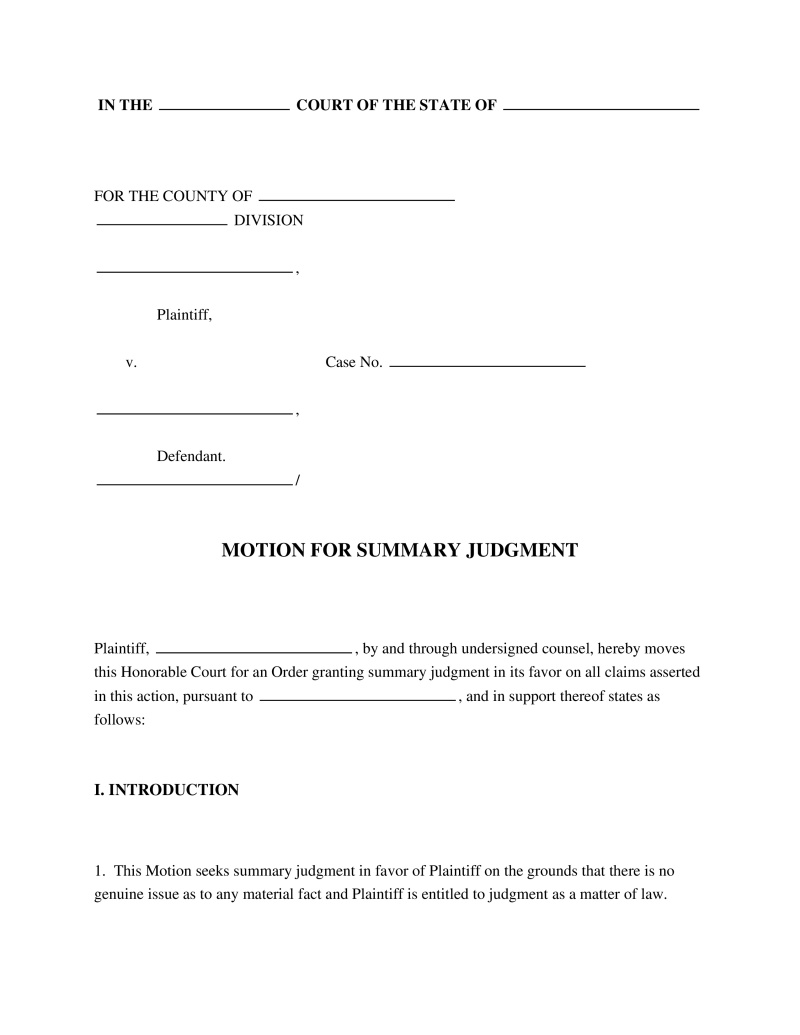
Motion for Summary Judgment
A Motion for Summary Judgment is a procedural request made to a court seeking a judgment without a full trial, asserting there are no genuine disputes of.
Filing Party Role
Select the role of the party submitting this Motion for Summary Judgment.
Provide the specific role if you selected 'Other'.
Table of Contents
What is a Motion for Summary Judgment?
A motion for summary judgment is a procedural device used in civil litigation to resolve a case, or parts of a case, without a full trial. This motion asserts that there are no genuine disputes regarding any material facts, and therefore, the moving party is entitled to judgment as a matter of law. It is typically filed by either the plaintiff or the defendant after discovery has concluded, but before trial commences. The primary purpose of such a motion is to streamline litigation by identifying and eliminating cases, or specific claims within cases, where a trial is unnecessary because the essential facts are not genuinely contested.
Legal Requirements and Validity
For a motion for summary judgment to be valid and successful, it must satisfy specific legal requirements, primarily focusing on the absence of factual disputes and the application of law to undisputed facts. The moving party bears the initial burden of demonstrating that there is no genuine issue as to any material fact and that they are entitled to judgment as a matter of law. If this burden is met, the opposing party must then present specific facts showing that there is a genuine issue for trial.
Key requirements for a valid motion include:
- No Genuine Dispute of Material Fact - The moving party must establish that, based on the evidence presented, no reasonable jury could find for the non-moving party on a material issue. A "material" fact is one that could affect the outcome of the suit under the governing law. A "genuine" dispute exists if the evidence is such that a reasonable jury could return a verdict for the non-moving party.
- Entitlement to Judgment as a Matter of Law - Even if the facts are undisputed, the moving party must demonstrate that the applicable law clearly dictates a judgment in their favor. This involves legal analysis applying the undisputed facts to relevant statutes, case law, and legal principles.
- Supporting Evidence - The motion must be supported by admissible evidence from the record. This includes affidavits, declarations, depositions, answers to interrogatories, and admissions. The court will only consider evidence that would be admissible at trial.
- Proper Notice and Opportunity to Respond - All parties must receive adequate notice of the motion and a reasonable opportunity to respond, including submitting their own evidence and legal arguments.
How to File a Motion for Summary Judgment
Filing a motion for summary judgment involves several structured steps, each critical for presenting a comprehensive and legally sound argument to the court.
- Drafting the Motion and Statement of Undisputed Facts - The initial step involves formally drafting the motion document, clearly stating the relief sought. Concurrently, the moving party must prepare a separate "Statement of Undisputed Material Facts" or a similar document as required by local court rules. This statement lists each fact the moving party contends is undisputed, with a precise citation to the supporting evidence in the record.
- Gathering Supporting Evidence - The motion must be substantiated by evidence collected during the discovery phase. This includes excerpts from depositions, answers to interrogatories, admissions, affidavits from witnesses or experts, and relevant documents. Each piece of evidence must be properly authenticated and admissible, meaning it would be allowed into evidence if the case proceeded to trial.
- Preparing the Memorandum of Points and Authorities - This crucial document provides the legal argument for summary judgment. It explains why the undisputed facts, when applied to the relevant law, entitle the moving party to judgment. The memorandum cites case law, statutes, and legal principles to support the claim that there is no genuine issue of material fact and that the movant is entitled to prevail as a matter of law.
- Filing and Serving the Motion - Once all components are prepared, the complete motion package is filed with the clerk of the court. Following filing, a copy of the motion and all supporting documents must be formally served on all other parties in the lawsuit, adhering to the rules of civil procedure for service of process. Proof of service is then filed with the court.
- Responding to Opposition (Reply Brief) - If the opposing party files an opposition to the motion, the moving party typically has an opportunity to submit a reply brief. This brief addresses the arguments and factual assertions made by the non-moving party, rebutting their claims and reinforcing the original arguments for summary judgment.
- Hearing and Court Decision - In many jurisdictions, the court may schedule a hearing for oral arguments on the motion. During the hearing, attorneys for both sides present their arguments and answer questions from the judge. The judge then reviews all submissions and arguments before issuing a ruling, either granting, denying, or partially granting the motion for summary judgment.
Rights and Obligations of Parties Involved
The process surrounding a motion for summary judgment imposes distinct rights and obligations on both the moving party, the non-moving party, and the court itself, ensuring fairness and adherence to legal standards.
- Moving Party (Movant) - The movant has the right to seek a judgment without trial if they believe the facts are undisputed. Their primary obligation is to demonstrate to the court that there is no genuine issue of material fact and that they are entitled to judgment as a matter of law. This requires presenting a compelling legal argument supported by admissible evidence from the record. The movant must identify specific facts and show how they are undisputed, and then apply the relevant law to those facts.
- Non-Moving Party (Opponent) - The non-moving party has the right to oppose the motion and to have all evidence viewed in the light most favorable to them. Their obligation is to demonstrate that a genuine issue of material fact does exist, thereby necessitating a trial. This cannot be done through mere allegations or denials; the opponent must present specific facts, supported by admissible evidence (such as affidavits, depositions, or documents), that contradict the movant's assertions and show that a reasonable jury could find in their favor. Failure to do so may result in the motion being granted.
- The Court - The court's primary obligation is to determine whether a genuine issue of material fact exists and whether the moving party is entitled to judgment as a matter of law. In doing so, the court must view the evidence in the light most favorable to the non-moving party and draw all reasonable inferences in that party's favor. The court does not weigh the evidence or make credibility determinations, as those are functions reserved for a jury at trial. The court also has the right to deny a motion for summary judgment if it finds that a genuine factual dispute exists or that the legal arguments are insufficient.
Applicable Federal and State Laws
The authority and procedure for motions for summary judgment are primarily established by rules of civil procedure at both the federal and state levels. These rules ensure a consistent framework for litigants to seek resolution without a full trial.
- Federal Rules of Civil Procedure Rule 56 - This federal rule governs summary judgment in all civil actions in United States district courts. It sets forth the standard that summary judgment is appropriate if "there is no genuine dispute as to any material fact and the movant is entitled to judgment as a matter of law." The rule also specifies requirements for supporting factual positions, including citing to particular parts of materials in the record and allowing for affidavits or declarations (Fed. R. Civ. P. 56).
- State Rules of Civil Procedure - Each U.S. state has its own set of civil procedure rules, many of which are modeled after the Federal Rules of Civil Procedure. Consequently, most states have a rule analogous to Federal Rule 56, governing motions for summary judgment in state courts. While the core principles are often similar, specific requirements regarding timing, formatting, and evidentiary submissions can vary significantly from state to state (e.g., California Code of Civil Procedure § 437c, New York CPLR 3212).
- Federal Rules of Civil Procedure Rule 11 - While not directly governing the motion itself, Rule 11 is relevant to the filing of any pleading, written motion, or other paper with the court. It requires that attorneys and unrepresented parties certify that their submissions are not presented for any improper purpose, are warranted by existing law or a nonfrivolous argument for changing the law, and that their factual contentions have evidentiary support. Filing a frivolous motion for summary judgment or an opposition lacking factual basis can lead to sanctions under this rule (Fed. R. Civ. P. 11).
Frequently Asked Questions
Motion For Summary Judgment Example
Not the form you're looking for?
Try our legal document generator to create a custom document
Ask about a Motion for Summary Judgment
Example questions:
Disclaimer: The templates available on this website are provided for general informational purposes only and do not constitute legal advice. They are not intended to be, and should not be interpreted as, compliant with any specific legal, regulatory, or privacy requirements. These templates are not a replacement for professional legal guidance and should not be relied upon for any particular matter or circumstance. Users are strongly encouraged to seek advice from a qualified attorney licensed in their jurisdiction before using, modifying, or relying on any template.
All templates are provided on an "as is," "with all faults," and "as available" basis. The provider disclaims any and all warranties of any kind, whether express, implied, statutory, or otherwise, including without limitation warranties of merchantability, fitness for a particular purpose, title, or non-infringement.
LegalTemplates.com makes no guarantees or representations regarding the accuracy, completeness, expected outcomes, or reliability of the materials contained in these templates or any materials referenced or linked from them.