5-2-2-5 Parenting Schedule Template
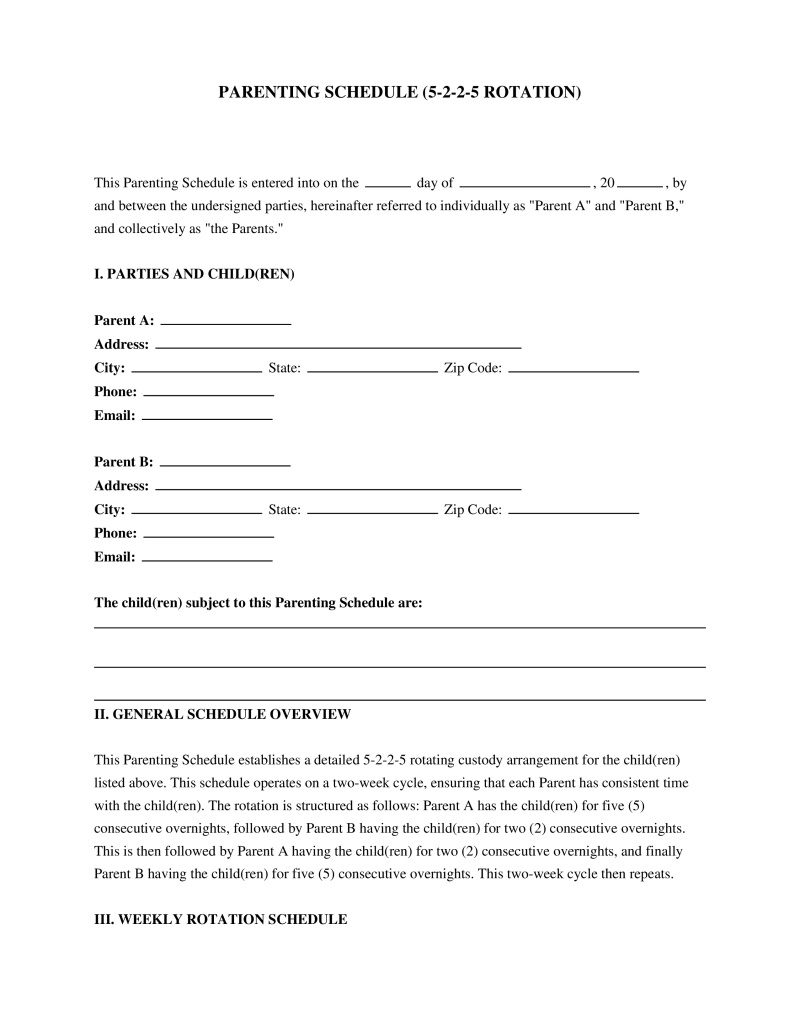
A 5-2-2-5 Parenting Schedule Template is a legal document that outlines a specific residential custody arrangement, detailing a recurring two-week rotation where children spend five days with one parent, two days with the other, then two days with the first, and finally five days with the second.
Schedule Start Date
Select the date when this parenting schedule will take effect.
Table of Contents
What Is a 5-2-2-5 Parenting Schedule Template?
A 5-2-2-5 Parenting Schedule Template is a structured document designed to outline a specific co-parenting custody arrangement where children spend 5 days with one parent, then 2 days with the other, followed by another 2 days with the first parent, and finally 5 days with the second parent. This cycle repeats every two weeks, resulting in an equitable 50/50 split of time between parents over the two-week period. This template serves as a clear, written agreement that helps co-parents establish predictability, minimize misunderstandings, and provide a stable routine for their children, detailing not just the core schedule but also provisions for holidays, vacations, and other logistical considerations.
What Is Included
A comprehensive 5-2-2-5 Parenting Schedule Template is far more than just a calendar; it's a detailed operational guide for co-parenting. Here's a breakdown of its typical components:
- Parent Information - This section is crucial for clearly identifying both co-parents, including their full names, contact information, and current residential addresses. It ensures that all parties involved are correctly identified and reachable for communication regarding the children.
- Child Information - Essential details about each child, such as their full name, date of birth, and any specific needs (e.g., medical conditions, school information), are listed here. This helps personalize the schedule and ensures all children's specific requirements are considered in the arrangement.
- Core 5-2-2-5 Weekly/Bi-Weekly Schedule - This is the heart of the template, explicitly detailing the rotating 5-2-2-5 pattern. It specifies which days the children will spend with each parent within the two-week cycle, often starting with a specific date to establish the ongoing rotation. This clarity prevents daily confusion about where the children should be.
- Holiday Schedule Override - Since regular routines are often disrupted by holidays, this section outlines specific arrangements for major holidays (e.g., Christmas, Thanksgiving, Fourth of July, Mother's Day, Father's Day). It typically specifies a rotating schedule or fixed allocation for each holiday, ensuring these special days are accounted for outside the standard 5-2-2-5 rotation.
- Vacation and Special Occasion Schedule - This component addresses longer periods away from the regular schedule, such as summer vacations, spring breaks, or other extended periods. It often includes provisions for notice periods for planning, travel arrangements, and communication during extended absences, allowing both parents to plan their personal time with the children.
- Transportation and Exchange Logistics - Details regarding how and where children will be exchanged between parents are critical for smooth transitions. This section covers pickup and drop-off locations, times, who is responsible for transportation, and what happens if one parent is late, minimizing potential friction points.
- Communication Protocols - Establishing clear guidelines for how co-parents will communicate about the children is vital. This includes preferred methods (e.g., email, co-parenting apps), expected response times, and topics appropriate for discussion, fostering respectful and effective information exchange.
- Decision-Making Authority - This section clarifies how significant decisions regarding the children's welfare—such as medical treatment, educational choices, and extracurricular activities—will be made. It can specify joint decision-making, primary decision-making by one parent, or areas where each parent has sole authority, preventing disputes over important aspects of the children's lives.
- Future Review and Modification Clause - Acknowledging that family circumstances can change, this clause outlines a process for reviewing and potentially modifying the parenting schedule in the future. It might suggest an annual review date or conditions under which a modification can be proposed, ensuring the template remains relevant and adaptable over time.
Who Should Use This Template?
The 5-2-2-5 Parenting Schedule Template is a powerful tool, but its effectiveness depends on the specific family dynamics and needs. Understanding its ideal applications and limitations is key to successful implementation.
Best For
- Parents Seeking a True 50/50 Physical Custody Split - The 5-2-2-5 schedule inherently balances time, ensuring each parent has the children for 7 nights out of every 14-day cycle. It's an excellent choice for co-parents committed to equal time sharing.
- Co-Parents with a Cooperative Relationship - This schedule, while structured, benefits greatly from parents who can communicate effectively and are willing to be flexible when minor, unforeseen circumstances arise. It thrives in environments of mutual respect.
- Children Who Adapt Well to Transitions - The schedule involves four transitions every two weeks. Children who are resilient and comfortable moving between homes frequently tend to do very well with this pattern.
- Parents Living in Reasonable Proximity - Frequent exchanges make this schedule most practical for co-parents who live close enough to each other to minimize travel time and logistical burdens for the children and themselves.
- Families Desiring Predictability with Variety - While highly structured, the 5-2-2-5 offers a good blend of predictability with slightly longer blocks of time (5 days) interspersed with shorter ones (2 days), preventing children from being away from either parent for too long.
Not Ideal For
- High-Conflict Co-Parenting Situations - The frequent exchanges in a 5-2-2-5 schedule can exacerbate conflict if parents struggle with direct communication or have difficulty cooperating during handovers. Schedules with fewer transitions, like an every-other-week arrangement, might be more suitable.
- Parents Living Significant Distances Apart - The logistics of four exchanges every two weeks become overly burdensome and time-consuming for children and parents if there's a considerable distance between homes, making the schedule impractical.
- Children Who Struggle with Frequent Transitions - Some children thrive on longer, uninterrupted periods with each parent and may find the frequent back-and-forth of the 5-2-2-5 schedule unsettling or exhausting. For these children, a schedule with fewer transitions, like the 2-2-3 or every-other-week, might be better.
- Parents with Highly Irregular or Demanding Work Schedules - While the template provides structure, parents whose work hours are unpredictable or require frequent travel may find it challenging to consistently adhere to the fixed exchange times and visitation days.
- Situations Requiring an Unequal Custody Split - If the goal is not a 50/50 time division (e.g., 60/40, 70/30), the 5-2-2-5 template is not appropriate as its fundamental design is based on equal time sharing. Other schedules would need to be considered.
Quick Start Guide
Implementing a 5-2-2-5 Parenting Schedule Template effectively requires careful planning and open communication. Follow these steps to get started:
- Gather Essential Information and Personalize the Template: Begin by filling in all basic details for both parents and each child. This includes full names, contact information, and any specific needs or school schedules for the children. Personalizing these sections ensures the template is tailored to your family's unique circumstances from the outset.
- Clearly Define the Core 5-2-2-5 Rotation with a Start Date: Visually map out the 5-2-2-5 pattern on a calendar for at least one month, clearly marking which parent has the children on which days. Crucially, establish a specific start date for the first rotation to ensure both parents are aligned on when the schedule officially begins and how it cycles.
- Integrate Holiday and Special Day Overrides: Systematically go through a calendar year and identify all significant holidays, including school breaks, religious observances, and birthdays. For each, determine how it will override the standard 5-2-2-5 schedule, specifying which parent has the children and for what duration. Consider rotating holidays annually for fairness.
- Plan for Extended Vacations and School Breaks: Outline the process for allocating longer periods like summer vacation, winter break, or spring break. Decide on notice periods for requesting vacation time, how conflicts will be resolved, and if any communication protocols (e.g., daily check-ins) will be in place during these extended periods.
- Detail Exchange Logistics and Responsibilities: Pinpoint precise pickup and drop-off locations (e.g., school, specific parent's home), exact times, and clearly assign responsibility for transportation for each exchange. Consider creating a contingency plan for delays or unforeseen circumstances to minimize disruption.
- Establish Clear Communication Protocols: Agree upon preferred methods of communication (e.g., a specific co-parenting app, email only, phone calls for emergencies), expected response times, and ground rules for respectful interaction. This helps manage expectations and reduces miscommunication.
- Review and Agree on Decision-Making Processes: Discuss and document how major decisions regarding the children's health, education, and extracurricular activities will be made. Specify whether decisions require joint agreement, if one parent has primary authority in certain areas, or if a tie-breaking mechanism is needed.
- Schedule Regular Reviews and Maintain Flexibility: Plan for periodic reviews of the parenting schedule—perhaps annually or bi-annually—to ensure it continues to meet the children's evolving needs and the parents' circumstances. While structure is important, acknowledge that flexibility and a willingness to make minor adjustments are vital for long-term success.
Frequently Asked Questions
Not the form you're looking for?
Try our legal document generator to create a custom document
Disclaimer: The templates available on this website are provided for general informational purposes only and do not constitute legal advice. They are not intended to be, and should not be interpreted as, compliant with any specific legal, regulatory, or privacy requirements. These templates are not a replacement for professional legal guidance and should not be relied upon for any particular matter or circumstance. Users are strongly encouraged to seek advice from a qualified attorney licensed in their jurisdiction before using, modifying, or relying on any template.
All templates are provided on an "as is," "with all faults," and "as available" basis. The provider disclaims any and all warranties of any kind, whether express, implied, statutory, or otherwise, including without limitation warranties of merchantability, fitness for a particular purpose, title, or non-infringement.
LegalTemplates.com makes no guarantees or representations regarding the accuracy, completeness, expected outcomes, or reliability of the materials contained in these templates or any materials referenced or linked from them.