Petition for Letters of Guardianship
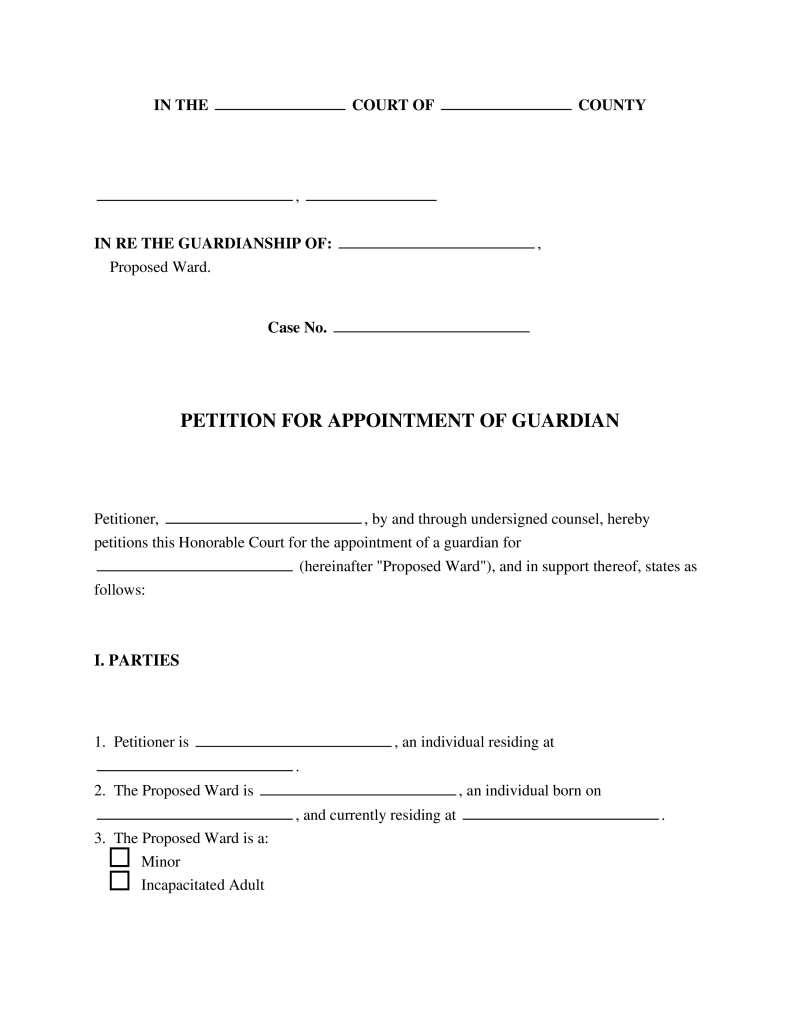
A Petition for Letters of Guardianship is a formal legal document filed with a court to request the appointment of a guardian for an incapacitated.
Ward Type
Select whether the person needing a guardian is a minor (under 18) or an adult who is incapacitated.
Table of Contents
What is a Petition for Letters of Guardianship?
A Petition for Letters of Guardianship is a formal legal document filed with a court, typically by an individual or entity seeking to be appointed as the guardian for another person. This petition initiates the legal process to establish a guardianship, which grants the appointed guardian the authority to make decisions regarding the personal care, medical treatment, or financial affairs of an individual who is deemed incapacitated or a minor. The purpose of this document is to inform the court of the need for a guardian, present evidence of the proposed ward's incapacity or minority, and propose a suitable individual to assume these critical responsibilities.
Legal Requirements and Validity
The validity of a Petition for Letters of Guardianship hinges on strict adherence to statutory requirements, which vary significantly by state jurisdiction. Generally, the petitioner must demonstrate a compelling need for guardianship, proving that the proposed ward is unable to make essential decisions for themselves or manage their own affairs. Key legal requirements often include:
- Jurisdictional Basis - The petition must be filed in the proper court, typically the probate or family court, in the county where the proposed ward resides or where their assets are located (e.g., State Probate Code § XXXX).
- Standing of Petitioner - The individual or entity filing the petition must have a legitimate interest in the proposed ward's welfare, often a family member, close friend, or social service agency.
- Notice to Interested Parties - Due process requires that all interested parties, including the proposed ward, their immediate family members, and sometimes other fiduciaries, receive formal notice of the petition and the scheduled hearing (e.g., State Rules of Civil Procedure Rule XX).
- Evidence of Incapacity - For adult guardianships, the petition must be supported by medical or psychological evaluations demonstrating the proposed ward's inability to manage their person or estate due to mental or physical impairment (e.g., State Guardianship Act § YYYY).
- Best Interests Standard - The court's primary consideration is always the best interests of the proposed ward, and the petition must articulate how the proposed guardianship serves this standard.
- Least Restrictive Alternative - Courts typically prefer the least restrictive means of intervention, meaning the petition should explain why less intrusive alternatives, such as a power of attorney or conservatorship, are insufficient (e.g., State Guardianship Statute § ZZZZ).
Failure to meet any of these requirements can lead to the dismissal of the petition or a denial of the guardianship request. Courts scrutinize these petitions carefully to protect the rights and autonomy of individuals.
Rights and Obligations of Parties Involved
The process initiated by a Petition for Letters of Guardianship involves several key parties, each with distinct rights and obligations:
- Proposed Ward - The individual for whom guardianship is sought retains significant rights throughout the process. They have the right to receive notice of the petition, attend the hearing, be represented by legal counsel (often appointed by the court if they cannot afford one), present evidence, and object to the guardianship or the proposed guardian. Even if found incapacitated, they retain rights not explicitly removed by the court order, such as the right to vote or marry, unless specifically limited.
- Petitioner - The individual or entity filing the Petition for Letters of Guardianship has the obligation to present a truthful and complete account of the proposed ward's situation and the reasons for seeking guardianship. They must comply with all procedural rules, including proper service of process, and be prepared to present evidence supporting their claims in court. Their primary obligation is to act in the proposed ward's best interests throughout the proceedings.
- Guardian (if appointed) - Upon appointment, a guardian assumes a fiduciary duty to the ward. Their obligations include making decisions in the ward's best interest, managing their person or estate prudently, and providing regular reports to the court. Guardians must prioritize the ward's well-being, protect their assets, and seek court approval for significant decisions, such as selling property or authorizing complex medical procedures. They are also obligated to respect the ward's autonomy to the greatest extent possible.
- Court - The court's obligation is to conduct a fair and thorough hearing, considering all evidence and arguments. It must ensure due process rights are protected for the proposed ward and make a determination based on the legal standards for guardianship, always prioritizing the ward's best interests and the least restrictive alternative. The court also has an ongoing oversight role, reviewing guardian reports and intervening if necessary.
How to Complete a Petition for Letters of Guardianship
Completing a Petition for Letters of Guardianship involves several critical steps to ensure its accuracy and legal sufficiency:
- Gather Necessary Information - Begin by collecting all pertinent details about the proposed ward, including their full legal name, date of birth, current address, and any known next of kin. Obtain medical records, psychological evaluations, or other documentation that supports the claim of incapacity. Identify all assets, income sources, and liabilities if a guardianship of the estate is sought.
- Identify the Appropriate Court and Forms - Determine the proper court jurisdiction, typically the probate or family court in the county where the proposed ward resides. Obtain the correct petition forms, which are often available on the court's website or from the clerk's office. Many states provide standardized forms, but local variations may exist.
- Draft the Petition Document - Carefully fill out the petition, providing all requested information accurately and completely. Clearly state the type of guardianship sought (of the person, estate, or both) and the specific reasons why guardianship is necessary. Detail the proposed ward's current condition, their inability to make decisions, and why less restrictive alternatives are not appropriate.
- Propose a Suitable Guardian - Identify the individual or entity you propose to serve as guardian, providing their full name, address, and relationship to the proposed ward. Explain why this person is suitable, highlighting their ability to manage the ward's affairs and commitment to their well-being. Disclose any potential conflicts of interest.
- Prepare Supporting Documents - Attach any required supporting documents, such as medical affidavits, psychological evaluations, or lists of assets. Some jurisdictions require a proposed care plan or a statement of the proposed guardian's qualifications. Ensure all attachments are properly referenced within the petition.
- Review, Sign, and Notarize - Thoroughly review the entire petition and all attachments for accuracy, completeness, and any typographical errors. Sign the petition in the presence of a notary public if required by local rules, attesting to the truthfulness of the information provided.
- File the Petition with the Court - Submit the original signed petition and all copies, along with the required filing fee, to the clerk of the appropriate court. The clerk will typically assign a case number and provide instructions for the next steps, including service of process.
Federal and State Laws Governing Guardianship
Guardianship proceedings are primarily governed by state law, but certain federal statutes can influence or interact with these processes:
- Health Insurance Portability and Accountability Act (HIPAA) - While not directly governing guardianship, HIPAA (45 CFR § 164.508) is critical in guardianship cases involving medical decisions. Once a guardian of the person is appointed, they generally gain the authority to access the ward's protected health information, which would otherwise require specific authorization.
- Americans with Disabilities Act (ADA) - The ADA (42 U.S.C. § 12101 et seq.) ensures that individuals with disabilities are not discriminated against. In guardianship, this means courts must consider accommodations and support services that might allow an individual to retain greater autonomy, aligning with the "least restrictive alternative" principle.
- Uniform Adult Guardianship and Protective Proceedings Jurisdiction Act (UAGPPJA) - Adopted by many states, this uniform act provides rules for determining which state has jurisdiction over an adult guardianship case when the proposed ward has connections to multiple states. It aims to prevent jurisdictional disputes and ensure continuity of care (e.g., California Probate Code § 1500 et seq.).
- State Guardianship Statutes - Every state has comprehensive statutes outlining the procedures for establishing guardianship, the rights of proposed wards, the duties of guardians, and the grounds for incapacity. These statutes dictate specific notice requirements, evidentiary standards, and reporting obligations for guardians (e.g., Florida Statute Chapter 744, New York Mental Hygiene Law Article 81).
- State Probate Codes - Guardianship proceedings are often handled within a state's probate court system, and the state's probate code will contain the relevant procedural rules and substantive law for these cases (e.g., Texas Estates Code Title 3).
Penalties for non-compliance with guardianship laws can be severe. Filing a fraudulent or frivolous petition can result in sanctions, including attorney's fees, court costs, and even contempt of court charges. Guardians who fail to meet their fiduciary duties, misuse a ward's assets, or neglect their personal care can face removal, civil liability for damages, and in egregious cases, criminal prosecution for elder abuse, fraud, or embezzlement. Courts take their oversight role seriously to protect vulnerable individuals from exploitation or abuse.
Required Elements of a Valid Petition for Letters of Guardianship
A properly drafted Petition for Letters of Guardianship must include specific information to be considered valid by the court. While exact requirements can vary by state and local court rules, common essential elements are:
- Court and Case Information - Identification of the court where the petition is filed, along with spaces for the case name and number.
- Petitioner's Information - Full legal name, address, and relationship to the proposed ward.
- Proposed Ward's Information - Full legal name, date of birth, current address, and last known address if different.
- Allegations of Incapacity - A detailed statement explaining why the proposed ward is incapacitated and unable to manage their personal or financial affairs, supported by factual examples.
- Type of Guardianship Sought - A clear indication of whether guardianship of the person, guardianship of the estate, or both is being requested.
- Proposed Guardian's Information - Full legal name, address, and a statement of their suitability to serve as guardian, including any required background information.
- Identification of Interested Parties - A list of all known interested parties, such as immediate family members, with their addresses, to ensure proper notification.
- Statement of Assets and Liabilities - If guardianship of the estate is sought, an estimated value of the proposed ward's assets, income, and liabilities.
- Verification and Signature - A sworn statement by the petitioner affirming the truthfulness of the petition's contents, signed under penalty of perjury, and often notarized.
- Request for Relief - A clear request to the court to appoint the proposed guardian and grant the specific powers necessary.
Frequently Asked Questions
Petition for Letters of Guardianship Sample
Not the form you're looking for?
Try our legal document generator to create a custom document
Disclaimer: The templates available on this website are provided for general informational purposes only and do not constitute legal advice. They are not intended to be, and should not be interpreted as, compliant with any specific legal, regulatory, or privacy requirements. These templates are not a replacement for professional legal guidance and should not be relied upon for any particular matter or circumstance. Users are strongly encouraged to seek advice from a qualified attorney licensed in their jurisdiction before using, modifying, or relying on any template.
All templates are provided on an "as is," "with all faults," and "as available" basis. The provider disclaims any and all warranties of any kind, whether express, implied, statutory, or otherwise, including without limitation warranties of merchantability, fitness for a particular purpose, title, or non-infringement.
LegalTemplates.com makes no guarantees or representations regarding the accuracy, completeness, expected outcomes, or reliability of the materials contained in these templates or any materials referenced or linked from them.