General Partnership Agreement
A General Partnership Agreement is a foundational legal document that delineates the structure, operational policies, and respective rights and obligations of partners within a business entity.
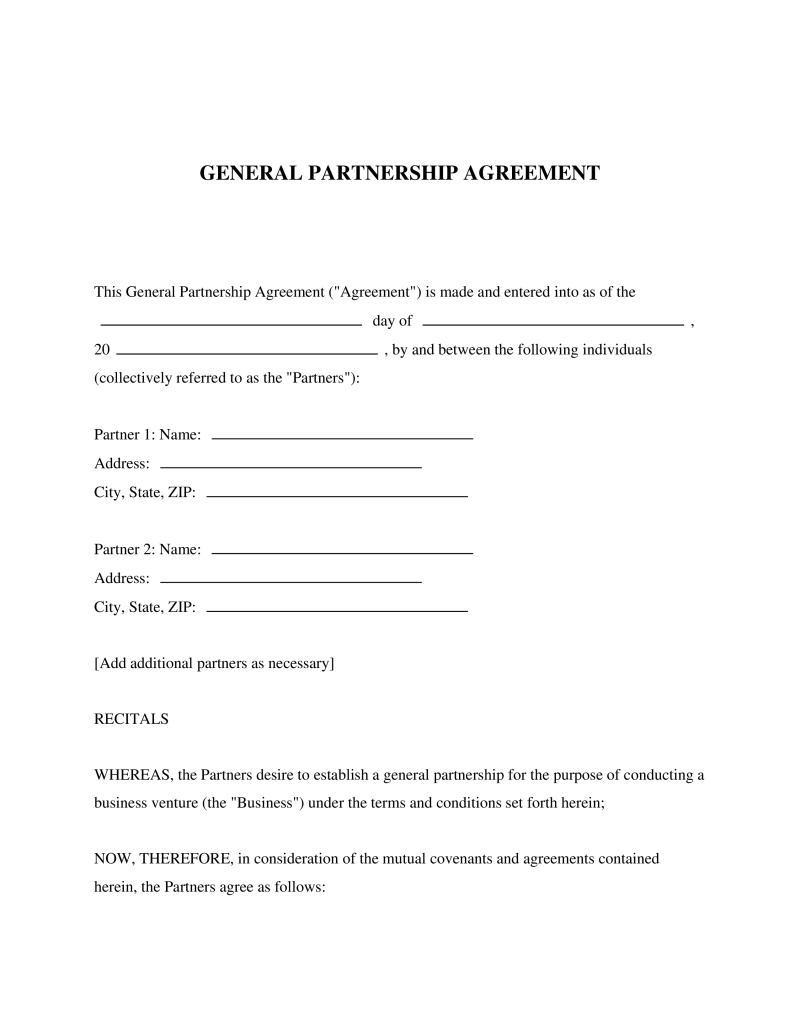
Partnership Term Type
Choose whether the partnership is for a "Fixed Term," which means it will last for a specific period (like one year), or "Indefinite," meaning it will continue until one partner decides to end it. This choice affects how the partnership operates and can influence your legal obligations. Make sure to select the option that accurately reflects your agreement with your partner(s).
Enter the date when the partnership will end, if fixed term.
Table of Contents
What is a General Partnership Agreement?
A General Partnership Agreement is a foundational legal document that outlines the terms and conditions governing a general partnership. This agreement establishes the rights, responsibilities, and obligations of each partner involved in the business. It serves to clarify operational procedures, profit and loss distribution, and decision-making processes, providing a clear framework for the partnership's existence and management.
Characteristics of a General Partnership
A general partnership is a business structure where two or more individuals agree to share in all assets, profits, and liabilities of a business. This structure is relatively simple to form, often requiring minimal formal filing beyond necessary business licenses, though a written agreement is highly recommended. Each partner contributes to the business, whether through money, property, labor, or skill, and shares in the management responsibilities.
Key characteristics defining a general partnership include:
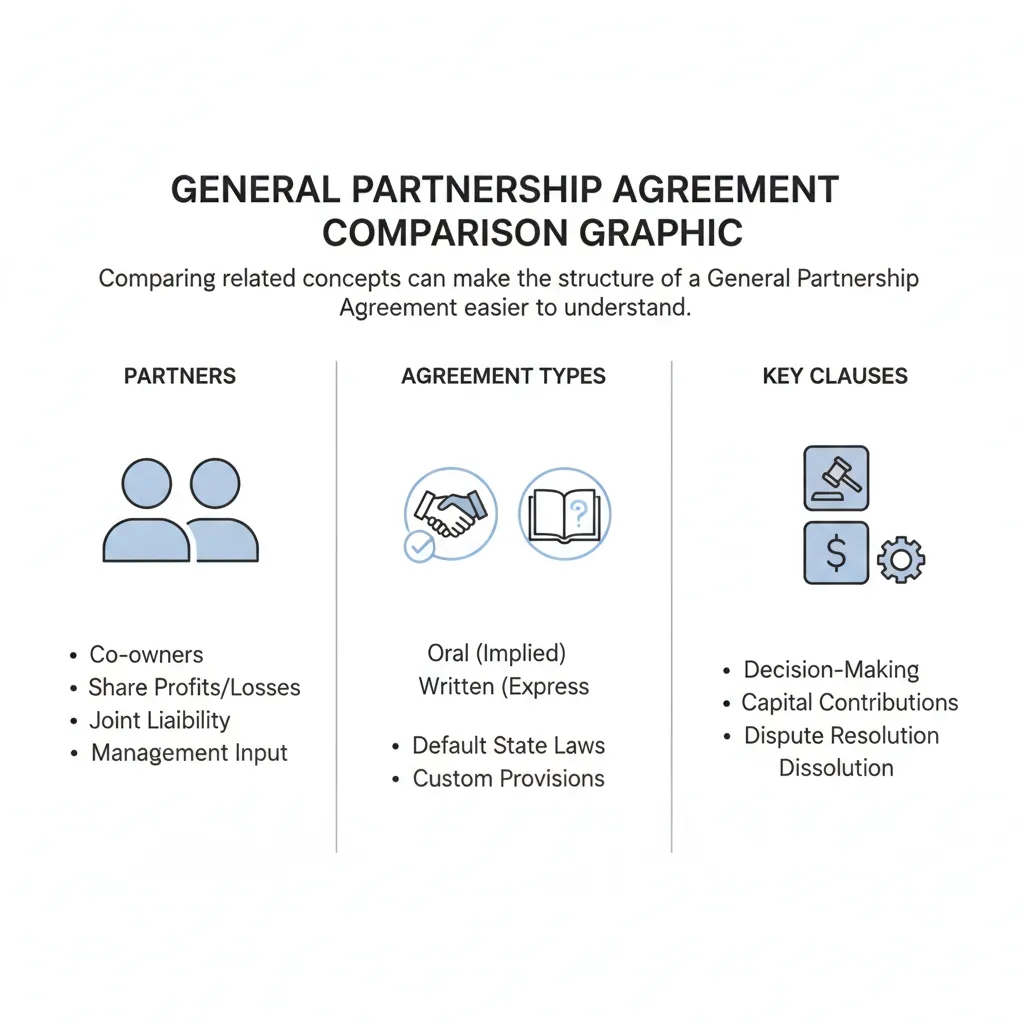
- Shared Ownership and Management - All partners typically have equal rights in the management and control of the business, unless otherwise specified in a General Partnership Agreement.
- Shared Profits and Losses - Profits and losses are distributed among partners, usually proportional to their ownership interest or as defined in the agreement.
- Personal Liability - A significant characteristic is that each partner is personally liable for the debts and obligations of the business. This means personal assets can be at risk to satisfy business liabilities.
- Pass-Through Taxation - The partnership itself does not pay income tax; instead, profits and losses are passed through to partners' individual tax returns (Internal Revenue Service).
- Ease of Formation - General partnerships can often be formed with little formal paperwork, sometimes even by implied agreement, though a comprehensive written General Partnership Agreement is crucial for clarity and protection.
Essential Provisions of a General Partnership Agreement
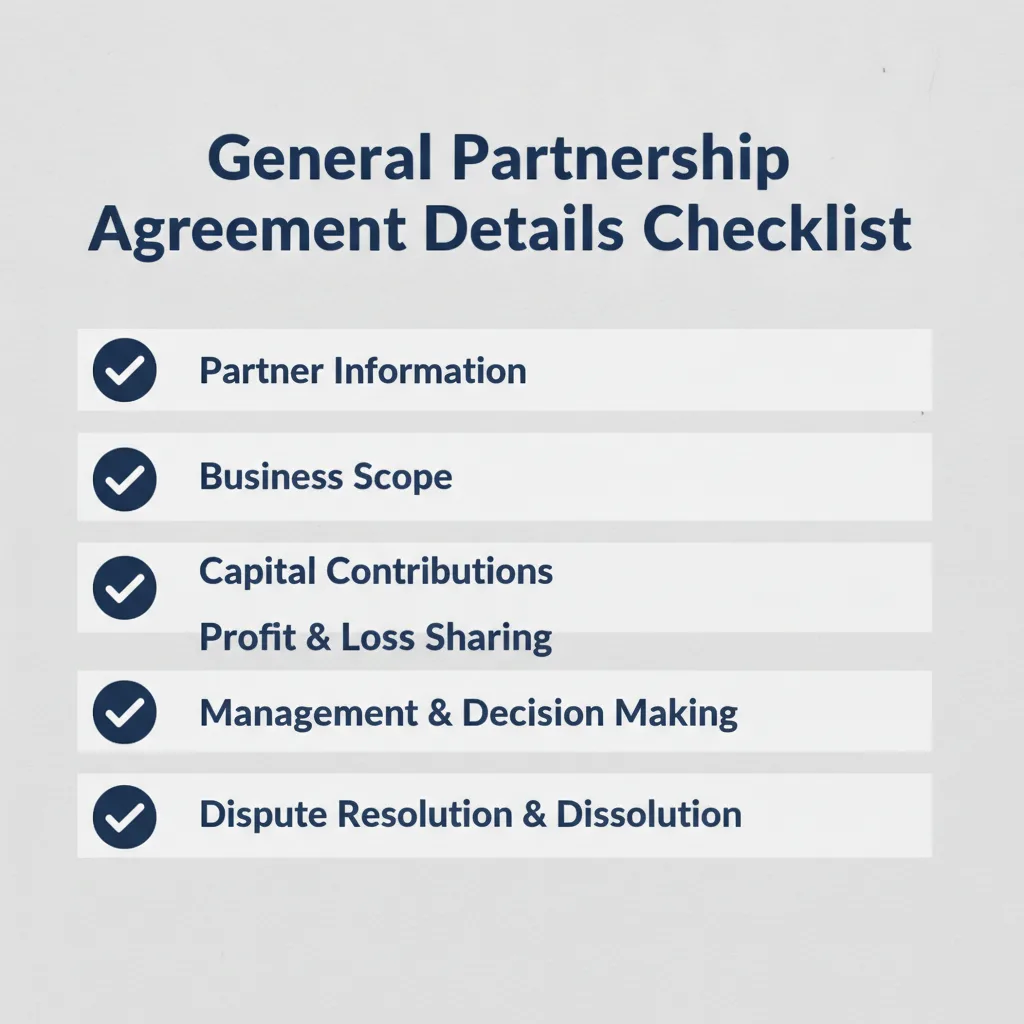
While a formal General Partnership Agreement may not be legally required to form a general partnership, it is strongly advised to create one. This document prevents future disputes by clearly defining the operational framework and partner expectations. A well-drafted agreement typically addresses a range of critical aspects:
- Partnership Name and Purpose - Clearly states the official name of the business and its primary objectives.
- Partner Contributions - Details each partner's initial contributions, which can include capital, property, services, or intellectual property.
- Profit and Loss Distribution - Specifies how profits and losses will be allocated among partners, which may not always be equal.
- Management and Decision-Making - Outlines the roles and responsibilities of each partner, voting rights, and procedures for making significant business decisions.
- Salaries and Draws - Defines if and how partners will receive regular compensation or withdraw funds from the business.
- Admission of New Partners - Establishes the process for bringing new partners into the partnership, including any required approvals or capital contributions.
- Partner Withdrawal or Death - Provides clear procedures for how the partnership will handle a partner's voluntary withdrawal, retirement, disability, or death, including buy-out clauses or dissolution terms.
- Dispute Resolution - Sets forth methods for resolving disagreements among partners, such as mediation or arbitration, to avoid costly litigation.
- Dissolution of the Partnership - Specifies the conditions under which the partnership can be dissolved and the process for winding up the business affairs, including asset distribution and debt settlement.
Taxation of General Partnerships
Frequently Asked Questions
Sources
- Partnerships | Internal Revenue Service - Provides information on partnership taxation and requirements
- Partnerships | U.S. Small Business Administration - Offers guidance on choosing a partnership structure for your business
Not the form you're looking for?
Try our legal document generator to create a custom document
Disclaimer: The templates available on this website are provided for general informational purposes only and do not constitute legal advice. They are not intended to be, and should not be interpreted as, compliant with any specific legal, regulatory, or privacy requirements. These templates are not a replacement for professional legal guidance and should not be relied upon for any particular matter or circumstance. Users are strongly encouraged to seek advice from a qualified attorney licensed in their jurisdiction before using, modifying, or relying on any template.
All templates are provided on an "as is," "with all faults," and "as available" basis. The provider disclaims any and all warranties of any kind, whether express, implied, statutory, or otherwise, including without limitation warranties of merchantability, fitness for a particular purpose, title, or non-infringement.
LegalTemplates.com makes no guarantees or representations regarding the accuracy, completeness, expected outcomes, or reliability of the materials contained in these templates or any materials referenced or linked from them.