Partnership Agreement
Create Partnership Agreement
Partnership Agreement
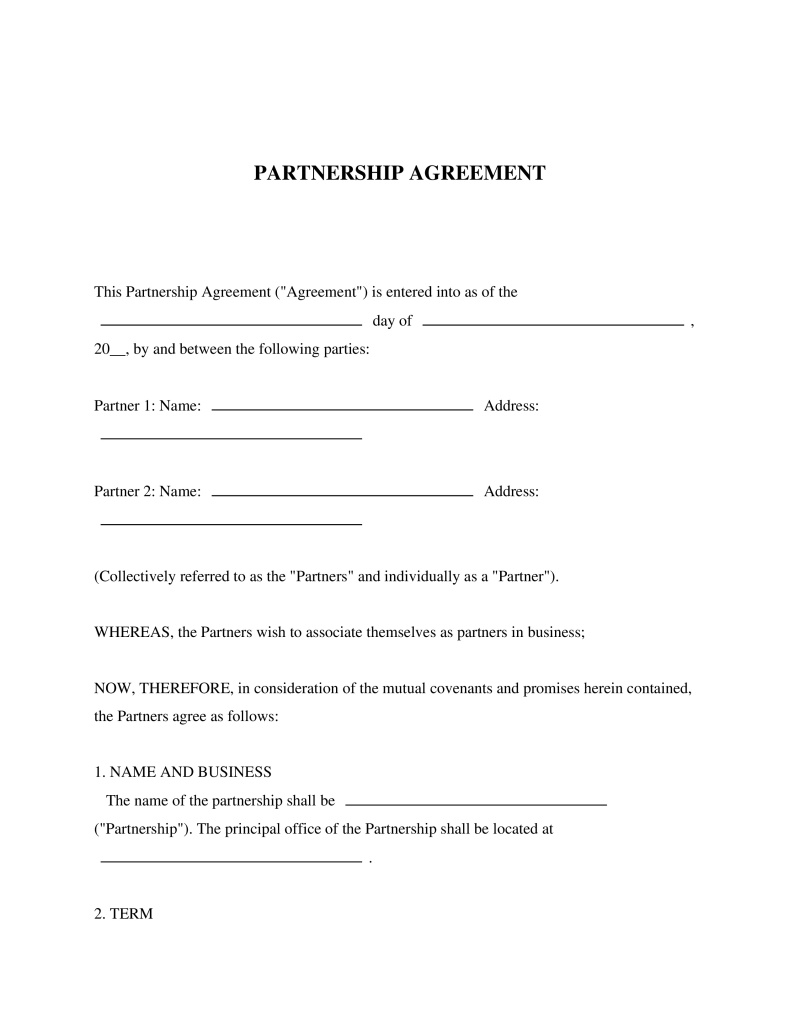
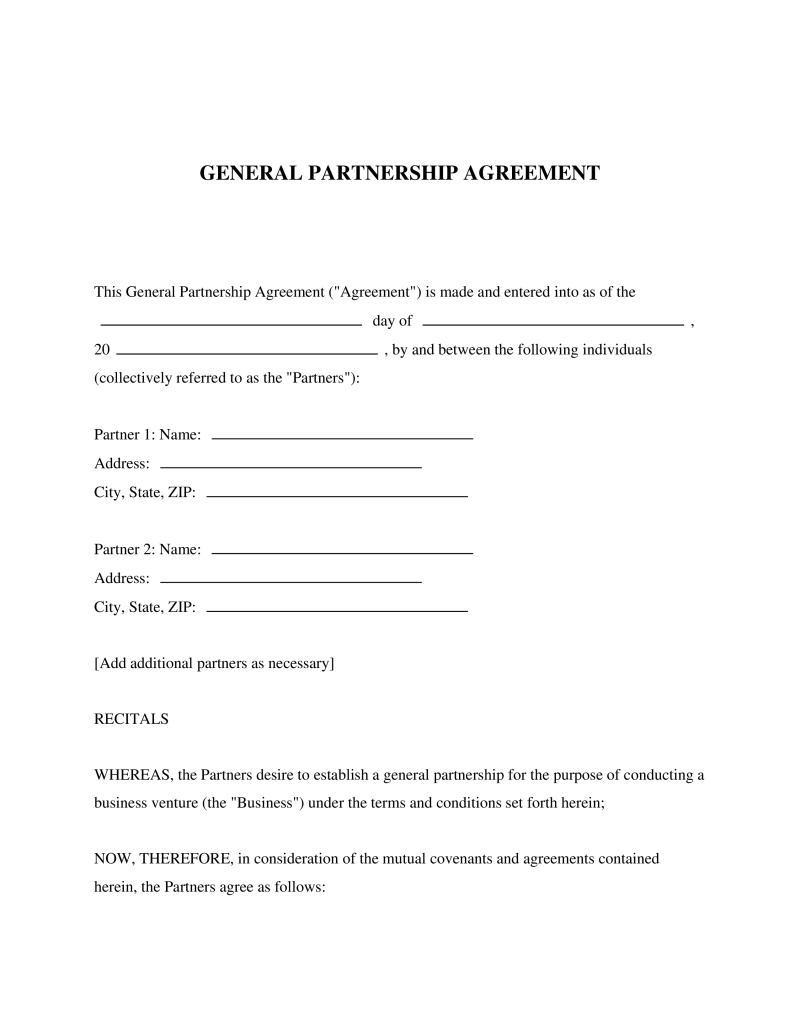
A Partnership Agreement is a legally binding document that delineates the operational framework for a business entity formed by two or more parties, specifying their respective rights, duties, and profit/loss distribution.
Answer the question(s) below to create your Partnership Agreement
Partnership Type
Select the type of partnership you are forming from the dropdown list. Each option has different legal responsibilities and protections, so choose the one that best fits your business needs. If your partnership does not fit any of the listed types, select "Other" and briefly describe it in the provided space.
Provide details if you selected 'Other'.
Table of Contents
What is a Partnership Agreement?
A Partnership Agreement is a legally binding contract that outlines the terms and conditions of a business partnership between two or more individuals or entities. This document defines the rights, responsibilities, and obligations of each partner, establishing a clear framework for the partnership's operation and management. Its primary purpose is to prevent misunderstandings and disputes by setting forth a comprehensive understanding among the partners regarding their business venture.
Key Elements of a Partnership Agreement
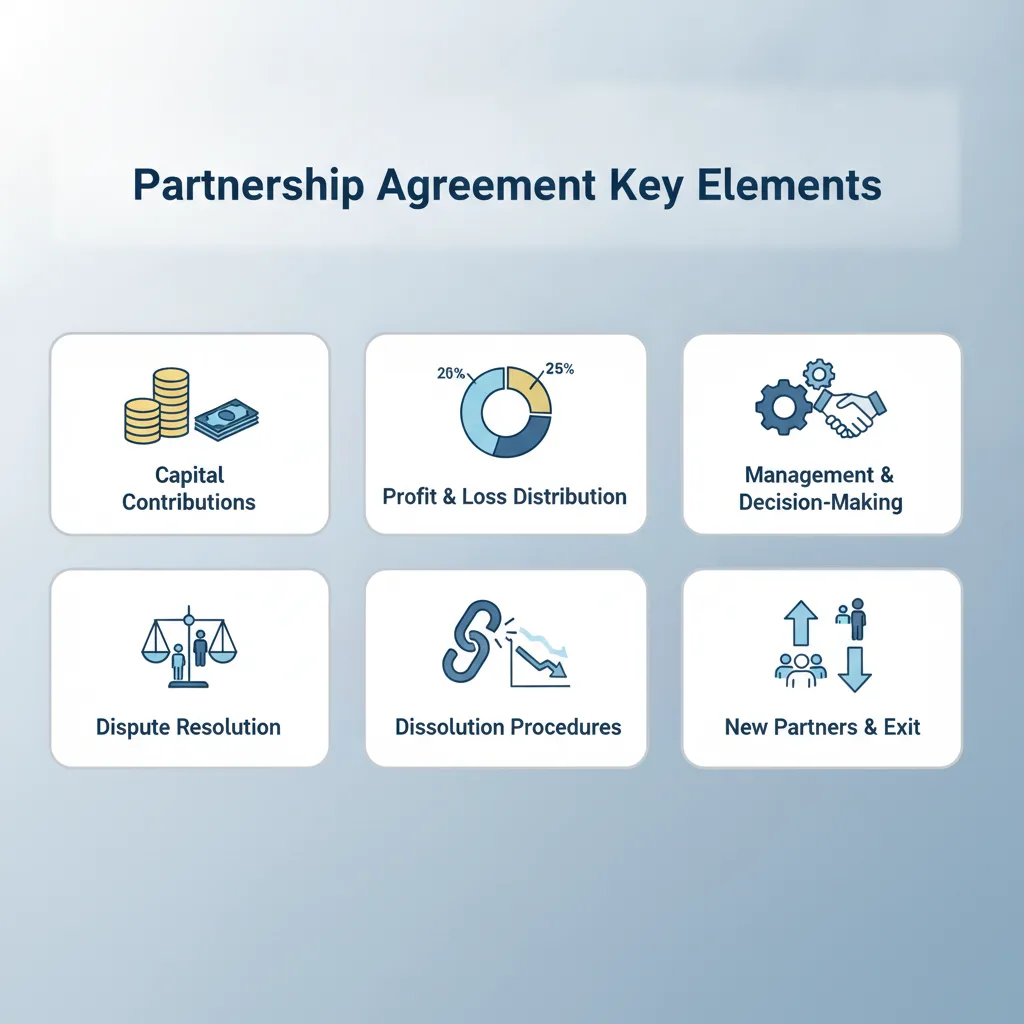
A comprehensive Partnership Agreement typically addresses various critical aspects of the business relationship. These elements ensure clarity and provide a roadmap for managing the partnership throughout its lifecycle, from formation to potential dissolution.
- Partnership Name and Business Purpose - Clearly identifies the legal name of the partnership and explicitly states the nature of the business it will conduct.
- Capital Contributions - Details the initial investment each partner will make, whether in cash, property, services, or a combination, and how future capital needs will be met.
- Profit and Loss Distribution - Specifies how the partnership's profits and losses will be shared among the partners, which may not always be equal and can be based on capital contributions or other factors.
- Management and Decision-Making - Outlines the roles and responsibilities of each partner, including who has authority to make specific decisions, voting rights, and procedures for resolving disagreements.
- Salaries and Draws - Establishes whether partners will receive regular salaries or have the ability to take draws from the partnership's profits, and under what conditions.
- Admission of New Partners - Defines the process and requirements for admitting new partners into the business, including any necessary approvals or adjustments to existing agreements.
- Withdrawal or Death of a Partner - Provides clear procedures for how the partnership will handle a partner's voluntary withdrawal, retirement, death, or disability, including buy-out provisions.
- Dispute Resolution - Establishes mechanisms for resolving conflicts between partners, such as mediation or arbitration, to avoid costly and time-consuming litigation.
- Dissolution Procedures - Specifies the conditions under which the partnership may be dissolved and the process for winding up the business, including asset distribution and debt settlement.
Types of Partnerships
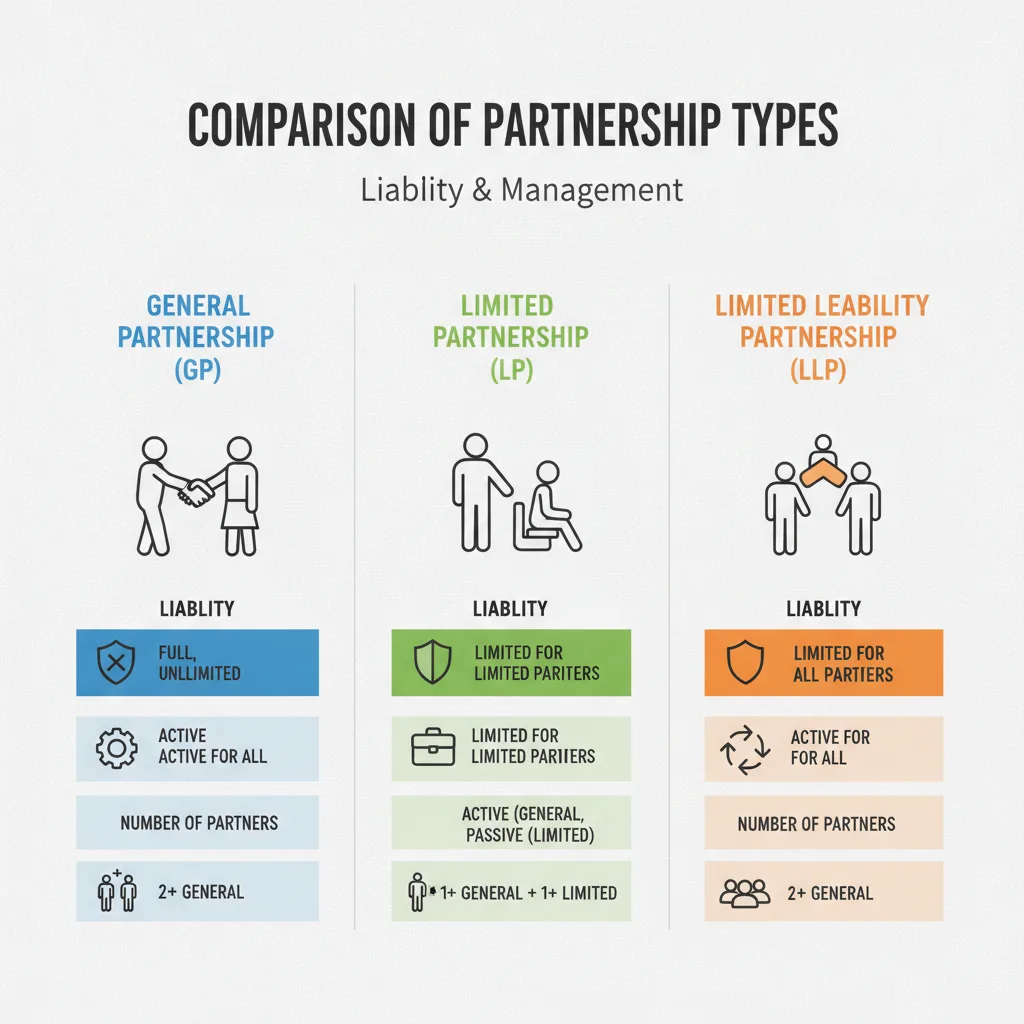
The structure of a partnership can vary significantly, impacting liability, management, and taxation. Selecting the appropriate partnership type is a foundational decision that influences the entire business operation.
- General Partnership (GP) - All partners share equally in profits, losses, and management responsibilities. Each partner has unlimited personal liability for the partnership's debts and obligations.
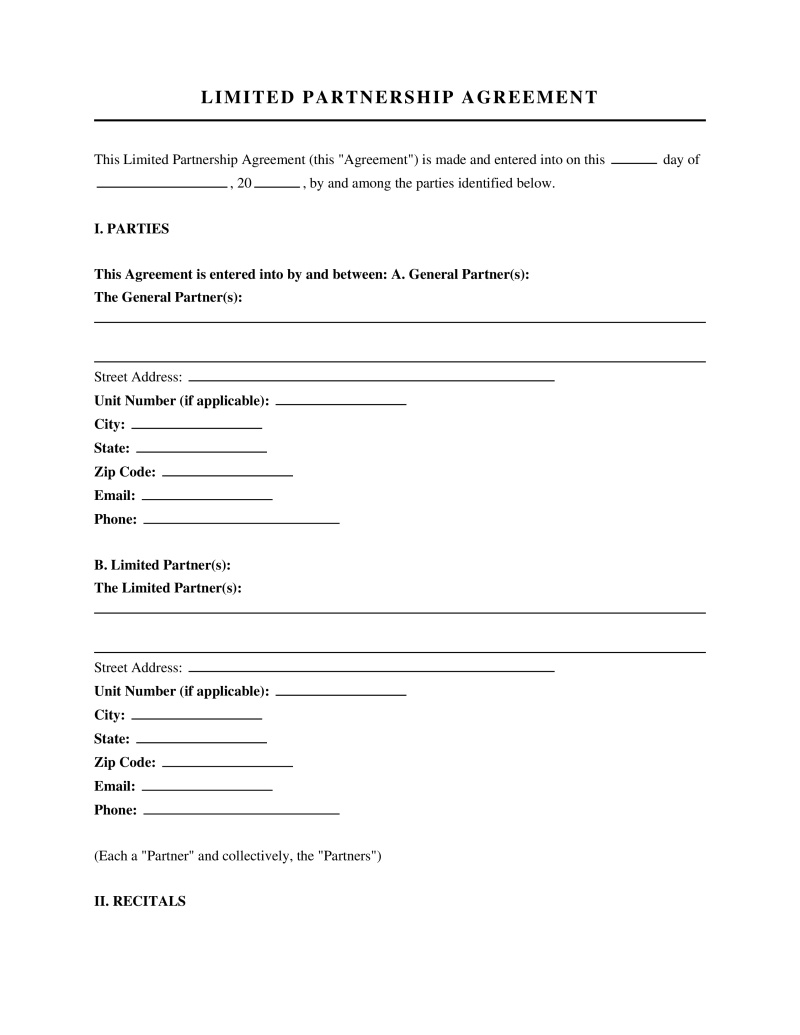
- Limited Partnership (LP) - Consists of at least one general partner and one or more limited partners. General partners manage the business and have unlimited personal liability, while limited partners contribute capital but have limited liability, usually up to the amount of their investment, and do not participate in management.
- Limited Liability Partnership (LLP) - Designed primarily for professional service firms (e.g., lawyers, accountants). It provides limited liability protection for all partners, shielding them from the debts and liabilities arising from the actions of other partners, though each partner remains liable for their own professional negligence.
- Limited Liability Limited Partnership (LLLP) - A relatively newer structure available in some states, offering limited liability to the general partner in a limited partnership. This means the general partner's personal assets are protected from partnership debts, similar to an LLP.
Importance of a Written Agreement
While some jurisdictions allow for oral partnership agreements, a written Partnership Agreement is critical for several reasons. It provides legal clarity, protects the interests of all parties involved, and serves as a foundational document for the business.
Key benefits of a written agreement include:
- Clarifies Expectations - Prevents misunderstandings by explicitly detailing each partner's roles, responsibilities, contributions, and expectations for the business's operation and future.
- Legal Enforceability - Provides a legally binding document that can be referenced and enforced in court should disputes arise, offering a clear framework for resolution.
- Liability Protection - For certain partnership types (e.g., LP, LLP), the agreement defines the scope of liability for partners, which is crucial for asset protection.
- Business Continuity - Outlines procedures for unforeseen events like a partner's death, disability, or withdrawal, ensuring the business can continue operating smoothly.
- Dispute Resolution - Establishes a pre-agreed method for resolving conflicts, which can save significant time and legal costs compared to litigation.
Taxation and Legal Considerations
Partnerships are subject to specific tax rules and various legal considerations that impact their operation and the partners themselves. Understanding these aspects is crucial for compliance and sound business management.
Regarding taxation, the Internal Revenue Service (IRS) provides guidance on how partnerships are treated for federal tax purposes:
- Pass-Through Entity - Partnerships are generally considered pass-through entities, meaning the business itself does not pay federal income tax. Instead, the partnership "passes through" any profits or losses to its partners (Internal Revenue Service).
- Individual Tax Reporting - Each partner reports their share of the partnership's income or loss on their individual income tax return (Internal Revenue Service).
- Information Return Requirement - Although partnerships do not pay income tax, they must file an annual information return with the IRS, reporting their income, deductions, gains, losses, etc. (Internal Revenue Service).
- Self-Employment Tax - General partners and, in some cases, limited partners, are often considered self-employed and must pay self-employment taxes (Social Security and Medicare) on their share of the partnership's earnings.
Beyond taxation, legal considerations for partnerships include state-specific registration requirements, compliance with business regulations, and adherence to uniform acts like the Uniform Partnership Act (UPA) or Revised Uniform Partnership Act (RUPA), which govern partnerships in the absence of or to supplement a written agreement.
Amending and Dissolving a Partnership
A Partnership Agreement is not static; it often requires amendments as the business evolves or circumstances change. Similarly, the agreement should detail the process for dissolving the partnership when necessary.
Key aspects include:
- Amendment Procedures - Most agreements specify that amendments require the unanimous consent of all partners or a supermajority vote, and must be documented in writing.
- Triggering Events for Dissolution - The agreement can define events that lead to dissolution, such as the achievement of a business goal, the expiration of a set term, or the death or withdrawal of a partner.
- Winding Up the Business - This process involves liquidating assets, paying off creditors, and distributing any remaining assets to partners according to the agreement's terms.
- Notice Requirements - Partners typically need to provide formal notice to each other and, in some cases, to state authorities, when dissolving the partnership.
Frequently Asked Questions
While not always legally mandated, a written Partnership Agreement is highly recommended to clarify terms, define responsibilities, and protect all partners' interests. Many states allow oral agreements, but these are difficult to prove and enforce in disputes.
Without a written agreement, state law (often based on the Uniform Partnership Act) will govern the partnership, which may impose terms that do not align with the partners' intentions. This can lead to significant disputes and personal liability for partners.
Yes, a Partnership Agreement can be amended if all partners agree to the changes. It is crucial to document any amendments in writing and have all partners sign the revised document to ensure legal enforceability.
A Partnership Agreement is for partnerships, defining the relationship between partners. An Operating Agreement is for Limited Liability Companies (LLCs), outlining the rights and responsibilities of members and the management structure of the LLC.
In a General Partnership, all partners typically have unlimited personal liability for the partnership's debts. In Limited Partnerships and Limited Liability Partnerships, liability can be restricted for certain partners based on their role and the partnership structure.
No, partnerships are generally pass-through entities and do not pay federal income tax themselves. Profits and losses are passed through to the individual partners, who then report their share on their personal tax returns (Internal Revenue Service).
Sources
- Partnerships | Internal Revenue Service - Provides information on partnership taxation and filing requirements.
Related Documents
Forms commonly used with Partnership Agreement.
Not the form you're looking for?
Try our legal document generator to create a custom document
Disclaimer: The templates available on this website are provided for general informational purposes only and do not constitute legal advice. They are not intended to be, and should not be interpreted as, compliant with any specific legal, regulatory, or privacy requirements. These templates are not a replacement for professional legal guidance and should not be relied upon for any particular matter or circumstance. Users are strongly encouraged to seek advice from a qualified attorney licensed in their jurisdiction before using, modifying, or relying on any template.
All templates are provided on an "as is," "with all faults," and "as available" basis. The provider disclaims any and all warranties of any kind, whether express, implied, statutory, or otherwise, including without limitation warranties of merchantability, fitness for a particular purpose, title, or non-infringement.
LegalTemplates.com makes no guarantees or representations regarding the accuracy, completeness, expected outcomes, or reliability of the materials contained in these templates or any materials referenced or linked from them.