Affidavit of Indigency Create an Affidavit of Indigency

Affidavit of Indigency

Updated Dec 28, 2025
0 Comments
5 (3)
17 Downloads

An Affidavit of Indigency is a sworn statement used to declare the financial inability of an individual to afford legal fees.

Applicant Type

Select 'Self' if you are the applicant. Select 'On behalf of another' if you are a guardian, parent, or legal representative.
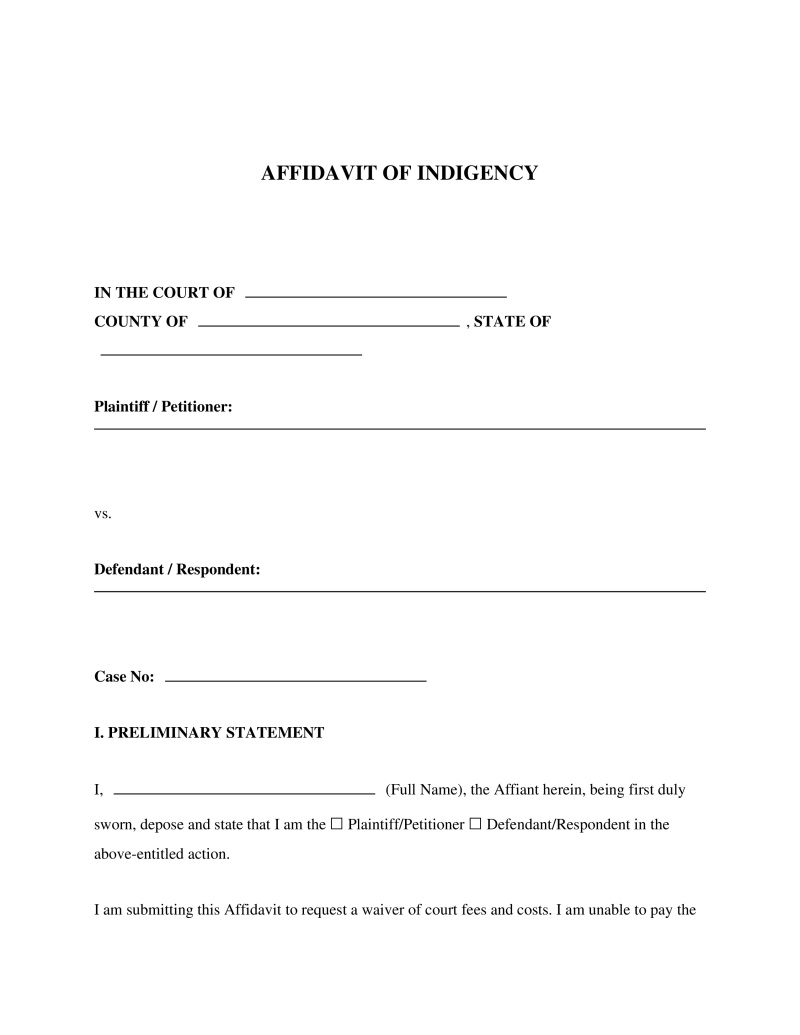
Table of Contents

0% Complete 0/0 Fields

AFFIDAVIT OF INDIGENCY

IN THE COURT OF

COUNTY OF , STATE OF

Plaintiff / Petitioner:
vs.
Defendant / Respondent:

Case No:

I. PRELIMINARY STATEMENT

I, , the Affiant herein, being first duly sworn, depose and state that I am the (check one):

in the above-entitled action.

I am submitting this Affidavit to request a waiver of court fees and costs. I am unable to pay the court costs and fees in this matter without substantial hardship to myself or my family. In support of this request, I provide the following financial information under penalty of perjury.

II. PERSONAL INFORMATION

Address:

Phone Number:

Date of Birth:

III. REPRESENTATION

Please select one:

IV. PUBLIC ASSISTANCE / GOVERNMENT BENEFITS

Do you currently receive any of the following forms of public assistance? (Check all that apply)

V. EMPLOYMENT AND INCOME

A. Employment Status

B. Employer Information (if applicable)

C. Monthly Income

Please list all sources of monthly income calculated as a gross monthly average:

1. Wages, Salary, Tips, Commissions: $

2. Self-Employment Income: $

3. Unemployment Benefits: $

4. Social Security / Retirement: $

5. Child Support / Alimony Received: $

6. Disability Benefits: $

7. Investment / Rental Income: $

8. Other Income: $

Total Monthly Income: $

VI. HOUSEHOLD AND DEPENDENTS

1. Marital Status:

3. Number of minor children living in the household:

4. Number of other dependents living in the household:

List the names and ages of all dependents:

VII. MONTHLY EXPENSES

Please list your average monthly expenses:

1. Rent or Mortgage Payment: $

2. Food and Household Supplies: $

3. Utilities (Gas, Electric, Water, Phone): $

4. Transportation (Car payment, gas, bus): $

5. Medical / Dental Insurance & Costs: $

6. Child Care / Child Support Paid: $

7. Credit Card / Loan Payments: $

8. Other Expenses: $

Total Monthly Expenses: $

VIII. ASSETS AND PROPERTY

A. Cash and Accounts

1. Cash on hand: $

2. Checking Account Balance: $

3. Savings Account Balance: $

B. Real Estate

Do you own any real estate (including your home)?

C. Vehicles

Do you own any vehicles?

D. Other Assets

List any other assets of value (stocks, bonds, jewelry, boats, etc.):

IX. DEBTS AND LIABILITIES

Please list any major debts (excluding those listed in monthly expenses above), such as judgments, tax liens, or large medical bills:

X. ADDITIONAL INFORMATION

Please state any other facts regarding your financial situation that you want the Court to consider (e.g., pending eviction, medical emergency, bankruptcy):

XI. OATH AND DECLARATION

I declare under penalty of perjury under the laws of the State of that the foregoing is true and correct. I understand that providing false information in this Affidavit may result in the dismissal of my claims, sanctions, or criminal prosecution.

I further understand that if my financial situation improves during the pendency of this case, I have a duty to notify the Court immediately.

AFFIANT SIGNATURE

Signature: _________________________

Date:

Print Name: _______________

What is an Affidavit of Indigency?

An Affidavit of Indigency is a legal document utilized by individuals who claim that they do not possess the financial resources necessary to pay for court costs or fees associated with legal proceedings. This affidavit serves as a formal statement, made under oath, detailing the person's income, assets, debts, and any other financial obligations. The purpose of this document is to demonstrate to the court that the individual's economic status qualifies them for waived or reduced fees, thus ensuring access to legal processes without the barrier of cost. Typically, those facing criminal charges or involved in civil matters who cannot afford representation or court fees would need this affidavit to seek relief from such expenses.

Key Features

Provides a detailed account of an individual's financial situation to assess eligibility for fee waivers.
Includes sections for listing assets, liabilities, income, and expenses to offer a comprehensive financial overview.
Facilitates a sworn declaration under penalty of perjury, ensuring the information provided is truthful and accurate.
Simplifies the process for requesting legal fee waivers, making it accessible for individuals of limited means.
Designed to meet court standards for evidence of indigency in both criminal and civil cases.
Aids in expediting the indigency hearing process by presenting organized and relevant financial data.

Important Provisions

  • Statement of Income: A detailed list of all sources and amounts of income received by the individual.
  • List of Assets: Includes real estate, vehicles, savings accounts, and any valuable property owned by the declarant.
  • Liabilities and Expenses: Outlines outstanding debts and monthly expenses such as rent, utilities, food, and medical bills.
  • Declaration Under Oath: A clause where the individual affirms that all information provided is true to the best of their knowledge.

Pros and Cons

Pros

  • +Enables financially disadvantaged individuals to access legal services and courts without prohibitive costs.
  • +Streamlines the waiver application process by providing a structured format for presenting financial information.
  • +Enhances credibility with courts through a formalized statement of financial hardship.
  • +Potentially accelerates the adjudication of indigency claims by supplying comprehensive financial details upfront.
  • +Reduces the risk of dismissal due to inability to pay court fees by demonstrating genuine need.

Cons

  • -Requires full disclosure of personal financial information, which might be uncomfortable for some individuals.
  • -The determination of indigency is ultimately at the discretion of the court, with no guarantee of fee waiver approval.
  • -Preparing an accurate affidavit requires careful attention to detail and potentially time-consuming collection of financial records.

Common Uses

  • Requesting a public defender or court-appointed attorney in criminal cases due to inability to afford private counsel.
  • Filing for divorce or other civil litigation when unable to pay filing fees.
  • Appealing against government agency decisions without bearing the full brunt of associated costs.
  • Seeking exemptions from costs related to obtaining court transcripts or other documents necessary for legal defense or appeal.
  • Petitioning for bankruptcy when filing fees are beyond an individual's financial reach.

Frequently Asked Questions

An affidavit of indigency refers to a legal document in which an individual declares under oath their inability to afford court-related costs due to their financial condition. This document is used to request fee waivers from the court.
Qualification criteria may vary by jurisdiction but generally involve demonstrating that one's income is below a certain threshold or insufficient to cover basic living expenses plus court costs.
Upon submission, a judge will review the affidavit at an indigency hearing and decide whether you qualify for fee waivers based on your financial status.
Yes. The opposing party can challenge your claim of indigency. If challenged, you may need to provide additional evidence proving your financial status.

Not the form you're looking for?

Try our legal document generator to create a custom document

Community Discussion

Share your experience and help others

0

Comments (0)

Leave a Comment

Your email will not be displayed publicly. It is used for validation purposes only and will never be used to send unwanted emails or sold to third parties.

No comments yet. Be the first to comment!

Legal Notice: Comments are personal opinions and do not constitute legal advice. Always consult a qualified attorney for matters specific to your situation.