Wisconsin Power of Attorney Form
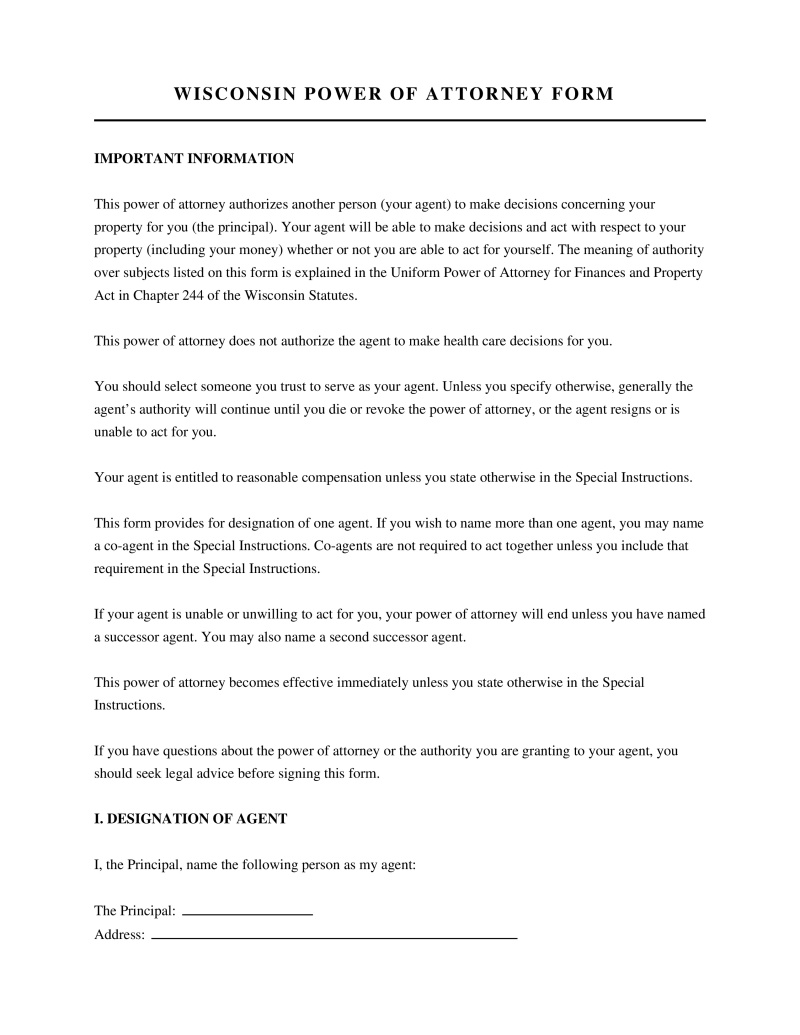
A Wisconsin Power of Attorney Form is a legal instrument whereby a principal designates an agent to manage financial or healthcare decisions within Wisconsin.
Authority Effective Timing
Many powers of attorney are effective immediately. A springing power of attorney becomes effective only after a stated event, commonly the Principal's incapacity, but some jurisdictions impose special requirements for proving that event.
Use this only if the authority should not begin immediately and should start on a calendar date.
Describe the triggering event clearly, such as written certification of incapacity by one or two licensed physicians.
For springing authority, third parties often need clear proof before accepting the Agent's authority.
Use precise language so banks, healthcare providers, or other institutions can verify when the authority has begun.
Table of Contents
What is a Wisconsin Power of Attorney Form?
A Wisconsin Power of Attorney Form is a legal instrument that authorizes an individual, known as the principal, to designate another person, referred to as the agent or attorney-in-fact, to manage specific legal, financial, or medical affairs on their behalf. This document serves as a critical component of estate planning by ensuring that a trusted representative can maintain the principal's affairs during periods of absence or incapacitation. The scope of authority granted within the document varies significantly based on the principal's preferences, ranging from a single specific transaction to broad management of all property and healthcare decisions.
Types of Wisconsin Power of Attorney Form
Wisconsin law recognizes several distinct categories of power of attorney documents, each designed to address specific needs and durations of authority:
- General Power of Attorney - Grants the agent broad authority to handle financial and legal matters for the principal, such as banking transactions and real estate management, but typically terminates if the principal becomes incapacitated.
- Durable Power of Attorney - Includes specific language stating that the agent's authority remains in effect or becomes effective if the principal becomes incapacitated or incompetent.
- Limited Power of Attorney - Restricts the agent's authority to specific actions or a defined time period, often used for one-time transactions like a real estate closing or vehicle sale.
- Power of Attorney for Health Care - Authorizes an agent to make medical decisions for the principal when physicians determine the principal is incapable of making those decisions personally.
- Power of Attorney for Minor Child - Allows parents to temporarily delegate their parental powers regarding the care and custody of their child to another adult for a period not exceeding one year.
Wisconsin Statutory Framework
The creation, validity, and enforcement of power of attorney documents in Wisconsin are governed by specific chapters of the state statutes:
- Uniform Power of Attorney for Finances and Property Act - Establishes the rules for creating financial powers of attorney, defining the duties of agents, and outlining statutory forms (Wis. Stat. ch. 244).
- Power of Attorney for Health Care - Governs the appointment of healthcare agents, the execution of healthcare directives, and the requirements for witnesses (Wis. Stat. ch. 155).
- Delegation of Power by Parent - Permits a parent to delegate powers regarding a child's care, custody, or property to another person for up to one year (Wis. Stat. § 48.979).
- Execution Requirements for Financial POA - Mandates that the principal's signature on a financial power of attorney must be acknowledged by a notary public (Wis. Stat. § 244.05).
- Execution Requirements for Healthcare POA - Requires the document to be signed in the presence of two witnesses who meet specific eligibility criteria (Wis. Stat. § 155.10).
Required Elements for Validity
To ensure a Wisconsin Power of Attorney is legally binding and accepted by third parties, specific formalities must be observed during execution:
- Principal Competency - The person creating the document must be of sound mind and at least 18 years old at the time of signing.
- Voluntary Execution - The principal must sign the document voluntarily without undue influence or coercion.
- Notarization for Finances - Financial powers of attorney require the principal's signature to be acknowledged before a notary public to be presumed genuine.
- Witnessing for Health Care - Healthcare documents require two witnesses who are not related to the principal by blood or marriage, are not the healthcare provider, and are not financially responsible for the principal's care.
- Agent Acceptance - While not always required on the form itself, the agent must agree to act and typically accepts the fiduciary responsibility implied by the role.
Agent Duties and Standards of Conduct
An agent appointed under a Wisconsin Power of Attorney assumes a fiduciary relationship with the principal. This relationship imposes strict legal and ethical obligations regarding how the agent manages the principal's affairs. The agent must act in good faith and solely in the interest of the principal, avoiding any conflicts of interest that could compromise their judgment. Wisconsin law requires agents to keep a complete record of all receipts, disbursements, and transactions made on behalf of the principal. Mismanagement of assets or failure to act in the principal's best interest can lead to civil liability and the revocation of authority.
Revocation of Authority
A principal retains the right to revoke a power of attorney at any time, provided they are mentally competent to do so. Revocation effectively terminates the agent's authority to act. The process typically involves creating a written revocation document and delivering it to the agent and any third parties, such as banks or hospitals, that may have the original power of attorney on file. In Wisconsin, the execution of a new power of attorney for finances does not automatically revoke a previous one unless the new document explicitly states that it revokes all prior powers of attorney. Divorce creates an automatic revocation of a spouse's authority as an agent in both financial and healthcare contexts unless the document expressly states otherwise.
How to Complete a Wisconsin Power of Attorney Form
Step 1: Select the Agent - Choose a trustworthy individual to act as the agent and, if possible, a successor agent to step in if the primary agent is unavailable.
Step 2: Define the Powers - Clearly indicate which specific powers are being granted, such as authority over real estate, banking, or healthcare decisions, by initialing the appropriate sections on the statutory form.
Step 3: Execute the Document - Sign the document in accordance with Wisconsin laws, utilizing a notary public for financial forms or two eligible witnesses for healthcare forms.
Step 4: Distribute Copies - Provide copies of the executed form to the agent, the principal's physician (for healthcare POAs), and financial institutions (for financial POAs).
Step 5: Store the Original - Keep the original document in a secure location where it can be easily accessed by the agent if necessary.
Frequently Asked Questions
Power of Attorney in other states
Not the form you're looking for?
Try our legal document generator to create a custom document
Disclaimer: The templates available on this website are provided for general informational purposes only and do not constitute legal advice. They are not intended to be, and should not be interpreted as, compliant with any specific legal, regulatory, or privacy requirements. These templates are not a replacement for professional legal guidance and should not be relied upon for any particular matter or circumstance. Users are strongly encouraged to seek advice from a qualified attorney licensed in their jurisdiction before using, modifying, or relying on any template.
All templates are provided on an "as is," "with all faults," and "as available" basis. The provider disclaims any and all warranties of any kind, whether express, implied, statutory, or otherwise, including without limitation warranties of merchantability, fitness for a particular purpose, title, or non-infringement.
LegalTemplates.com makes no guarantees or representations regarding the accuracy, completeness, expected outcomes, or reliability of the materials contained in these templates or any materials referenced or linked from them.