Policy and Procedure Template
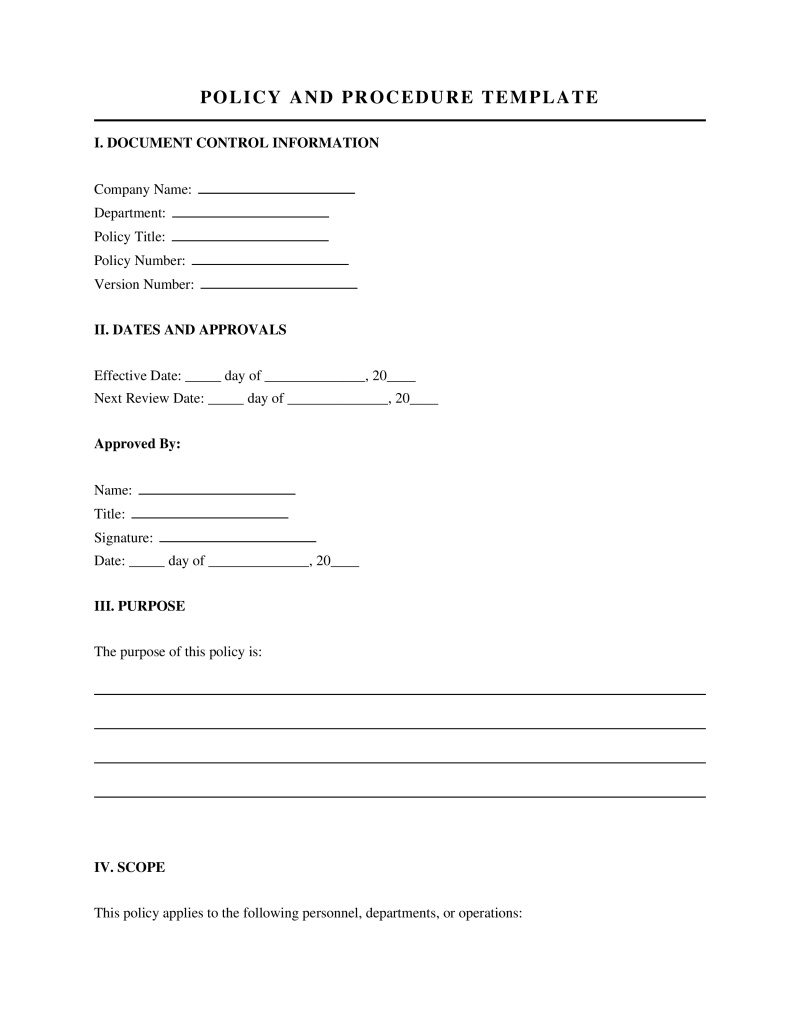
A Policy and Procedure Template is a formal organizational document that outlines internal rules, operational guidelines, and standard protocols for employees.
Policy Type
Select the main category that best describes this policy or procedure. This will help tailor the template to your needs.
Provide a brief description if your policy type is not listed.
Table of Contents
What is a Policy and Procedure Template?
A Policy and Procedure Template acts as a standardized document framework that organizations utilize to establish consistent rules and operational instructions. This tool enables management to outline regulatory requirements, company standards, and step-by-step processes in a uniform format across an entire entity. Human resources departments, compliance officers, and operations managers rely on these documents to ensure legal compliance, maintain workplace safety, and promote organizational efficiency by reducing ambiguity in daily operations.
Legal and Regulatory Framework
The content within policy and procedure templates often derives directly from federal and state regulations. Organizations must ensure their internal documents align with statutory requirements to avoid liability and penalties. Key federal laws influencing these templates include:
- Occupational Safety and Health Act - Mandates that employers provide a workplace free from recognized hazards and adhere to specific safety standards (29 U.S.C. § 651 et seq.).
- Fair Labor Standards Act - Establishes minimum wage, overtime pay, recordkeeping, and youth employment standards affecting wage and hour policies (29 U.S.C. § 201 et seq.).
- Health Insurance Portability and Accountability Act - Requires specific policies regarding the protection and handling of sensitive patient health information (Pub. L. 104-191).
- Sarbanes-Oxley Act - Impressed strict reforms to improve financial disclosures and prevent accounting fraud, requiring detailed financial reporting procedures (Pub. L. 107-204).
- Family and Medical Leave Act - Entitles eligible employees to take unpaid, job-protected leave for specified family and medical reasons (29 U.S.C. § 2601 et seq.).
Types of Policy and Procedure Templates
Organizations utilize various distinct templates depending on the specific department or operational area they address. These documents vary in scope and technical detail.
- Human Resources Policy Template - Covers employment-related guidelines such as code of conduct, attendance, anti-harassment, and benefits administration.
- Information Technology Security Template - Addresses data protection protocols, acceptable use of company assets, password management, and incident response strategies.
- Health and Safety Template - Outlines emergency evacuation routes, hazard reporting mechanisms, personal protective equipment requirements, and accident investigation steps.
- Financial and Accounting Template - Establishes controls for expense reimbursement, procurement, payroll processing, and cash handling to prevent fraud.
- Remote Work Policy Template - Defines eligibility for telecommuting, equipment provision, data security measures for off-site work, and communication expectations.
- Clinical Procedure Template - Used primarily in healthcare settings to detail specific medical protocols, patient care standards, and sanitation requirements.
Essential Components of a Valid Template
A functional policy and procedure document requires specific structural elements to ensure clarity and enforceability. Standardizing these components helps employees understand the document regardless of the subject matter.
- Header Information - Includes the policy title, identification number, effective date, revision date, and approving authority.
- Purpose Statement - Explains the reason the policy exists and the specific organizational goal it achieves.
- Scope of Application - Defines who the policy applies to, such as specific departments, all employees, or third-party contractors.
- Policy Statement - States the actual rule or standard that must be followed.
- Definitions Section - Clarifies technical terms or specific language used within the document to prevent misinterpretation.
- Procedure Section - Lists the step-by-step actions required to comply with the policy statement.
- References and Authority - Cites relevant laws, regulations, or related internal documents that support the policy.
Distinction Between Policy and Procedure
Understanding the difference between these two concepts is vital for effective documentation. Confusing the two often leads to disorganized and ineffective manuals.
- Policy Characteristics - A policy is a high-level statement of intent or a rule. It answers the questions "what" and "why." It sets the standard and is generally broad in nature, changing infrequently.
- Procedure Characteristics - A procedure is a detailed instruction on how to perform a task. It answers the questions "how," "when," and "who." Procedures are action-oriented, sequential, and may change frequently as technology or workflows evolve.
Process for Developing and Implementing Policies
Creating a new policy and procedure document involves a systematic approach to ensure it is legally sound and operationally feasible.
Step 1: Needs Assessment - Identify the regulatory requirement or operational gap that necessitates a new policy.
Step 2: Drafting - Write the initial content using the standardized template, ensuring clear and concise language.
Step 3: Stakeholder Review - Circulate the draft to legal counsel, department heads, and subject matter experts for feedback.
Step 4: Approval - Obtain formal sign-off from senior management or the board of directors.
Step 5: Distribution and Training - Publish the document in the central repository and conduct necessary training sessions for affected employees.
Step 6: Acknowledgement - Require employees to sign a statement confirming they have read and understood the new policy.
FAQs
Not the form you're looking for?
Try our legal document generator to create a custom document
Disclaimer: The templates available on this website are provided for general informational purposes only and do not constitute legal advice. They are not intended to be, and should not be interpreted as, compliant with any specific legal, regulatory, or privacy requirements. These templates are not a replacement for professional legal guidance and should not be relied upon for any particular matter or circumstance. Users are strongly encouraged to seek advice from a qualified attorney licensed in their jurisdiction before using, modifying, or relying on any template.
All templates are provided on an "as is," "with all faults," and "as available" basis. The provider disclaims any and all warranties of any kind, whether express, implied, statutory, or otherwise, including without limitation warranties of merchantability, fitness for a particular purpose, title, or non-infringement.
LegalTemplates.com makes no guarantees or representations regarding the accuracy, completeness, expected outcomes, or reliability of the materials contained in these templates or any materials referenced or linked from them.