Offer Letter Template
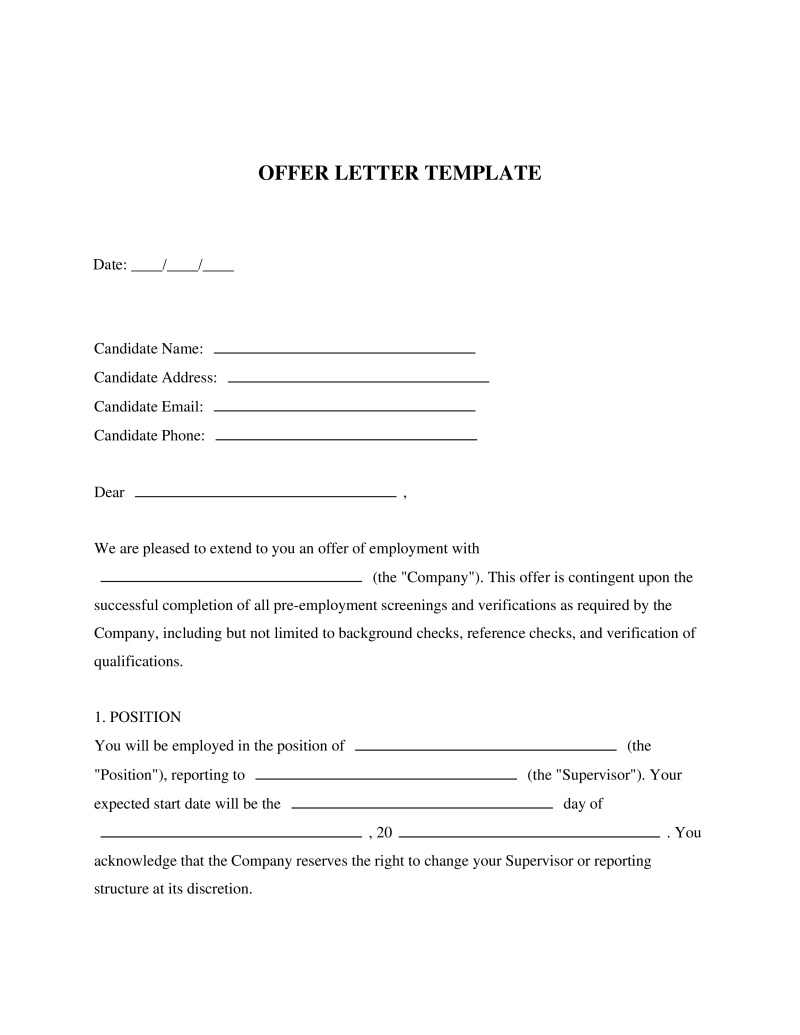
An offer letter template is a formal document outlining job details, salary, and terms provided by an employer to a selected candidate.
Employment Basis
Select the option that best describes the nature of the job being offered. The choices are Full-Time, Part-Time, Temporary/Fixed-Term, Internship, or Contractor. This information is important as it can affect benefits, job security, and legal responsibilities for both the employer and employee.
Table of Contents
What Is a Offer Letter Template?
An Offer Letter Template is a pre-structured document designed to formally extend a job offer to a prospective employee. It outlines the key terms and conditions of employment, such as the position, start date, compensation, and benefits. Teams use this template to standardize their hiring process, ensure consistency in communication, and clearly articulate the specifics of a job offer, reducing the risk of misunderstandings and streamlining the onboarding journey for new hires.
What Is Included
A comprehensive Offer Letter Template includes several critical sections that ensure clarity and formality in the job offer process. Understanding each component is vital for creating effective and informative offers.
- Company Information - This section establishes the sender, including the company's legal name, address, and often a brief statement of welcome, setting a professional tone for the entire document.
- Candidate Information - Clearly states the full legal name and address of the prospective employee, ensuring the offer is correctly addressed and legally binding to the intended recipient.
- Position Details - Specifies the exact job title being offered, the department, the immediate supervisor, and whether the role is full-time, part-time, or temporary. This clarifies the new hire's place within the organizational structure.
- Start Date - Crucial for planning, this outlines the agreed-upon first day of employment, allowing both the company and the candidate to make necessary preparations.
- Compensation Structure - Details the salary, hourly wage, or commission structure, including payment frequency (e.g., bi-weekly, monthly), and clarifies any eligibility for bonuses or incentives. This is often the most scrutinized section by candidates.
- Benefits Package Overview - Provides a summary of the benefits offered, such as health insurance, paid time off (PTO), retirement plans (e.g., 401k), and other perks. While often a high-level overview, it highlights the total compensation value.
- Contingencies and Conditions - States any conditions that must be met for employment to begin or continue, such as successful background checks, drug screenings, or verification of employment eligibility (e.g., I-9 form completion).
- Employment At-Will Statement (if applicable) - In jurisdictions where it applies, this clarifies that employment is at-will, meaning either the employee or the employer can terminate the employment relationship at any time, with or without cause, subject to applicable laws.
- Offer Expiration Date - Sets a deadline by which the candidate must accept or decline the offer, prompting a timely decision and allowing the hiring team to manage their recruitment pipeline effectively.
- Acknowledgment and Signature Block - Provides space for the candidate's signature, date of acceptance, and often a line for them to print their name, formally accepting the terms outlined in the offer letter.
Who Should Use This Template?
The Offer Letter Template is a versatile tool, but its utility shines brightest for specific organizational needs and hiring scenarios. Understanding its optimal use cases and where it might be less suitable helps teams make informed decisions.
Best For
- Small to Medium-Sized Businesses (SMBs) - Companies with limited HR resources benefit immensely from a standardized template, ensuring consistency and professionalism without needing a dedicated legal team for every offer.
- Startups and Growing Companies - As hiring scales, a template prevents ad-hoc offers, maintaining brand consistency and ensuring all essential information is conveyed clearly to new team members.
- HR Departments and Hiring Managers - These professionals can quickly generate formal offers, significantly reducing the administrative burden and accelerating the hiring timeline.
- Companies with Standardized Roles - Organizations frequently hiring for similar positions (e.g., sales representatives, customer service agents) can pre-fill much of the template, customizing only specific candidate details.
- Situations Requiring Clear, Non-Complex Offers - When the terms of employment are straightforward and do not involve highly intricate contractual clauses, a standard offer letter template is perfectly adequate.
Not Ideal For
- Highly Regulated Industries with Complex Employment Contracts - Sectors like finance, healthcare, or government often require intricate legal disclaimers, non-compete clauses, or specialized regulatory language that goes beyond a standard offer letter.
- Senior Executive Roles or Highly Specialized Positions - Offers for C-suite executives or roles with unique intellectual property agreements typically necessitate bespoke employment contracts drafted by legal counsel, not a template.
- Organizations with Fully Automated HRIS Systems - Larger enterprises with advanced Human Resources Information Systems (HRIS) often have integrated modules that automatically generate offer letters based on system inputs, making a standalone template redundant.
- International Hires with Varying Labor Laws - When hiring across different countries, a single template cannot account for the diverse and complex labor laws, tax implications, and benefit structures, requiring localized legal review.
- Situations Requiring Extensive Negotiation Documentation - While an offer letter can be a basis for negotiation, if the negotiation process is extensive and involves multiple rounds of complex changes to terms, a more dynamic or legally reviewed document might be necessary.
Quick Start Guide
Implementing an Offer Letter Template effectively involves more than just filling in blanks. Follow these steps to ensure your offers are professional, compliant, and compelling.
- Select the Right Template Version - Begin by choosing an offer letter template that aligns with the complexity of the role and your company's standard practices. Some roles might require a more detailed benefits breakdown, while others can be more concise. Ensure it includes all necessary sections for your jurisdiction and industry.
- Customize Key Candidate & Role Fields - Populate the template with the specific candidate's name, the exact job title, reporting manager, and the proposed start date. Double-check all spellings and details to avoid errors that could undermine professionalism.
- Detail Compensation and Benefits Accurately - Clearly state the salary (annual, hourly, or monthly), any bonus structures, and an overview of the benefits package. For benefits, refer to your company's official benefits guide but provide a concise summary in the letter itself. Be precise about vesting schedules for equity if applicable.
- Define and Include All Contingencies - Explicitly list any conditions of employment, such as successful background checks, drug screenings, or proof of eligibility to work. Ensure these contingencies are clearly worded and understood by the candidate.
- Add a Personalized Welcome Message - While a template provides structure, a brief, genuine paragraph welcoming the candidate to the team and expressing excitement about their potential contributions can significantly enhance the candidate experience and foster a sense of belonging.
- Set a Clear Offer Expiration Date - Include a reasonable deadline for the candidate to accept or decline the offer, typically 3-5 business days. This helps manage your hiring pipeline and prompts a timely decision from the candidate.
- Obtain Internal Approvals Before Sending - Before extending the offer, ensure all necessary internal stakeholders (e.g., hiring manager, HR, finance) have reviewed and approved the final terms. This prevents miscommunications and ensures the offer aligns with budget and company policy.
- Send Securely and Track Acceptance - Deliver the offer letter via a secure method, such as an encrypted email or an HR portal. Utilize e-signature platforms for easy and legally compliant acceptance tracking, and follow up promptly if the deadline approaches without a response.
Frequently Asked Questions
Not the form you're looking for?
Try our legal document generator to create a custom document
Disclaimer: The templates available on this website are provided for general informational purposes only and do not constitute legal advice. They are not intended to be, and should not be interpreted as, compliant with any specific legal, regulatory, or privacy requirements. These templates are not a replacement for professional legal guidance and should not be relied upon for any particular matter or circumstance. Users are strongly encouraged to seek advice from a qualified attorney licensed in their jurisdiction before using, modifying, or relying on any template.
All templates are provided on an "as is," "with all faults," and "as available" basis. The provider disclaims any and all warranties of any kind, whether express, implied, statutory, or otherwise, including without limitation warranties of merchantability, fitness for a particular purpose, title, or non-infringement.
LegalTemplates.com makes no guarantees or representations regarding the accuracy, completeness, expected outcomes, or reliability of the materials contained in these templates or any materials referenced or linked from them.