Job Description Template
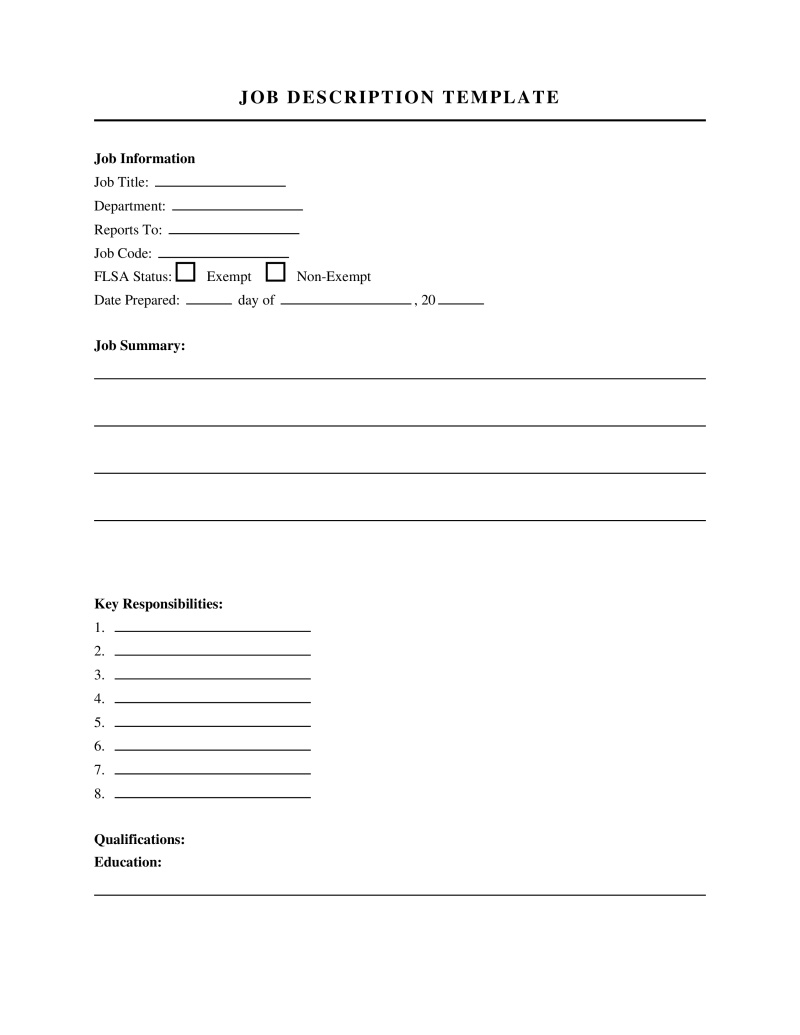
A job description template outlines essential job duties, responsibilities, and qualifications, aiding in recruitment and employee role clarity.
Job Category
Select the primary functional area for this position. This helps tailor responsibilities and requirements.
Provide a brief description if 'Other' was selected.
Table of Contents
What Is a Job Description Template?
A job description template is a standardized, pre-formatted document designed to streamline the process of creating detailed outlines for open positions within an organization. It provides a consistent framework for articulating the essential duties, responsibilities, qualifications, and reporting structure of a role. Teams leverage these templates to ensure clarity, efficiency, and uniformity across all hiring efforts, helping to attract the right candidates, set clear expectations, and maintain compliance with internal standards.
What Is Included
A well-structured job description template is built from several key sections, each serving a distinct purpose in informing potential candidates and internal stakeholders about the role. Understanding these components is crucial for creating effective job descriptions that resonate with your target audience and accurately reflect the position's demands.
- Job Title - This is the primary identifier for the role. It needs to be clear, concise, and reflective of the position's seniority and function to help candidates quickly understand the role and to optimize for search engine visibility.
- Department & Reporting Structure - Clearly states which department the role belongs to and who the position reports to. This provides organizational context and clarifies the internal hierarchy, helping candidates visualize their place within the company.
- Job Summary/Overview - A brief, compelling paragraph that encapsulates the main purpose of the role, its overall contribution to the company, and why it's an important position. This section acts as an elevator pitch for the job, engaging candidates immediately.
- Key Responsibilities & Duties - A bulleted or numbered list detailing the primary tasks and functions the employee will be expected to perform regularly. This section should be comprehensive yet specific, using action verbs to describe the core deliverables and day-to-day activities, which helps candidates assess if their skills align.
- Required Qualifications - Outlines the essential education, experience, specific technical skills, and certifications a candidate must possess to be considered for the role. This acts as a filter, ensuring only truly qualified applicants move forward.
- Preferred Qualifications - Details additional skills, experiences, or educational backgrounds that would be advantageous but are not strictly mandatory. This helps differentiate candidates and indicates potential for growth or specialized expertise.
- Skills & Competencies - Lists both hard skills (e.g., specific software proficiency, data analysis) and soft skills (e.g., communication, problem-solving, teamwork) necessary for success in the role. This section gives candidates a holistic view of the abilities needed beyond formal qualifications.
- Working Conditions & Physical Demands - Describes the typical work environment, any travel requirements, or specific physical demands (e.g., lifting, prolonged standing) associated with the job. This ensures transparency and helps candidates understand the practical realities of the role.
- Company Culture & Benefits (Optional but Recommended) - Provides a glimpse into the company's values, work environment, and the perks or benefits offered. While not strictly part of the job's core, this section significantly enhances the candidate experience and can be a powerful differentiator in attracting top talent.
Who Should Use This Template?
A job description template is a versatile tool, but its utility shines brightest for specific organizational needs and team structures. Understanding when and for whom it's most beneficial, as well as situations where a more tailored approach might be necessary, helps maximize its effectiveness.
Best For
- Growing Small to Medium-Sized Businesses (SMBs) - As SMBs scale, they frequently open new roles. A template ensures consistency in job postings, saving HR or hiring managers significant time in drafting descriptions from scratch while maintaining a professional image.
- Companies with High-Volume Recruitment - Organizations that frequently hire for similar roles (e.g., customer service, sales, entry-level positions) can greatly benefit from templates, allowing for rapid customization and deployment of new job descriptions.
- Human Resources Departments - HR teams use templates to standardize their hiring process, ensure compliance with internal policies, and create a consistent candidate experience across all departments.
- Department Heads & Hiring Managers - Provides a clear framework for managers to articulate their team's needs, ensuring all critical aspects of a role are covered without needing extensive writing experience.
- Organizations Prioritizing Consistency & Branding - Companies that want to maintain a uniform voice and structure in all public-facing recruitment materials will find templates invaluable for brand integrity.
Not Ideal For
- Highly Specialized or Niche Roles - For positions that are entirely unique, experimental, or require an exceptionally rare combination of skills, a standard template might be too restrictive. These roles often benefit from a custom-written description that can capture their specific nuances and innovative nature.
- Very Small Startups (Pre-Hiring Phase) - In the earliest stages, a startup might only hire a few key individuals whose roles are highly fluid and undefined. A template could prematurely formalize responsibilities that are still evolving.
- Organizations with Extremely Flat Structures - In environments where roles are highly collaborative and responsibilities overlap significantly, a rigid job description might not accurately reflect the dynamic nature of work.
Quick Start Guide
Implementing a job description template effectively involves more than just filling in blanks. Follow these tactical steps to ensure your job descriptions are comprehensive, engaging, and optimized for your hiring goals.
- Define the Core Role & Needs: Before touching the template, convene with the hiring manager and relevant stakeholders to clearly define the fundamental purpose of the new role, its impact, and the top 3-5 critical problems it will solve. This ensures the job description aligns with strategic business objectives.
- Gather Comprehensive Role Information: Collect all necessary details for each template section. This includes specific responsibilities, required and preferred qualifications, essential technical and soft skills, and any unique working conditions. Look at similar roles within your organization or industry for benchmarks, but always tailor to your specific opening.
- Customize the Template for Specificity: Populate the template's placeholders with the gathered information. Focus on using specific, measurable, achievable, relevant, and time-bound (SMART) language wherever possible, especially in the responsibilities section. Avoid generic phrases and instead describe actual tasks and outcomes.
- Optimize for Candidate Search & Experience: Integrate relevant keywords that potential candidates would use when searching for jobs (e.g., "Senior Software Engineer - Python," "Marketing Manager - SaaS"). Structure sentences for readability and clarity, using bullet points for lists. Consider the tone—is it engaging and reflective of your company culture?
- Review and Refine with Stakeholders: Share the drafted job description with the hiring manager, HR, and potentially a team member who holds a similar role. Solicit feedback on accuracy, completeness, and clarity. This collaborative review helps catch omissions and ensures alignment across the hiring team.
- Integrate with Your Applicant Tracking System (ATS): Ensure the final job description is easily transferable to your ATS. Pay attention to formatting requirements and keyword parsing to maximize searchability within your system and for external job boards. A clean, well-structured document will perform better.
- Publish and Monitor Performance: Post the job description on your chosen platforms. Continuously monitor application rates and candidate quality. If you're not attracting the right talent, be prepared to iterate and adjust the job description based on performance metrics and feedback.
Technical Requirements and Format Compatibility
The usability of a job description template is heavily influenced by its technical format and compatibility with various tools and platforms. Choosing the right format ensures ease of use, collaboration, and seamless integration into your recruitment workflow.
| Requirement | Why It Matters | Recommended Option |
|---|---|---|
| Editable Format | Allows for easy customization of each job description without starting from scratch. Essential for efficiency. | Microsoft Word (Docx), Google Docs, LibreOffice Writer |
| Collaborative Editing | Enables multiple stakeholders (HR, hiring managers) to review and edit the document simultaneously or asynchronously. | Google Docs, Microsoft 365 Word Online, Notion, Confluence |
| Version Control | Tracks changes and allows reversion to previous versions, preventing loss of information and ensuring accountability. | Google Docs (Version History), Microsoft 365 (SharePoint/OneDrive), dedicated document management systems |
| ATS Compatibility | Ensures the content can be easily parsed and displayed correctly by Applicant Tracking Systems and job boards. | Plain Text, Rich Text Format (RTF), well-structured HTML, or direct copy-paste from Docx/Google Docs (verifying formatting post-paste) |
| Export/Sharing Options | Ability to save or share the final job description in various formats (e.g., for external posting, internal archives). | PDF (for static sharing), Docx/Google Docs (for continued editing) |
| Accessibility | Ensures the document is readable and understandable by all users, including those using assistive technologies. | Standard document formats with clear headings, sufficient color contrast, and alt text for images (if any). |
Frequently Asked Questions
Job Description Template Sample
Not the form you're looking for?
Try our legal document generator to create a custom document
Disclaimer: The templates available on this website are provided for general informational purposes only and do not constitute legal advice. They are not intended to be, and should not be interpreted as, compliant with any specific legal, regulatory, or privacy requirements. These templates are not a replacement for professional legal guidance and should not be relied upon for any particular matter or circumstance. Users are strongly encouraged to seek advice from a qualified attorney licensed in their jurisdiction before using, modifying, or relying on any template.
All templates are provided on an "as is," "with all faults," and "as available" basis. The provider disclaims any and all warranties of any kind, whether express, implied, statutory, or otherwise, including without limitation warranties of merchantability, fitness for a particular purpose, title, or non-infringement.
LegalTemplates.com makes no guarantees or representations regarding the accuracy, completeness, expected outcomes, or reliability of the materials contained in these templates or any materials referenced or linked from them.