FMLA Request Form
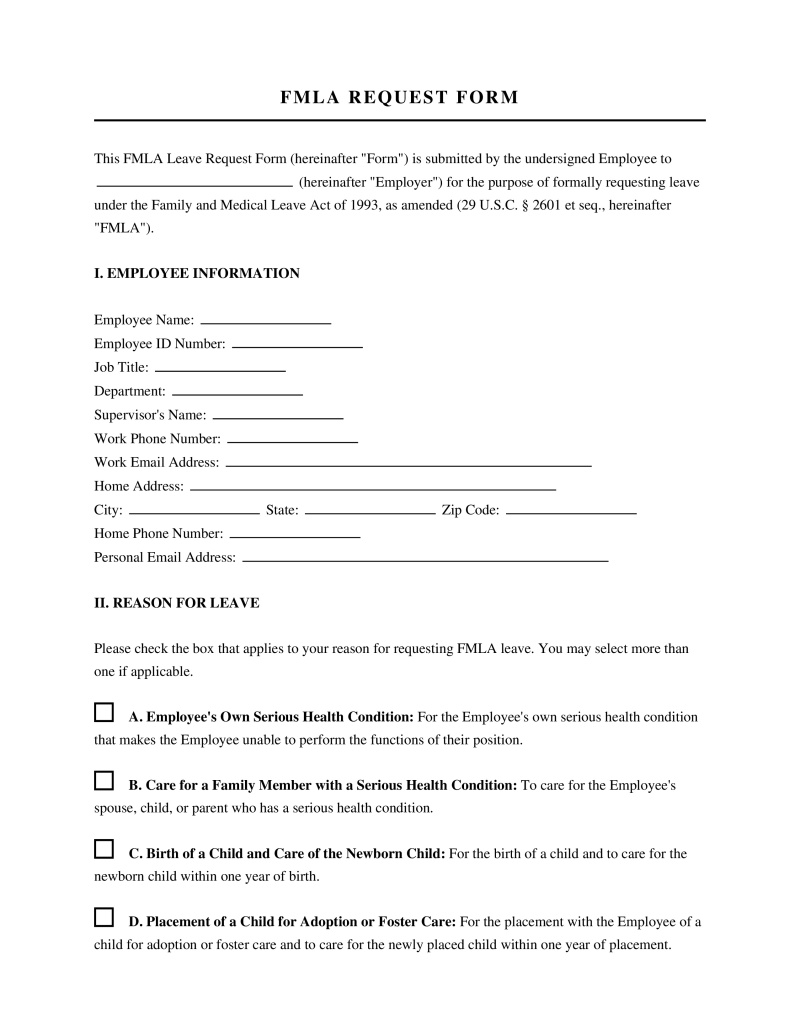
The FMLA Request Form is used by employees to formally request leave under the Family and Medical Leave Act for qualifying reasons.
Leave Reason Type
Select the main qualifying reason for your FMLA leave. This determines what documentation may be required.
Select your relationship to the family member for whom you are requesting leave.
Provide details if you selected 'Other'.
Select your relationship to the covered servicemember.
Table of Contents
What is a FMLA Request Form?
An FMLA Request Form is a standardized document used by employees to formally request leave under the Family and Medical Leave Act (FMLA). This form serves as the initial step in notifying an employer of an employee's need for FMLA-qualifying leave, whether for personal serious health conditions, family member care, or military family leave. It helps both the employee and employer document the request, ensuring compliance with federal regulations and facilitating the proper administration of job-protected leave. The form is crucial for establishing the employee's intent to take leave and for the employer to initiate the process of determining eligibility and designating the leave.
Legal Requirements
For an FMLA Request Form to be legally valid and for the underlying leave request to be enforceable, specific criteria must be met by both the employee and the employer. The FMLA establishes eligibility requirements for employees and outlines the responsibilities of employers once a request is received. Adherence to these requirements ensures that the leave is properly designated and that the employee's rights to job protection and health benefits are upheld.
- Employee Eligibility - An employee must have worked for the employer for at least 12 months, accumulated at least 1,250 hours of service during the 12-month period immediately preceding the leave, and work at a location where the employer has 50 or more employees within 75 miles.
- Qualifying Reasons for Leave - The request must be for a reason covered by FMLA, such as the birth or placement of a child for adoption or foster care, caring for a spouse, child, or parent with a serious health condition, a serious health condition that renders the employee unable to perform their job, or qualifying exigencies arising from a family member's military service.
- Timely Notice - Employees are generally required to provide 30 days' advance notice for foreseeable leave. If leave is not foreseeable, notice must be provided as soon as practicable, typically within one or two business days of learning of the need for leave.
- Medical Certification - For leave due to a serious health condition, employers may require medical certification from a healthcare provider. The employee must provide this certification within 15 calendar days of the employer's request, unless it is not practicable despite diligent good faith efforts.
- Employer Response - Employers are obligated to respond to an FMLA request within five business days, notifying the employee of their eligibility and rights and responsibilities under FMLA.
How to Complete a FMLA Request Form
Completing an FMLA Request Form accurately is essential for a smooth leave process. The form typically requires detailed information to help the employer assess eligibility and properly designate the leave. Employees should approach this task with care, ensuring all sections are thoroughly addressed.
- Obtain the Correct Form - Secure the official FMLA Request Form from your employer's human resources department or a relevant government agency. Employers often have their own specific forms, but the Department of Labor also provides optional forms (e.g., WH-380E for employee's serious health condition, WH-380F for family member's serious health condition) that can be adapted.
- Provide Personal and Employment Information - Fill in your full legal name, contact information, employee identification number, job title, and department. This information helps the employer quickly identify you and your employment records.
- State the Reason for Leave - Clearly indicate the specific FMLA-qualifying reason for your leave, such as your own serious health condition, caring for a family member, or military exigency. Be precise about the relationship if caring for a family member.
- Specify Leave Dates and Duration - Provide the requested start and end dates for your leave. If the leave is intermittent or for a reduced schedule, specify the estimated frequency and duration of absences. This helps the employer plan for your absence and determine the amount of FMLA leave you will use.
- Obtain Medical Certification (If Applicable) - If your leave is for a serious health condition, you will likely need to have a healthcare provider complete a medical certification form. Ensure this form is filled out accurately by the provider, detailing the nature of the condition, its probable duration, and any necessary treatments or restrictions.
- Review and Submit the Form - Before submission, carefully review all sections of the FMLA Request Form to ensure accuracy and completeness. Sign and date the form, then submit it to your employer's designated HR representative or manager, keeping a copy for your personal records.
Rights and Obligations of Parties Involved
The Family and Medical Leave Act defines specific rights for employees and corresponding obligations for employers, ensuring a balanced framework for managing job-protected leave. Understanding these roles is critical for both parties to comply with the law and avoid disputes.
- Employee Rights
- Job Protection - Employees have the right to return to their same or an equivalent position with equivalent pay, benefits, and other terms and conditions of employment after FMLA leave.
- Maintenance of Health Benefits - During FMLA leave, employers must maintain the employee's group health insurance coverage under the same conditions as if the employee had not taken leave.
- Protection Against Retaliation - Employees are protected from discrimination or retaliation for exercising their FMLA rights or for opposing unlawful FMLA practices.
- Intermittent or Reduced Schedule Leave - Employees may be entitled to take FMLA leave intermittently or on a reduced work schedule under certain circumstances, particularly for medical necessity.
- Employer Obligations
- Provide FMLA Notice - Employers must post general FMLA notices and provide specific written notices to employees regarding their eligibility, rights, and responsibilities under the FMLA.
- Determine Eligibility and Designate Leave - Within five business days of receiving an FMLA request, employers must inform the employee of their FMLA eligibility and, if eligible, designate the leave as FMLA-qualifying.
- Maintain Confidentiality - Employers must maintain the confidentiality of medical information provided in support of an FMLA request, in accordance with HIPAA and other applicable privacy laws.
- Not Interfere with FMLA Rights - Employers are prohibited from interfering with, restraining, or denying the exercise of, or the attempt to exercise, any FMLA right.
Required Elements of a Valid FMLA Request Form
A comprehensive FMLA Request Form ensures that all necessary information is collected for the employer to make an informed decision regarding the leave request. While specific forms may vary, certain elements are consistently required for validity.
- Employee's full legal name and contact information
- Employee's job title and department
- Employer's name and contact information
- Clear indication of the FMLA-qualifying reason for leave
- Requested start and end dates of leave, or estimated frequency/duration for intermittent leave
- Signature of the employee and date of request
- (If applicable) Medical certification from a healthcare provider, including:
- Diagnosis or nature of the serious health condition
- Date of onset and probable duration of the condition
- Statement of medical necessity for leave or reduced schedule
- Healthcare provider's signature and date
- (If applicable) Certification of qualifying exigency for military family leave
Applicable Federal Laws
The FMLA Request Form and the subsequent leave process are governed by several federal statutes designed to protect employee rights and ensure proper handling of sensitive medical and personal information. Compliance with these laws is mandatory for employers operating within their scope.
- Family and Medical Leave Act (FMLA) - This is the primary federal law that entitles eligible employees of covered employers to take unpaid, job-protected leave for specified family and medical reasons with continuation of group health insurance coverage under the same terms and conditions as if the employee had not taken leave (29 U.S.C. § 2601 et seq.).
- Health Insurance Portability and Accountability Act (HIPAA) - HIPAA establishes national standards to protect individuals' medical records and other personal health information. It governs how employers handle medical certifications and other health data provided in connection with an FMLA request, requiring strict confidentiality (45 CFR § 160, 164).
- Americans with Disabilities Act (ADA) - The ADA prohibits discrimination against individuals with disabilities and may require employers to provide reasonable accommodations, including leave, for employees with disabilities. When an employee's serious health condition under FMLA also constitutes a disability under the ADA, both laws may apply, and employers must comply with whichever law provides greater rights to the employee (42 U.S.C. § 12101 et seq.).
- Genetic Information Nondiscrimination Act (GINA) - GINA prohibits discrimination on the basis of genetic information in health insurance and employment. If an FMLA medical certification incidentally reveals genetic information, GINA's protections against discrimination and rules for handling such information become relevant (42 U.S.C. § 2000ff et seq.).
Penalties for non-compliance with the FMLA can be significant. Employers found to have violated the FMLA may be liable for damages equal to the amount of any wages, salary, or other compensation denied or lost to the employee by reason of the violation. Additionally, an employer may be liable for interest on that amount, as well as liquidated damages equal to the amount of actual damages and interest, unless the employer can prove that the act or omission was in good faith and that the employer had reasonable grounds for believing that the act or omission was not a violation. Employees may also seek equitable relief, such as employment, reinstatement, or promotion, and may recover reasonable attorney's fees, expert witness fees, and other costs of the action.
Frequently Asked Questions
FMLA Request Form Sample
Not the form you're looking for?
Try our legal document generator to create a custom document
Disclaimer: The templates available on this website are provided for general informational purposes only and do not constitute legal advice. They are not intended to be, and should not be interpreted as, compliant with any specific legal, regulatory, or privacy requirements. These templates are not a replacement for professional legal guidance and should not be relied upon for any particular matter or circumstance. Users are strongly encouraged to seek advice from a qualified attorney licensed in their jurisdiction before using, modifying, or relying on any template.
All templates are provided on an "as is," "with all faults," and "as available" basis. The provider disclaims any and all warranties of any kind, whether express, implied, statutory, or otherwise, including without limitation warranties of merchantability, fitness for a particular purpose, title, or non-infringement.
LegalTemplates.com makes no guarantees or representations regarding the accuracy, completeness, expected outcomes, or reliability of the materials contained in these templates or any materials referenced or linked from them.