Corporate Bylaws Template Create Corporate Bylaws Template

Corporate Bylaws Template

Updated Mar 29, 2026 3 Downloads

A corporate bylaws template outlines the rules governing a corporation's internal management, detailing roles, procedures, and member rights.

Corporation Name

Enter the exact legal name as it appears on your Articles of Incorporation.

Start typing to see address suggestions

This is the main business address for the corporation.

Select the last day of the corporation's fiscal year.

Corporate Bylaws Template Preview
View Document
Create
Download PDF

Table of Contents

What is a Corporate Bylaws Template?

A corporate bylaws template is a standardized legal document that outlines the internal operating rules and procedures for a corporation. This foundational document governs how the company will be managed, from the election of directors to the conduct of shareholder meetings. It serves as an essential guide for corporate governance, providing clarity on roles, responsibilities, and decision-making processes. Typically, incorporators or initial directors utilize such a template during the formation phase of a new corporation to establish a robust internal framework.

Legal Significance

Corporate bylaws hold significant legal weight as they establish the internal regulations that complement a corporation's articles of incorporation. While articles of incorporation typically outline fundamental structural elements filed with the state, bylaws delve into the granular details of day-to-day operations and governance. They are legally binding upon the corporation, its shareholders, directors, and officers, ensuring a consistent and predictable operational environment.

The primary purpose of bylaws is to provide a comprehensive framework for how the corporation functions. This includes defining the authority of various corporate bodies, establishing procedures for meetings and voting, and outlining the rights and obligations of key stakeholders. Without clear bylaws, a corporation risks internal disputes, operational inefficiencies, and potential legal challenges regarding the legitimacy of its actions or decisions.

Required Elements

For a corporate bylaws template to be comprehensive and legally sound, it must address several key areas that dictate the corporation's internal operations and governance structure:

  • Corporate Name and Office - The official legal name of the corporation and the location of its principal office.
  • Shareholder Meetings - Provisions for annual and special shareholder meetings, including notice requirements, quorum definitions, and voting procedures.
  • Board of Directors - Details regarding the number of directors, their qualifications, election process, terms of office, and procedures for board meetings.
  • Officers - Specification of corporate officer titles (e.g., President, Secretary, Treasurer), their duties, election, and removal processes.
  • Stock Certificates and Transfers - Rules governing the issuance, transfer, and record-keeping of corporate stock.
  • Indemnification - Clauses outlining the extent to which the corporation will protect its directors and officers from liability for actions taken on behalf of the company.
  • Amendments - Procedures for amending or repealing the bylaws, typically requiring a vote by shareholders or, in some cases, the board of directors.
  • Fiscal Year - The designated accounting period for the corporation's financial reporting.

How to Complete a Corporate Bylaws Template

Completing a corporate bylaws template involves a systematic process to ensure all necessary internal governance provisions are clearly articulated and compliant with relevant laws:

  1. Review State Requirements - Begin by thoroughly researching the specific corporate statutes of the state where the corporation is incorporated. State laws dictate certain mandatory provisions and permissible variations for corporate governance. Understanding these requirements ensures the bylaws align with the legal framework governing the corporation.
  2. Fill in Corporate Details - Accurately input the corporation's full legal name, its principal office address, and the official date of its formation. These foundational details link the bylaws directly to the specific legal entity they govern. This step establishes the identity of the corporation within the document.
  3. Define Shareholder Provisions - Establish clear rules for shareholder meetings, including how often they occur, the method and timing of notice, and the percentage of shares required to constitute a quorum for voting. Also, specify voting rights for different classes of shares, if applicable, and procedures for proxy voting.
  4. Establish Board of Directors Structure - Outline the precise number of directors, any qualifications they must meet, and the process for their election and removal. Detail their terms of office, how vacancies are filled, and the procedures for holding regular and special board meetings, including notice and quorum requirements.
  5. Delineate Officer Roles and Duties - Clearly define the titles of the corporation's officers, such as President, Secretary, and Treasurer, and comprehensively describe their specific responsibilities and authority. Establish the procedures for their election, appointment, and potential removal from their positions.
  6. Include Indemnification and Amendments - Incorporate clauses that specify the extent to which the corporation will indemnify its directors and officers against legal expenses or judgments incurred while performing their corporate duties. Additionally, detail the precise procedures that must be followed to amend or repeal the bylaws in the future, typically requiring a specific vote threshold.
  7. Adopt and Record - Once drafted, the initial bylaws must be formally adopted by the incorporators or the initial board of directors. Ensure that a signed copy of the adopted bylaws is kept securely with the corporation's official records, as they are a critical legal document that may need to be referenced frequently.

Rights and Obligations of Parties Involved

Corporate bylaws delineate the specific rights and obligations of the key constituents within a corporation, ensuring a structured and accountable governance system:

  • Shareholders - Possess rights such as voting on major corporate decisions (e.g., election of directors, significant corporate transactions, bylaw amendments) and the right to inspect corporate records. They also have the right to receive dividends if declared by the board. Shareholders are generally obligated to abide by the bylaws and any resolutions properly passed by the corporation.
  • Directors - Hold significant obligations, including fiduciary duties of care and loyalty, requiring them to act in good faith and in the best interests of the corporation and its shareholders. Their rights typically include participating in board meetings, voting on corporate policy, and receiving reasonable compensation for their service. Directors are obligated to oversee the corporation's management and strategic direction.
  • Officers - Are granted specific rights to exercise the authority delegated to their respective positions, such as managing day-to-day operations or executing contracts. Their primary obligations involve performing their duties diligently, honestly, and in accordance with the bylaws and directives from the board of directors. They must also uphold their fiduciary duties to the corporation.

Applicable Laws and Compliance

Corporate bylaws must operate within the framework of various federal and state laws, ensuring legal compliance and validity. Non-compliance can lead to significant legal and operational repercussions for the corporation and its stakeholders.

Federal Statutes

While most corporate governance is state-regulated, certain federal laws impact corporations, especially those that are publicly traded or operate in regulated industries:

  • Sarbanes-Oxley Act (SOX) - Mandates specific corporate governance and financial reporting standards for public companies, influencing internal controls and board responsibilities (15 U.S.C. § 7201 et seq.).
  • Securities Exchange Act of 1934 - Governs the secondary trading of securities, requiring disclosures and impacting how public companies communicate with shareholders (15 U.S.C. § 78a et seq.).
  • Federal Trade Commission Act - Prohibits unfair methods of competition and unfair or deceptive acts or practices in commerce, which can indirectly influence corporate operational guidelines (15 U.S.C. § 41 et seq.).

State Laws and Requirements

State law is the primary authority governing the formation and internal affairs of corporations. Each state has its own corporate statute:

  • Model Business Corporation Act (MBCA) - A non-binding model statute that has heavily influenced the corporate laws of many U.S. states, providing a template for corporate governance (eRevised Model Business Corporation Act).
  • Delaware General Corporation Law (DGCL) - Widely regarded as the most influential and frequently referenced state corporate statute, often chosen by corporations due to its flexibility and well-developed case law (Del. Code Ann. tit. 8).
  • [Specific State] Business Corporation Act - Every state maintains its own comprehensive statute governing the formation, operation, and dissolution of corporations within its jurisdiction (e.g., California Corporations Code, New York Business Corporation Law). These acts dictate fundamental aspects like director duties, shareholder rights, and meeting requirements.

Penalties for Non-Compliance

Failure to adhere to corporate bylaws or applicable state and federal laws can result in severe consequences:

  • Invalidation of Corporate Actions - Decisions made or actions taken without following bylaw procedures (e.g., improper notice for a meeting, lack of a quorum) can be challenged and potentially deemed invalid.
  • Internal Disputes and Litigation - Ambiguous or unenforced bylaws often lead to conflicts among shareholders, directors, and officers, potentially resulting in costly and time-consuming lawsuits.
  • Loss of Limited Liability Protection - In extreme cases, a court may "pierce the corporate veil," holding shareholders personally liable for corporate debts if the corporation fails to observe corporate formalities, including adhering to its bylaws.
  • Regulatory Fines and Sanctions - Corporations, particularly public ones, can face substantial fines, penalties, or other sanctions from regulatory bodies (e.g., SEC) for violations of securities laws or other industry-specific regulations stemming from inadequate governance.

Frequently Asked Questions

Articles of incorporation are filed with the state to officially create the corporation, outlining fundamental details like its name and purpose. Bylaws are internal documents that provide detailed rules for the corporation's operation and governance, complementing the broader framework established by the articles.
Yes, most state corporate laws require corporations to adopt bylaws. While not always filed with the state, they are essential for establishing the internal legal framework and ensuring proper corporate governance.
The power to amend bylaws typically rests with the shareholders, though the board of directors may also have limited authority to amend them, depending on state law and the specific provisions within the bylaws themselves. Any amendment usually requires a formal vote.
Corporate bylaws are a critical legal document and should be kept with the corporation's official records at its principal place of business. They are not typically filed with the state after initial adoption.
Yes, non-profit organizations also require bylaws to govern their internal operations, membership, board of directors, and decision-making processes. These bylaws ensure the organization adheres to its stated mission and maintains its tax-exempt status.
No, corporate bylaws cannot conflict with the corporate laws of the state in which the corporation is incorporated. If a bylaw provision contradicts state statute, the state law will prevail, rendering the conflicting bylaw provision unenforceable.
A corporation operating without bylaws faces significant risks, including internal disputes over authority and procedures, potential challenges to the validity of corporate actions, and difficulties in proving adherence to corporate formalities, which could jeopardize limited liability protection.
It is advisable to review corporate bylaws periodically, ideally every few years or whenever there are significant changes in corporate structure, operations, or relevant state laws. Regular review ensures they remain current, effective, and compliant with all legal requirements.

Corporate Bylaws Example

0% Complete 0/0 Fields

Corporate Bylaws

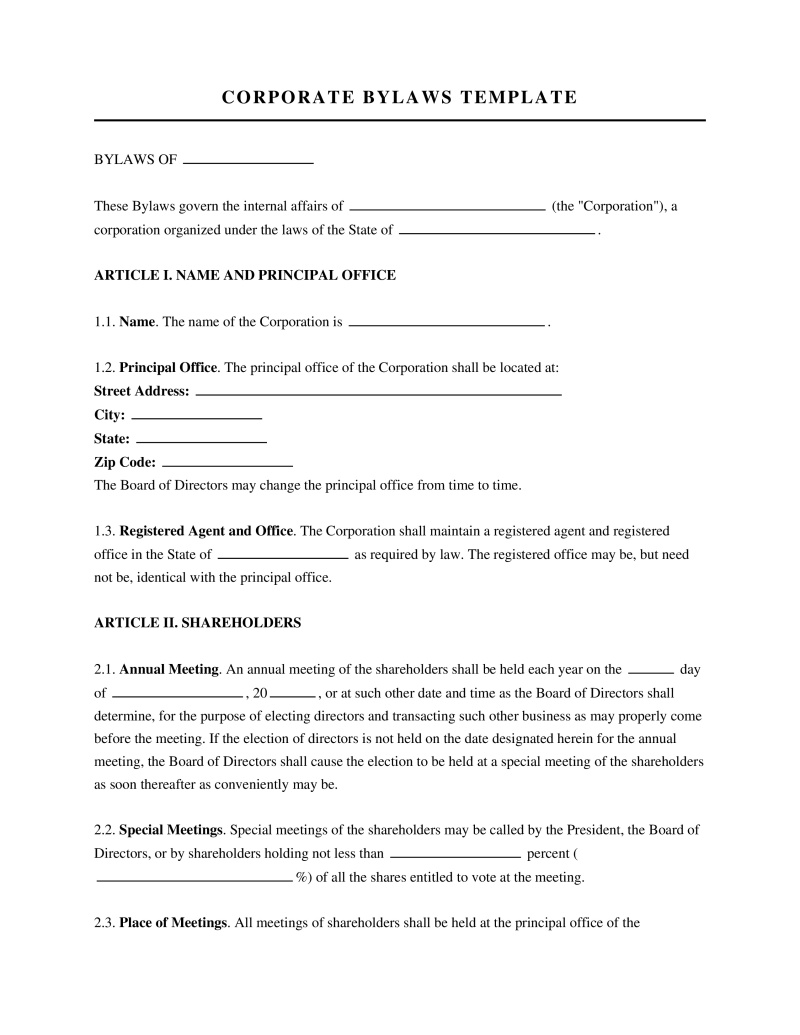
These Bylaws govern the internal affairs of (the "Corporation"), a corporation organized under the laws of the State of .

ARTICLE I. NAME AND PRINCIPAL OFFICE

1.1. Name. The name of the Corporation is _______________.

1.2. Principal Office. The principal office of the Corporation shall be located at:
Street Address:
City:
State:
Zip Code:

The Board of Directors may change the principal office from time to time.

1.3. Registered Agent and Office. The Corporation shall maintain a registered agent and registered office in the State of as required by law. The registered office may be, but need not be, identical with the principal office.

ARTICLE II. SHAREHOLDERS

2.1. Annual Meeting. An annual meeting of the shareholders shall be held each year on the day of , , or at such other date and time as the Board of Directors shall determine, for the purpose of electing directors and transacting such other business as may properly come before the meeting. If the election of directors is not held on the date designated herein for the annual meeting, the Board of Directors shall cause the election to be held at a special meeting of the shareholders as soon thereafter as conveniently may be.

2.2. Special Meetings. Special meetings of the shareholders may be called by the President, the Board of Directors, or by shareholders holding not less than percent (_______________%) of all the shares entitled to vote at the meeting.

2.3. Place of Meetings. All meetings of shareholders shall be held at the principal office of the Corporation or at such other place, within or without the State of , as may be designated in the notice of the meeting.

2.4. Notice of Meetings. Written notice stating the place, date, and hour of the meeting, and in the case of a special meeting, the purpose or purposes for which the meeting is called, shall be delivered not less than (_______________) nor more than (_______________) days before the date of the meeting, either personally, by mail, or by electronic transmission, to each shareholder of record entitled to vote at such meeting. If mailed, such notice shall be deemed to be delivered when deposited in the United States mail, addressed to the shareholder at the shareholder's address as it appears on the records of the Corporation, with postage thereon prepaid. If transmitted electronically, such notice shall be deemed to be delivered when sent to the shareholder's electronic mail address as it appears on the records of the Corporation.

2.5. Waiver of Notice. A shareholder may waive any notice required by these Bylaws or by law, either before or after the date and time stated in the notice. The waiver must be in writing, signed by the shareholder entitled to the notice, and delivered to the Corporation for inclusion in the corporate records. Attendance at a meeting by a shareholder shall constitute a waiver of notice of such meeting, except when the shareholder attends for the express purpose of objecting to the transaction of any business because the meeting is not lawfully called or convened.

2.6. Quorum. A majority of the shares entitled to vote, represented in person or by proxy, shall constitute a quorum at any meeting of shareholders. If a quorum is not present, a majority of the shares represented at the meeting may adjourn the meeting from time to time without further notice.

2.7. Voting. Each outstanding share entitled to vote shall be entitled to one vote on each matter submitted to a vote at a meeting of shareholders, unless otherwise provided by the Articles of Incorporation.

2.8. Proxies. At all meetings of shareholders, a shareholder may vote in person or by proxy executed in writing by the shareholder or by the shareholder's duly authorized attorney-in-fact. No proxy shall be valid after (_______________) months from the date of its execution, unless otherwise provided in the proxy.

2.9. Action Without Meeting. Any action required or permitted to be taken at a meeting of the shareholders may be taken without a meeting if a consent in writing, setting forth the action so taken, shall be signed by all of the shareholders entitled to vote with respect to the subject matter thereof. Such consent shall have the same force and effect as a unanimous vote of the shareholders.

2.10. Record Date. For the purpose of determining shareholders entitled to notice of or to vote at any meeting of shareholders or any adjournment thereof, or shareholders entitled to receive payment of any dividend, or in order to make a determination of shareholders for any other proper purpose, the Board of Directors may fix in advance a date as the record date for any such determination of shareholders. Such record date shall not be more than (_______________) days and not less than (_______________) days prior to the date on which the particular action requiring such determination of shareholders is to be taken.

ARTICLE III. BOARD OF DIRECTORS

3.1. General Powers. The business and affairs of the Corporation shall be managed by or under the direction of its Board of Directors.

3.2. Number, Election, and Term of Office. The number of directors of the Corporation shall be not less than (_______________) nor more than (_______________) as determined from time to time by resolution of the Board of Directors or by the shareholders. Directors shall be elected at the annual meeting of shareholders and shall hold office until the next annual meeting of shareholders and until their successors are elected and qualified, or until their earlier resignation or removal.

3.3. Qualifications. Directors need not be residents of the State of or shareholders of the Corporation.

3.4. Regular Meetings. Regular meetings of the Board of Directors may be held without notice at such time and place as shall from time to time be determined by resolution of the Board.

3.5. Special Meetings. Special meetings of the Board of Directors may be called by the President or any (_______________) directors. Notice of any special meeting shall be given at least (_______________) days prior thereto by written notice delivered personally, by mail, or by electronic transmission to each director at the director's address as shown on the records of the Corporation. If mailed, such notice shall be deemed to be delivered when deposited in the United States mail, addressed to the director with postage thereon prepaid. If transmitted electronically, such notice shall be deemed to be delivered when sent to the director's electronic mail address.

3.6. Quorum. A majority of the number of directors fixed by these Bylaws shall constitute a quorum for the transaction of business at any meeting of the Board of Directors.

3.7. Manner of Acting. The act of the majority of the directors present at a meeting at which a quorum is present shall be the act of the Board of Directors, unless the act of a greater number is required by law or by the Articles of Incorporation.

3.8. Action Without Meeting. Any action required or permitted to be taken at a meeting of the Board of Directors may be taken without a meeting if a consent in writing, setting forth the action so taken, shall be signed by all of the directors. Such consent shall have the same force and effect as a unanimous vote of the directors.

3.9. Vacancies. Any vacancy occurring in the Board of Directors, and any directorship to be filled by reason of an increase in the number of directors, shall be filled by the affirmative vote of a majority of the remaining directors, though less than a quorum of the Board of Directors. A director elected to fill a vacancy shall be elected for the unexpired term of the director's predecessor in office.

3.10. Removal of Directors. At a meeting of shareholders called expressly for that purpose, any director or the entire Board of Directors may be removed, with or without cause, by a vote of the holders of a majority of the shares then entitled to vote at an election of directors.

3.11. Compensation. Directors, as such, shall not receive any stated salaries for their services, but by resolution of the Board of Directors, a fixed sum and expenses of attendance, if any, may be allowed for attendance at each regular or special meeting of the Board; provided that nothing herein contained shall be construed to preclude any director from serving the Corporation in any other capacity and receiving compensation therefor.

ARTICLE IV. OFFICERS

4.1. Number and Titles. The officers of the Corporation shall consist of a President, a Secretary, and a Treasurer, and such other officers as the Board of Directors may from time to time elect. Any two or more offices may be held by the same person, except the offices of President and Secretary.

4.2. Election and Term of Office. The officers of the Corporation shall be elected annually by the Board of Directors at the first regular meeting of the Board of Directors held after each annual meeting of the shareholders. Each officer shall hold office until a successor shall have been duly elected and shall have qualified, or until the officer's earlier resignation or removal.

4.3. Removal. Any officer or agent elected or appointed by the Board of Directors may be removed by the Board of Directors whenever in its judgment the best interests of the Corporation would be served thereby, but such removal shall be without prejudice to the contract rights, if any, of the person so removed.

4.4. Vacancies. A vacancy in any office because of death, resignation, removal, disqualification, or otherwise, may be filled by the Board of Directors for the unexpired portion of the term.

4.5. President. The President shall be the principal executive officer of the Corporation and, subject to the control of the Board of Directors, shall in general supervise and control all of the business and affairs of the Corporation. The President shall preside at all meetings of the shareholders and of the Board of Directors. The President may sign, with the Secretary or any other proper officer of the Corporation thereunto authorized by the Board of Directors, certificates for shares of the Corporation, any deeds, mortgages, bonds, contracts, or other instruments which the Board of Directors has authorized to be executed, except in cases where the signing and execution thereof shall be expressly delegated by the Board of Directors or by these Bylaws to some other officer or agent of the Corporation, or shall be required by law to be otherwise signed or executed; and in general shall perform all duties incident to the office of President and such other duties as may be prescribed by the Board of Directors from time to time.

4.6. Secretary. The Secretary shall: (a) keep the minutes of the meetings of the shareholders and of the Board of Directors in one or more books provided for that purpose; (b) see that all notices are duly given in accordance with the provisions of these Bylaws or as required by law; (c) be custodian of the corporate records and of the seal of the Corporation and see that the seal of the Corporation is affixed to all documents the execution of which on behalf of the Corporation under its seal is duly authorized; (d) keep a register of the post office address of each shareholder; (e) sign with the President or a Vice President certificates for shares of the Corporation, the issue of which shall have been authorized by resolution of the Board of Directors; (f) have general charge of the stock transfer books of the Corporation; and (g) in general perform all duties incident to the office of Secretary and such other duties as from time to time may be assigned to the Secretary by the President or by the Board of Directors.

4.7. Treasurer. The Treasurer shall: (a) have charge and custody of and be responsible for all funds and securities of the Corporation; (b) receive and give receipts for moneys due and payable to the Corporation from any source whatsoever, and deposit all such moneys in the name of the Corporation in such banks, trust companies, or other depositories as shall be selected by the Board of Directors; and (c) in general perform all of the duties incident to the office of Treasurer and such other duties as from time to time may be assigned to the Treasurer by the President or by the Board of Directors.

4.8. Salaries. The salaries of the officers shall be fixed from time to time by the Board of Directors, and no officer shall be prevented from receiving such salary by reason of being also a director of the Corporation.

ARTICLE V. SHARES

5.1. Certificates for Shares. Shares of the Corporation may be represented by certificates or may be uncertificated. If represented by certificates, such certificates shall be in such form as the Board of Directors may prescribe, shall be signed by the President or a Vice President and by the Secretary or an Assistant Secretary, and shall be sealed with the seal of the Corporation or a facsimile thereof. Each certificate shall state upon its face: (a) that the Corporation is organized under the laws of the State of _______________; (b) the name of the person to whom issued; (c) the number and class of shares represented thereby; and (d) any restrictions on transfer or other special rights or limitations.

5.2. Transfer of Shares. Transfer of shares of the Corporation shall be made only on the stock transfer books of the Corporation by the holder of record thereof or by the holder's legal representative, who shall furnish proper evidence of authority to transfer, or by the holder's attorney thereunto authorized by power of attorney duly executed and filed with the Secretary of the Corporation, and on surrender for cancellation of the certificate for such shares. The person in whose name shares stand on the books of the Corporation shall be deemed by the Corporation to be the owner thereof for all purposes.

5.3. Lost, Stolen, or Destroyed Certificates. The Board of Directors may direct the issuance of a new certificate in place of any certificate theretofore issued by the Corporation alleged to have been lost, stolen, or destroyed, upon the making of an affidavit of that fact by the person claiming the certificate to be lost, stolen, or destroyed. When authorizing such issuance, the Board of Directors may require the claimant to give the Corporation a bond in such sum as it may direct, as indemnity against any claim that may be made against the Corporation on account of the alleged loss, theft, or destruction of any such certificate or the issuance of such new certificate.

ARTICLE VI. INDEMNIFICATION

6.1. Indemnification of Directors and Officers. The Corporation shall indemnify any person who was or is a party or is threatened to be made a party to any threatened, pending, or completed action, suit, or proceeding, whether civil, criminal, administrative, or investigative (other than an action by or in the right of the Corporation) by reason of the fact that the person is or was a director, officer, employee, or agent of the Corporation, or is or was serving at the request of the Corporation as a director, officer, employee, or agent of another corporation, partnership, joint venture, trust, or other enterprise, against expenses (including attorneys' fees), judgments, fines, and amounts paid in settlement actually and reasonably incurred by the person in connection with such action, suit, or proceeding, if the person acted in good faith and in a manner the person reasonably believed to be in or not opposed to the best interests of the Corporation, and, with respect to any criminal action or proceeding, had no reasonable cause to believe the person's conduct was unlawful. The termination of any action, suit, or proceeding by judgment, order, settlement, conviction, or upon a plea of nolo contendere or its equivalent, shall not, of itself, create a presumption that the person did not act in good faith and in a manner which the person reasonably believed to be in or not opposed to the best interests of the Corporation, and, with respect to any criminal action or proceeding, had reasonable cause to believe that the person's conduct was unlawful.

6.2. Indemnification in Derivative Actions. The Corporation shall indemnify any person who was or is a party or is threatened to be made a party to any threatened, pending, or completed action or suit by or in the right of the Corporation to procure a judgment in its favor by reason of the fact that the person is or was a director, officer, employee, or agent of the Corporation, or is or was serving at the request of the Corporation as a director, officer, employee, or agent of another corporation, partnership, joint venture, trust, or other enterprise against expenses (including attorneys' fees) actually and reasonably incurred by the person in connection with the defense or settlement of such action or suit if the person acted in good faith and in a manner the person reasonably believed to be in or not opposed to the best interests of the Corporation, except that no indemnification shall be made in respect of any claim, issue, or matter as to which such person shall have been adjudged to be liable for negligence or misconduct in the performance of the person's duty to the Corporation unless and only to the extent that the court in which such action or suit was brought shall determine upon application that, despite the adjudication of liability but in view of all circumstances of the case, such person is fairly and reasonably entitled to indemnity for such expenses as such court shall deem proper.

6.3. Expenses. To the extent that a director, officer, employee, or agent of the Corporation has been successful on the merits or otherwise in defense of any action, suit, or proceeding referred to in Sections 6.1 or 6.2, or in defense of any claim, issue, or matter therein, the person shall be indemnified against expenses (including attorneys' fees) actually and reasonably incurred by the person in connection therewith.

6.4. Insurance. The Corporation shall have the power to purchase and maintain insurance on behalf of any person who is or was a director, officer, employee, or agent of the Corporation, or who is or was serving at the request of the Corporation as a director, officer, employee, or agent of another corporation, partnership, joint venture, trust, or other enterprise against any liability asserted against the person and incurred by the person in any such capacity, or arising out of the person's status as such, whether or not the Corporation would have the power to indemnify the person against such liability under the provisions of this Article.

ARTICLE VII. AMENDMENTS

7.1. Amendments by Shareholders. These Bylaws may be altered, amended, or repealed and new Bylaws may be adopted by the affirmative vote of the holders of a majority of the shares entitled to vote at any annual or special meeting of shareholders, provided that notice of the proposed alteration, amendment, or repeal is included in the notice of such meeting.

7.2. Amendments by Directors. The Board of Directors shall have the power to alter, amend, or repeal these Bylaws and adopt new Bylaws, provided that any Bylaws adopted by the Board of Directors may be altered, amended, or repealed by the shareholders.

ARTICLE VIII. MISCELLANEOUS PROVISIONS

8.1. Fiscal Year. The fiscal year of the Corporation shall end on the day of , .

8.2. Corporate Seal. The Board of Directors may provide for a corporate seal which shall have inscribed thereon the name of the Corporation and the words "Corporate Seal, ."

8.3. Waiver of Notice. Whenever any notice is required to be given to any shareholder or director of the Corporation under the provisions of these Bylaws or under the provisions of the Articles of Incorporation or under the provisions of the law, a waiver thereof in writing, signed by the person or persons entitled to such notice, whether before or after the time stated therein, shall be deemed equivalent to the giving of such notice.

8.4. Severability. If any provision of these Bylaws or the application thereof to any person or circumstance is held invalid, such invalidity shall not affect other provisions or applications of these Bylaws which can be given effect without the invalid provision or application, and to this end the provisions of these Bylaws are declared to be severable.

8.5. Governing Law. These Bylaws shall be governed by and construed in accordance with the laws of the State of , without regard to its conflict of laws principles.

8.6. Entire Agreement. These Bylaws constitute the entire agreement regarding the internal governance of the Corporation and supersede all prior or contemporaneous understandings and agreements, whether written or oral, regarding such subject matter.

8.7. Notices. Any notice required or permitted to be given under these Bylaws shall be in writing and shall be deemed to have been duly given when delivered personally, sent by recognized overnight courier service, or mailed by certified or registered mail, return receipt requested, postage prepaid, to the party at the address specified in the Corporation's records.

8.8. Successors and Assigns. These Bylaws shall be binding upon and inure to the benefit of the Corporation and its successors and assigns.

8.9. Counterparts. These Bylaws may be executed in counterparts, each of which shall be deemed an original, but all of which together shall constitute one and the same instrument.

8.10. Headings. The headings of the Articles and Sections of these Bylaws are for convenience only and shall not affect their interpretation.

8.11. Construction. No provision of these Bylaws shall be construed against the drafter.

ADOPTION OF BYLAWS

These Bylaws were adopted by the Incorporator(s) / Initial Director(s) of the Corporation on the .

INCORPORATOR / INITIAL DIRECTOR
Signature: _________________________
Print Name:
Date:
Address:

SECRETARY'S CERTIFICATION

I, , the duly elected and acting Secretary of _______________, a corporation organized under the laws of the State of _______________, do hereby certify that the foregoing Bylaws, consisting of (_______________) pages, constitute the true and correct Bylaws of the Corporation, as adopted by the Incorporator(s) / Initial Director(s) on the , and that they are now in full force and effect.

IN WITNESS WHEREOF, I have hereunto set my hand and affixed the corporate seal, if any, this .

Signature: _________________________
Print Name: _______________
Title: Secretary
Date:

Not the form you're looking for?

Try our legal document generator to create a custom document

Ask about a Corporate Bylaws Template

Disclaimer: The templates available on this website are provided for general informational purposes only and do not constitute legal advice. They are not intended to be, and should not be interpreted as, compliant with any specific legal, regulatory, or privacy requirements. These templates are not a replacement for professional legal guidance and should not be relied upon for any particular matter or circumstance. Users are strongly encouraged to seek advice from a qualified attorney licensed in their jurisdiction before using, modifying, or relying on any template.

All templates are provided on an "as is," "with all faults," and "as available" basis. The provider disclaims any and all warranties of any kind, whether express, implied, statutory, or otherwise, including without limitation warranties of merchantability, fitness for a particular purpose, title, or non-infringement.

LegalTemplates.com makes no guarantees or representations regarding the accuracy, completeness, expected outcomes, or reliability of the materials contained in these templates or any materials referenced or linked from them.

We Value Your Privacy

We use cookies to enhance your browsing experience, analyze site traffic, and personalize content. We do not sell your personal data. By clicking "Accept All," you consent to our use of cookies. For more information, please read our Privacy Policy.