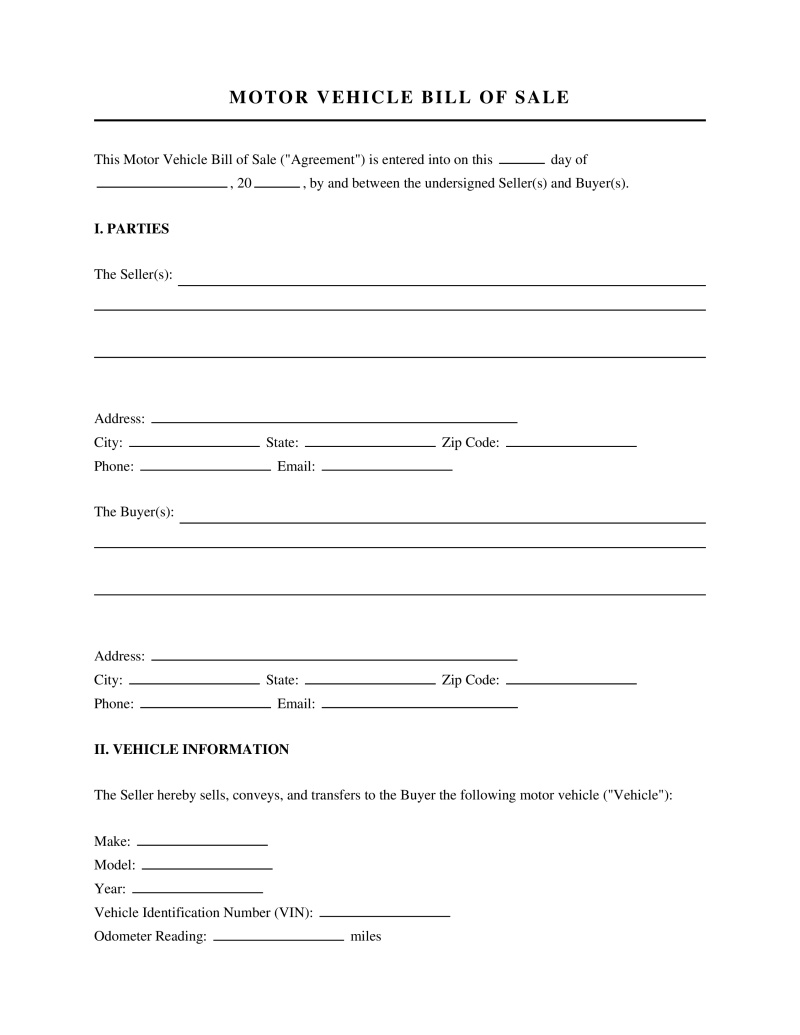
Motor Vehicle Bill of Sale
A Motor Vehicle Bill of Sale is a legal document recording the sale details of a vehicle, including buyer, seller, price, and vehicle specifics.
Vehicle Type
Select the category that best describes the vehicle.
Provide the specific type if 'Other' was selected.
Table of Contents
What is a Motor Vehicle Bill of Sale?
A Motor Vehicle Bill of Sale is a legal document that records the transfer of ownership of a motor vehicle from a seller to a buyer. It serves as a crucial piece of evidence for both parties, documenting the terms of the transaction, including the purchase price, date of sale, and details of the vehicle. This document is widely used in private party sales, providing protection and clarity by formally acknowledging the change in ownership. It is often a prerequisite for the buyer to register the vehicle and transfer its title with the state's Department of Motor Vehicles (DMV) or equivalent agency.
Required Elements of a Valid Motor Vehicle Bill of Sale
For a Motor Vehicle Bill of Sale to be legally binding and effective, it must contain several key pieces of information. These elements ensure clarity, prevent disputes, and satisfy state requirements for vehicle ownership transfer:
- Date of Sale - The specific calendar date on which the transaction occurred and ownership officially transferred.
- Buyer's Information - The full legal name and current residential address of the individual or entity purchasing the vehicle.
- Seller's Information - The full legal name and current residential address of the individual or entity selling the vehicle.
- Vehicle Identification Number (VIN) - The unique 17-character alphanumeric code that identifies the specific vehicle, typically found on the dashboard and door jamb.
- Vehicle Description - Comprehensive details including the make, model, year, body style, and color of the motor vehicle.
- Odometer Reading - The exact mileage displayed on the vehicle's odometer at the precise moment of the sale, crucial for federal disclosure requirements.
- Purchase Price - The agreed-upon monetary amount for which the vehicle is being sold, clearly stated in both numerical and written form.
- Payment Method - A description of how the payment was made (e.g., cash, cashier's check, personal check).
- Signatures of Parties - The legal signatures of both the buyer and the seller, affirming their agreement to the terms of the sale.
- Notarization (If Applicable) - The signature and seal of a notary public if required by state law for vehicle title transfers or bills of sale.
- Warranty Statement - A clear indication of whether the vehicle is sold "as-is" with no warranties, or if any express warranties are provided.
Rights and Obligations of Parties Involved
The Motor Vehicle Bill of Sale delineates the responsibilities and entitlements of both the buyer and the seller in a vehicle transaction. Understanding these rights and obligations helps ensure a smooth and legally compliant transfer of ownership.
The seller typically holds several obligations to the buyer. The seller must provide a clear title to the vehicle, free from any liens or encumbrances, unless otherwise explicitly agreed upon and disclosed. They are also obligated to accurately disclose known defects and provide a truthful odometer reading, complying with federal and state laws. In many jurisdictions, the seller is responsible for removing their license plates from the vehicle and canceling their registration after the sale. The seller has the right to receive the full agreed-upon purchase price for the vehicle.
The buyer, in turn, has a right to receive the vehicle as described in the bill of sale and to obtain a clear, transferable title. They are entitled to all necessary documentation required for vehicle registration and titling in their name. The buyer's primary obligation is to pay the agreed-upon purchase price according to the terms specified in the bill of sale. Following the purchase, the buyer is responsible for promptly registering the vehicle in their name with the appropriate state authorities and obtaining adequate insurance coverage before operating the vehicle on public roads.
How to Complete a Motor Vehicle Bill of Sale
Completing a Motor Vehicle Bill of Sale correctly is essential for both legal compliance and protection against future disputes. The process involves several critical steps to ensure all necessary information is accurately recorded.
- Gather Essential Information - Begin by collecting all pertinent details for both the buyer and the seller, including full legal names, current addresses, and contact information. Simultaneously, compile all vehicle specifics: the Vehicle Identification Number (VIN), make, model, year, body style, and color. Having this information readily available streamlines the completion process and minimizes errors.
- Specify Sale Terms and Conditions - Clearly document the agreed-upon purchase price for the vehicle, stating it numerically and in written form to avoid ambiguity. Detail the method of payment, such as cash, cashier's check, or bank transfer. Crucially, explicitly state whether the sale is "as-is" (meaning no warranties are provided by the seller) or if any express warranties are included.
- Document Accurate Odometer Reading - Record the exact mileage displayed on the vehicle's odometer at the precise moment of the sale. Federal law mandates an accurate odometer disclosure, and this reading is a critical component of the bill of sale. Ensure the reading is clearly legible and matches the vehicle's current mileage to comply with legal requirements and prevent fraud.
- Obtain Signatures and Dates - Both the buyer and the seller must sign and date the Motor Vehicle Bill of Sale. These signatures legally bind the parties to the terms outlined in the document and signify their agreement to the transaction. Each party should sign in the designated area, indicating their role in the sale.
- Notarization (If Required by State) - Check your specific state's requirements regarding notarization for vehicle bills of sale or title transfers. If notarization is mandatory, both parties must sign the document in the presence of a licensed notary public. The notary will then affix their signature and official seal, lending additional legal weight to the document.
- Distribute Copies to All Parties - After the bill of sale is fully completed, signed, and notarized (if applicable), ensure that both the buyer and the seller receive an original, signed copy for their records. The buyer will need their copy for vehicle registration and title transfer, while the seller should retain a copy as proof of sale to protect against future liability.
Legal Requirements and Validity
The legal validity and requirements for a Motor Vehicle Bill of Sale vary significantly by jurisdiction. While some states mandate a formal bill of sale for every vehicle transaction, others may accept a properly endorsed vehicle title as sufficient proof of ownership transfer. Regardless of state-specific mandates, a detailed bill of sale provides substantial legal protection for both the buyer and the seller, documenting the terms of the agreement and mitigating potential disputes.
The document serves as undeniable proof of the transaction date, purchase price, and the condition of the vehicle at the time of sale. This evidence can be critical in resolving disagreements over vehicle defects, payment issues, or liability for incidents occurring after the sale. Ensuring all information is accurate and truthfully represented is paramount, as misrepresentations can lead to legal challenges, including claims of fraud or breach of contract. Adherence to all state and federal regulations, particularly concerning odometer disclosures, is essential for the document's full legal enforceability.
Applicable Laws and Regulations
The sale of motor vehicles, including through a Motor Vehicle Bill of Sale, is governed by a complex framework of federal and state laws designed to protect consumers, prevent fraud, and ensure proper ownership transfer. Understanding these regulations is crucial for both buyers and sellers.
Federal Laws
Several federal statutes influence the requirements for a Motor Vehicle Bill of Sale, primarily focusing on consumer protection and fraud prevention:
- Truth in Mileage Act - Mandates that sellers provide an accurate odometer disclosure statement to the buyer at the time of sale, detailing the vehicle's mileage (49 U.S.C. § 32705). This act aims to prevent odometer tampering and fraud.
- Used Car Rule (Federal Trade Commission) - While primarily applicable to used car dealers, this rule (16 CFR Part 455) sets standards for disclosures, such as requiring a Buyer's Guide to be displayed. Although private sales are generally exempt, the principles of clear disclosure remain important.
State Laws and Requirements
State laws play a significant role in governing vehicle sales and the use of a Motor Vehicle Bill of Sale. These regulations often build upon federal guidelines and introduce state-specific requirements:
- Uniform Commercial Code (UCC) Article 2 - Sales - Adopted in various forms by all states, this section of the UCC (UCC § 2-101 et seq.) governs the sale of goods, including motor vehicles. It addresses contract formation, warranties (express and implied), and remedies for breach of contract, laying the foundation for many aspects of a vehicle sale.
- Vehicle Titling and Registration Laws - Every state has specific statutes outlining the process for transferring vehicle titles and registering vehicles. These laws often dictate whether a bill of sale is required for title transfer, what information it must contain, and the timeline for completing these actions (e.g., California Vehicle Code § 5900, New York Vehicle and Traffic Law § 2113).
- Sales Tax Laws - States typically impose sales tax on the purchase of motor vehicles. The bill of sale is a critical document for establishing the vehicle's purchase price, which serves as the basis for calculating the sales tax due. These taxes are often collected during the vehicle registration process (e.g., Texas Tax Code § 152.021).
- "As-Is" Disclosure Laws - Many states have specific requirements for how an "as-is" sale must be disclosed to be legally enforceable. This typically involves clear, conspicuous language on the bill of sale stating that the buyer accepts the vehicle with all its existing faults and without any warranties from the seller.
Penalties for Non-Compliance
Failure to adhere to federal and state laws regarding motor vehicle sales and the Motor Vehicle Bill of Sale can result in significant penalties for both buyers and sellers:
- Fraudulent Odometer Disclosure - Federal penalties for odometer fraud can include substantial fines, potentially up to $10,000 per violation, and imprisonment for up to three years (49 U.S.C. § 32709). State laws also impose civil and criminal penalties for such deception.
- Failure to Transfer Title or Register Vehicle - Buyers who fail to promptly transfer the title or register the vehicle may face late fees, fines, and the inability to legally operate the vehicle. Sellers who do not ensure proper title transfer can remain liable for parking tickets, tolls, or even accidents involving the vehicle.
- Tax Evasion - Intentionally understating the vehicle's purchase price on a bill of sale to avoid sales tax can lead to penalties for tax evasion, including significant fines and interest on unpaid taxes.
- Misrepresentation or Fraud - Providing false information on a bill of sale or misrepresenting the vehicle's condition can result in civil lawsuits for fraud or breach of contract, potentially requiring the offending party to pay damages or even reverse the sale.
Frequently Asked Questions
Motor Vehicle Bill of Sale Sample
Not the form you're looking for?
Try our legal document generator to create a custom document
Disclaimer: The templates available on this website are provided for general informational purposes only and do not constitute legal advice. They are not intended to be, and should not be interpreted as, compliant with any specific legal, regulatory, or privacy requirements. These templates are not a replacement for professional legal guidance and should not be relied upon for any particular matter or circumstance. Users are strongly encouraged to seek advice from a qualified attorney licensed in their jurisdiction before using, modifying, or relying on any template.
All templates are provided on an "as is," "with all faults," and "as available" basis. The provider disclaims any and all warranties of any kind, whether express, implied, statutory, or otherwise, including without limitation warranties of merchantability, fitness for a particular purpose, title, or non-infringement.
LegalTemplates.com makes no guarantees or representations regarding the accuracy, completeness, expected outcomes, or reliability of the materials contained in these templates or any materials referenced or linked from them.