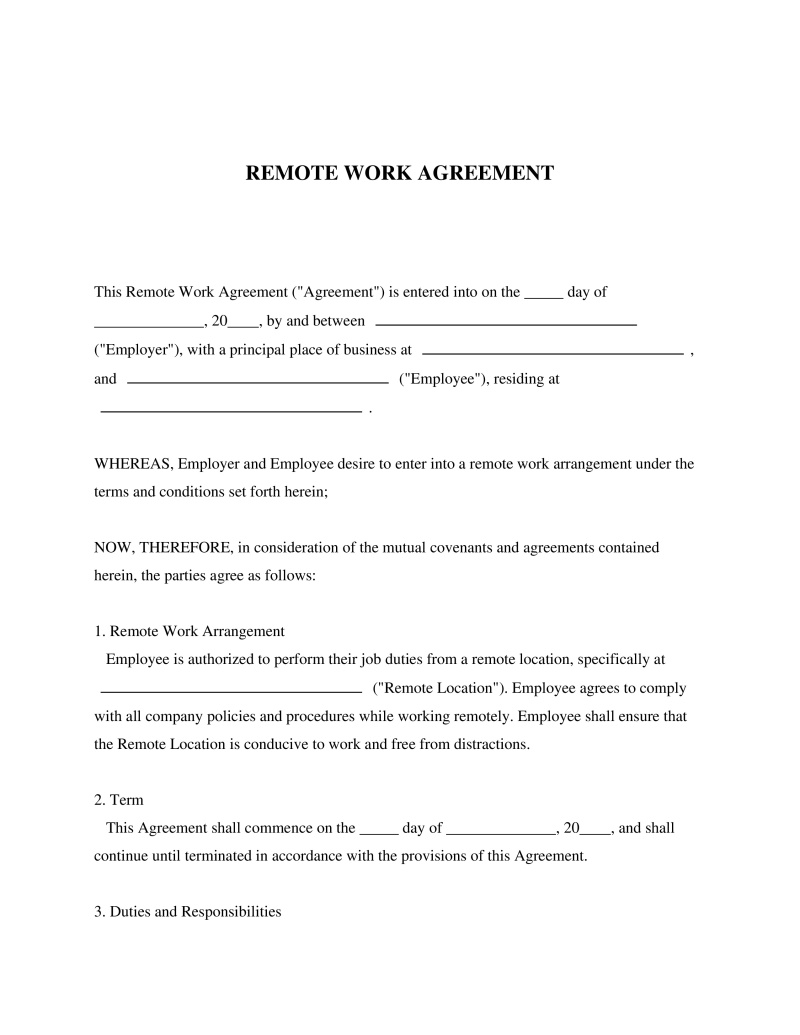
Remote Work Agreement
A Remote Work Agreement is a document designed for employers and employees to formalize remote work arrangements. This document outlines key terms and conditions regarding the remote work setup, including work hours, communication protocols, confidentiality agreements, and performance expectations.
Agreement Type
Select whether this agreement is for a new remote work arrangement or a renewal of an existing one.
Table of Contents
What is a Remote Work Agreement?
A Remote Work Agreement is a legally binding document that outlines the terms and conditions under which an employee can perform their duties from a location outside of the company's primary office environment. This document serves a crucial role in today’s increasingly digital and flexible workplace by setting clear expectations regarding work hours, communication methods, data security, and other employment conditions specific to remote work. Employers and employees alike benefit from such agreements, as they ensure both parties have a mutual understanding of each other's responsibilities and expectations. This type of agreement is particularly useful for organizations that embrace telecommuting, offering a structured framework to manage remote work effectively while minimizing potential misunderstandings or conflicts.
Key Features
Important Provisions
- Definition of Remote Work: Establishes what constitutes remote work within the context of this agreement.
- Work Hours and Availability: Specifies expected working hours, including breaks, and how availability should be communicated between parties.
- Confidentiality and Data Security: Outlines measures required to protect sensitive information outside of the corporate office environment.
- Equipment Provision and Maintenance: Details who is responsible for providing, maintaining, and replacing necessary equipment for remote work.
Pros and Cons
Pros
- +Facilitates flexibility and autonomy for employees, potentially increasing job satisfaction and productivity.
- +Reduces overhead costs for employers by minimizing the need for physical office space.
- +Enhances the ability of a company to attract talent by offering remote work options.
- +Improves work-life balance for employees, leading to higher retention rates.
- +Provides a clear legal framework that protects both the employer's and employee's interests.
Cons
- -May require additional effort to maintain team cohesion and company culture remotely.
- -Could lead to potential misunderstandings if expectations around availability and performance are not clearly communicated.
- -Requires trust in employees to manage their time effectively without direct supervision.
Common Uses
- For employees who live in a different geographic location than the company's main office.
- When accommodating employees with disabilities who may require a home-based work environment.
- To retain key employees who need flexible working arrangements due to personal circumstances.
- During unexpected events such as natural disasters or pandemics that prevent commuting or office access.
- As part of a company’s sustainability efforts to reduce commuting and its environmental impact.
- In industries where freelance or contract work is common, providing structure similar to traditional employment.
Frequently Asked Questions
Not the form you're looking for?
Try our legal document generator to create a custom document
Disclaimer: The templates available on this website are provided for general informational purposes only and do not constitute legal advice. They are not intended to be, and should not be interpreted as, compliant with any specific legal, regulatory, or privacy requirements. These templates are not a replacement for professional legal guidance and should not be relied upon for any particular matter or circumstance. Users are strongly encouraged to seek advice from a qualified attorney licensed in their jurisdiction before using, modifying, or relying on any template.
All templates are provided on an "as is," "with all faults," and "as available" basis. The provider disclaims any and all warranties of any kind, whether express, implied, statutory, or otherwise, including without limitation warranties of merchantability, fitness for a particular purpose, title, or non-infringement.
LegalTemplates.com makes no guarantees or representations regarding the accuracy, completeness, expected outcomes, or reliability of the materials contained in these templates or any materials referenced or linked from them.