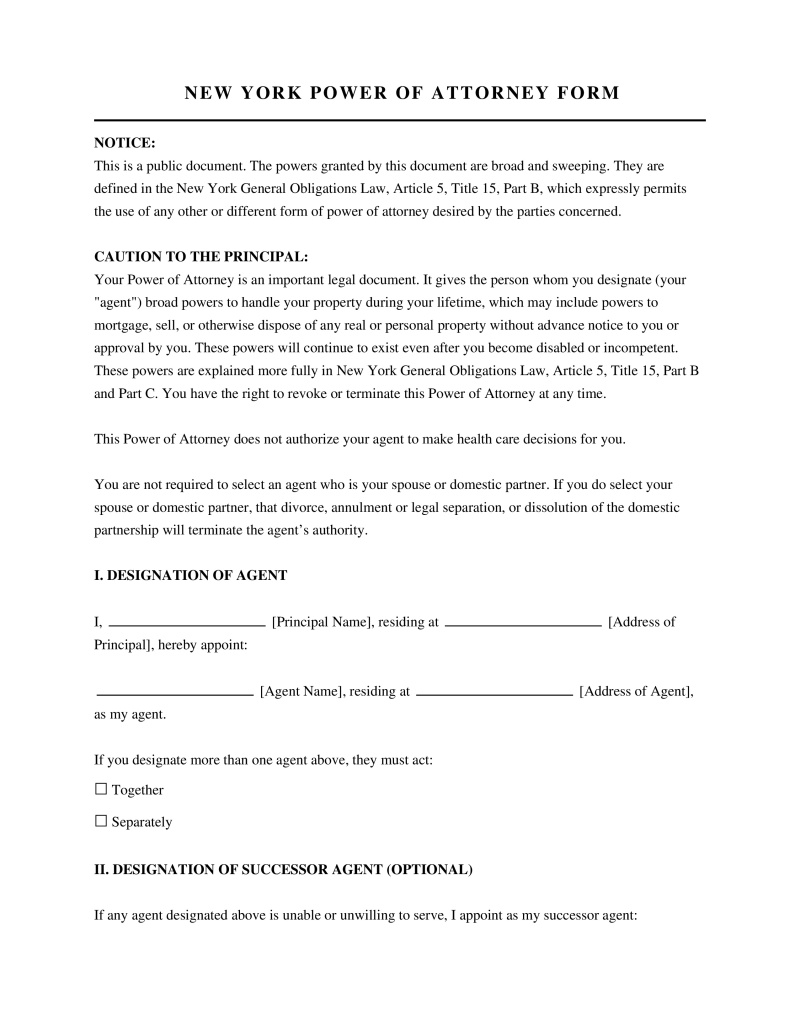
New York Power of Attorney Form
A New York Power of Attorney Form is a legal instrument allowing a principal to designate an agent to manage financial and legal affairs within the state.
Authority Effective Timing
Many powers of attorney are effective immediately. A springing power of attorney becomes effective only after a stated event, commonly the Principal's incapacity, but some jurisdictions impose special requirements for proving that event.
Use this only if the authority should not begin immediately and should start on a calendar date.
Describe the triggering event clearly, such as written certification of incapacity by one or two licensed physicians.
For springing authority, third parties often need clear proof before accepting the Agent's authority.
Use precise language so banks, healthcare providers, or other institutions can verify when the authority has begun.
Table of Contents
What is a New York Power of Attorney Form?
A New York Power of Attorney Form acts as a legal instrument granting a designated individual the authority to manage financial and legal affairs on behalf of another person. The individual bestowing this authority is known as the principal, while the appointed representative is referred to as the agent or attorney-in-fact. This document allows the agent to perform specific acts such as banking transactions, real estate management, and tax filing, often remaining valid even if the principal becomes incapacitated.
Types of New York Power of Attorney Form
- Durable Power of Attorney - Remains effective even if the principal becomes mentally or physically incapacitated and unable to make decisions.
- Non-Durable Power of Attorney - Grants authority to the agent only while the principal remains competent and typically terminates upon the principal's incapacitation.
- Springing Power of Attorney - Becomes active only upon the occurrence of a specific future event or condition, typically the certified incapacity of the principal.
- Limited Power of Attorney - Restricts the agent's authority to specific transactions or a defined period, such as handling a real estate closing or managing a single bank account.
New York State Laws and Regulations
New York maintains strict statutory requirements regarding the creation and acceptance of power of attorney documents under the General Obligations Law:
- Statutory Short Form Requirements - Establishes the standard text and formatting required for a valid power of attorney document in the state (NY Gen. Oblig. Law § 5-1513).
- witnessing and Acknowledgment - Mandates that the principal's signature must be acknowledged by a notary public and witnessed by two disinterested adults (NY Gen. Oblig. Law § 5-1501B).
- Modifications to Statutory Gifts Rider - Eliminates the separate Statutory Gifts Rider and allows the principal to authorize gifts within the Modifications section of the standard form (2020 N.Y. Laws ch. 323).
- Acceptance by Third Parties - Prohibits financial institutions and other third parties from unreasonably refusing to honor a properly executed statutory short form (NY Gen. Oblig. Law § 5-1504).
- Fiduciary Duties of Agent - Defines the legal standard of care required of an agent, including the duty to act in the principal's best interest and keep separate records (NY Gen. Oblig. Law § 5-1505).
Execution Requirements for Validity
To ensure a New York Power of Attorney Form is legally binding, specific execution formalities must be observed without deviation:
- Capacity of Principal - The individual creating the document must possess the mental capacity to understand the nature and consequences of the appointment at the time of signing.
- Notarization - The principal must sign the document in the presence of a notary public who acknowledges the signature.
- Two Witnesses - Two adult witnesses must observe the principal signing the document; the notary public may serve as one of these witnesses.
- Agent's Signature - The appointed agent must sign the document and have their signature notarized before they can legally act under the authority granted.
- Exact Wording - The document must contain the exact "Caution to the Principal" and "Important Information for the Agent" language prescribed by state statute.
How to Complete a New York Power of Attorney Form
Step 1: Designation of Agent - Identify the primary agent and any successor agents who will act if the primary appointee is unable or unwilling to serve.
Step 2: Granting of Authority - Initial the specific brackets next to the powers granted, such as "Real estate transactions" or "Banking transactions," or initial letter (P) to grant all listed powers.
Step 3: Modifications - Use the modifications section to add specific instructions, limit powers, or authorize the agent to make gifts in excess of the statutory annual default.
Step 4: Execution by Principal - Sign and date the document in the physical presence of a notary public and two witnesses.
Step 5: Acceptance by Agent - Ensure the agent signs the "Agent's Signature and Acknowledgment of Appointment" section before a notary public.
Distinction from Health Care Proxy
New York law separates financial authority from medical decision-making authority. A standard New York Power of Attorney Form does not grant the agent the right to make health care decisions.
- Financial Management - The Power of Attorney covers assets, contracts, litigation, and business interests.
- Medical Decisions - A separate document known as a Health Care Proxy is required to appoint an agent for medical treatment and end-of-life decisions (NY Pub. Health Law § 2981).
- Scope of Authority - Agents under a Power of Attorney cannot access medical records unless a HIPAA release is specifically included or a separate medical directive is executed.
FAQs
Already have a Power of Attorney?
Get it reviewed free — checked against your state's laws in about a minute.
Not the form you're looking for?
Try our legal document generator to create a custom document
Disclaimer: The templates available on this website are provided for general informational purposes only and do not constitute legal advice. They are not intended to be, and should not be interpreted as, compliant with any specific legal, regulatory, or privacy requirements. These templates are not a replacement for professional legal guidance and should not be relied upon for any particular matter or circumstance. Users are strongly encouraged to seek advice from a qualified attorney licensed in their jurisdiction before using, modifying, or relying on any template.
All templates are provided on an "as is," "with all faults," and "as available" basis. The provider disclaims any and all warranties of any kind, whether express, implied, statutory, or otherwise, including without limitation warranties of merchantability, fitness for a particular purpose, title, or non-infringement.
LegalTemplates.com makes no guarantees or representations regarding the accuracy, completeness, expected outcomes, or reliability of the materials contained in these templates or any materials referenced or linked from them.