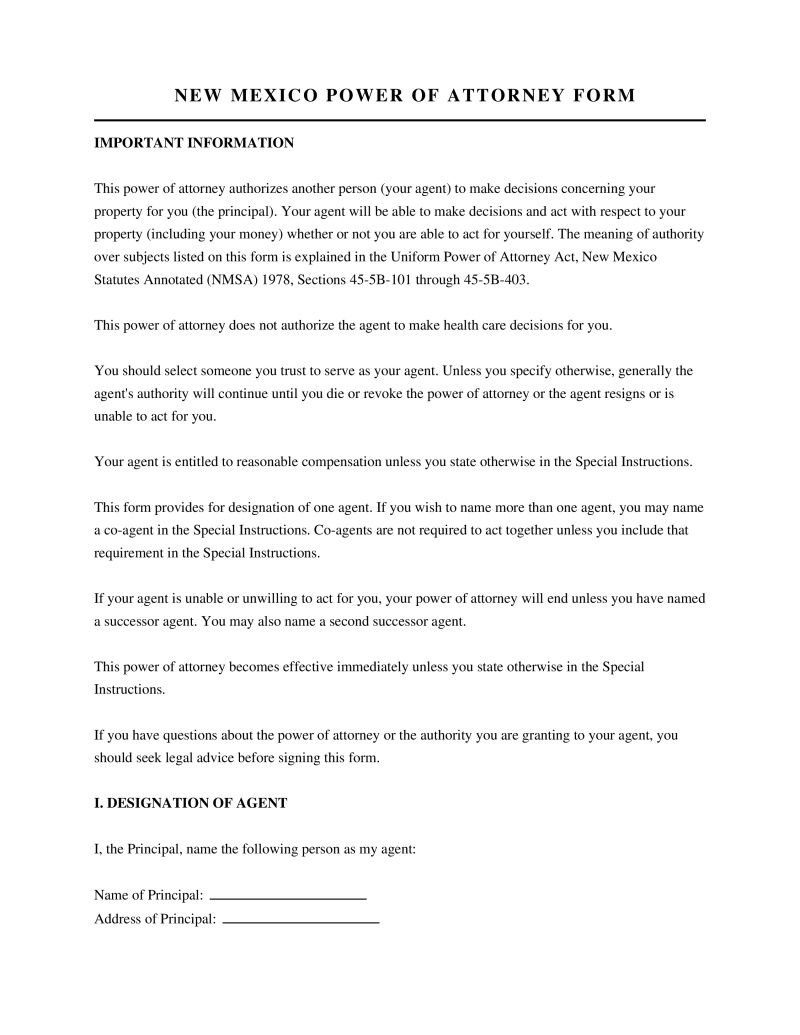
New Mexico Power of Attorney Form
A New Mexico Power of Attorney is a legal instrument granting an agent authority to manage financial or healthcare decisions on behalf of a principal.
Authority Effective Timing
Many powers of attorney are effective immediately. A springing power of attorney becomes effective only after a stated event, commonly the Principal's incapacity, but some jurisdictions impose special requirements for proving that event.
Use this only if the authority should not begin immediately and should start on a calendar date.
Describe the triggering event clearly, such as written certification of incapacity by one or two licensed physicians.
For springing authority, third parties often need clear proof before accepting the Agent's authority.
Use precise language so banks, healthcare providers, or other institutions can verify when the authority has begun.
Table of Contents
What is a New Mexico Power of Attorney Form?
A New Mexico Power of Attorney Form is a legal instrument that allows an individual, referred to as the principal, to delegate legal authority to another person, known as the agent or attorney-in-fact. This document enables the appointed agent to manage specific affairs on behalf of the principal, ranging from financial transactions and property management to healthcare decisions. Residents of New Mexico utilize this tool to ensure their personal and business matters continue without interruption during periods of absence, illness, or incapacitation. The document operates under the strict guidelines of state statutes to ensure the protection of the principal's interests and the validity of the agent's actions.
Types of New Mexico Power of Attorney Forms
New Mexico law recognizes various forms of delegated authority, each designed to address specific needs and durations of validity:
- General Power of Attorney - Grants the agent broad authority to handle financial and business affairs but typically terminates if the principal becomes incapacitated or mentally incompetent.
- Durable Power of Attorney - Contains specific language stating that the agent's authority continues or takes effect upon the incapacity of the principal, ensuring management continuity.
- Limited Power of Attorney - Restricts the agent's authority to specific transactions, such as selling a particular piece of real estate or handling a single business deal, often for a set timeframe.
- Medical Power of Attorney - Designates an agent to make healthcare decisions for the principal if they are unable to communicate their own wishes, often created under the Uniform Health-Care Decisions Act.
- Parental Power of Attorney - Allows a parent or guardian to temporarily delegate caregiving authority regarding a minor child's education and medical care to another adult for a period usually not exceeding six months.
- Tax Power of Attorney - Authorizes a representative, such as a CPA or tax attorney, to handle tax filings and communicate with the New Mexico Taxation and Revenue Department on behalf of the taxpayer.
Legal Requirements for Validity
For a New Mexico Power of Attorney Form to be legally binding and enforceable, it must adhere to specific execution standards set forth by state law:
- Mental Capacity - The principal must be of sound mind and understand the nature and consequences of the document at the time of signing.
- Written Format - The authorization must be in writing to be recognized by courts and third parties such as banks or hospitals.
- Notarization - Financial powers of attorney generally require the principal's signature to be acknowledged by a notary public to be presumed genuine (NMSA 1978, § 45-5B-105).
- Agent Acceptance - While not always required on the document itself, agents must act within the scope of authority and accept the fiduciary duty imposed by the appointment.
- Recording - Documents granting authority over real estate transactions must be recorded with the County Clerk in the county where the property is located.
Relevant New Mexico and Federal Statutes
The creation, execution, and enforcement of these documents are governed by specific state and federal laws:
- Uniform Power of Attorney Act - Governs the creation and scope of financial powers of attorney, outlining the duties of agents and the statutory form (NMSA 1978, § 45-5B-101 et seq.).
- Uniform Health-Care Decisions Act - Regulates advance directives and the appointment of agents for healthcare decisions (NMSA 1978, § 24-7A-1 et seq.).
- Delegation of Powers by Parent or Guardian - Permits the temporary delegation of parental powers regarding a minor's care and education (NMSA 1978, § 45-5-104).
- HIPAA Privacy Rule - Federal regulation protecting medical information and requiring specific authorization for agents to access health records (45 CFR § 160 et seq.).
- Tax Administration Act - Guidelines for representation before tax authorities (NMSA 1978, § 7-1-1 et seq.).
How to Complete a New Mexico Power of Attorney Form
Executing this document involves a structured process to ensure it meets legal standards and accurately reflects the principal's wishes:
- Step 1: Select the Appropriate Form - Choose a document template that aligns with the specific type of authority needed, such as financial, medical, or limited scope.
- Step 2: Appoint an Agent - Identify a trustworthy individual to act as the attorney-in-fact, and consider appointing a successor agent in case the primary choice cannot serve.
- Step 3: Define Powers - Clearly initial or list the specific powers granted to the agent, such as banking, real estate, or business operations, and strike through any powers not intended to be granted.
- Step 4: Execute the Document - Sign the form in the presence of a notary public to satisfy statutory presumptions of validity and prevent challenges to the document's authenticity.
- Step 5: Distribute Copies - Provide copies of the executed form to the agent, financial institutions, healthcare providers, and any other relevant third parties.
Agent Duties and Liabilities
An individual accepting the role of agent assumes a fiduciary relationship with the principal. New Mexico law imposes strict standards of conduct on agents to prevent abuse and ensure the principal's assets are managed appropriately:
- Fiduciary Duty - The agent must act in good faith, solely in the principal's best interest, and avoid conflicts of interest.
- Record Keeping - Agents must maintain accurate records of all receipts, disbursements, and transactions made on behalf of the principal.
- Competence - The agent must act with the care, competence, and diligence that a prudent person would exercise in similar circumstances.
- Preservation of Estate Plan - To the extent the agent knows the principal's estate plan, they must act to preserve it, considering the value of the property and the principal's needs.
FAQs
Power of Attorney in other states
Already have a Power of Attorney?
Get it reviewed free — checked against your state's laws in about a minute.
Not the form you're looking for?
Try our legal document generator to create a custom document
Disclaimer: The templates available on this website are provided for general informational purposes only and do not constitute legal advice. They are not intended to be, and should not be interpreted as, compliant with any specific legal, regulatory, or privacy requirements. These templates are not a replacement for professional legal guidance and should not be relied upon for any particular matter or circumstance. Users are strongly encouraged to seek advice from a qualified attorney licensed in their jurisdiction before using, modifying, or relying on any template.
All templates are provided on an "as is," "with all faults," and "as available" basis. The provider disclaims any and all warranties of any kind, whether express, implied, statutory, or otherwise, including without limitation warranties of merchantability, fitness for a particular purpose, title, or non-infringement.
LegalTemplates.com makes no guarantees or representations regarding the accuracy, completeness, expected outcomes, or reliability of the materials contained in these templates or any materials referenced or linked from them.