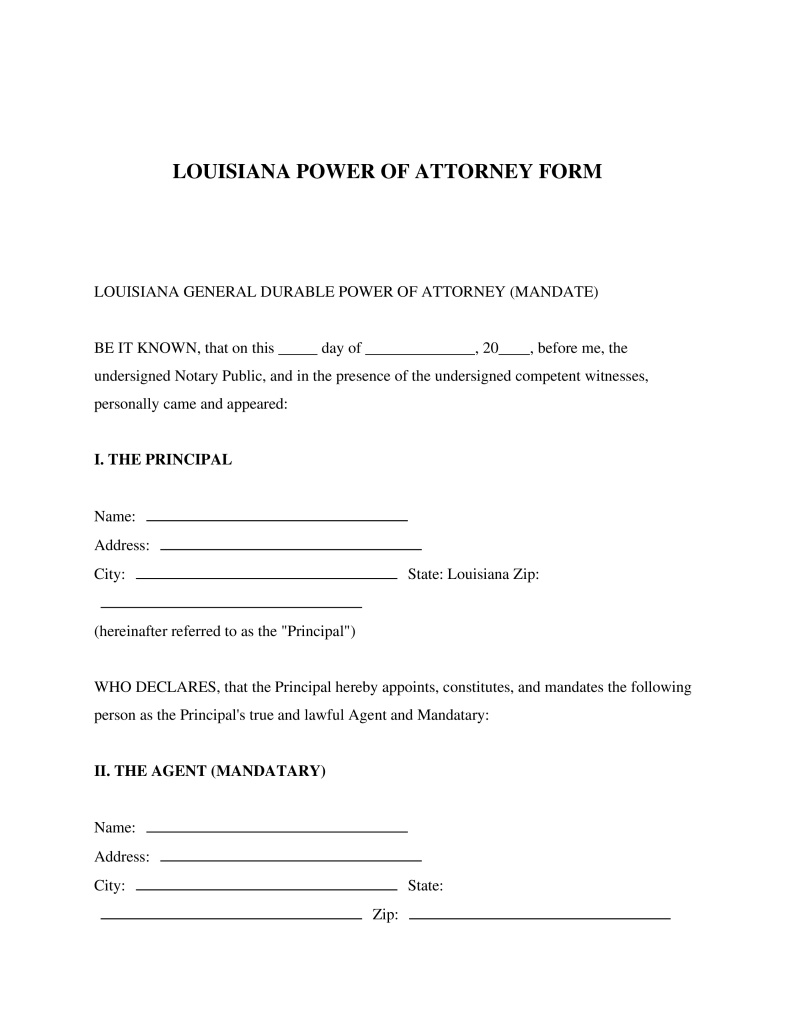
Louisiana Power of Attorney Form
A Louisiana Lease Agreement is a legal contract used to document the rental arrangement between a landlord and tenant, specifying the terms, duties, and conditions for leasing property within the state.
Authority Effective Timing
Many powers of attorney are effective immediately. A springing power of attorney becomes effective only after a stated event, commonly the Principal's incapacity, but some jurisdictions impose special requirements for proving that event.
Use this only if the authority should not begin immediately and should start on a calendar date.
Describe the triggering event clearly, such as written certification of incapacity by one or two licensed physicians.
For springing authority, third parties often need clear proof before accepting the Agent's authority.
Use precise language so banks, healthcare providers, or other institutions can verify when the authority has begun.
Table of Contents
What is a Louisiana Power of Attorney Form?
A Louisiana Power of Attorney Form, legally referred to under state civil law as a contract of mandate, is a document that authorizes one individual to act on behalf of another in legal, financial, or medical matters. The person granting the authority is known as the principal, while the individual receiving the authority is termed the agent or mandatary. This legal tool is utilized to ensure the continuity of personal and business affairs during periods of incapacitation or for convenience when the principal cannot be physically present to execute necessary transactions.
The Concept of Mandate in Louisiana Civil Law
Unlike the other 49 states that follow common law traditions, Louisiana law is primarily based on the Civil Code. Consequently, what is commonly recognized as a power of attorney is governed by the laws regarding "mandate." A mandate is a contract by which a person, the principal, confers authority on another person, the mandatary, to transact one or more affairs for the principal. While the term power of attorney is frequently used to describe the physical document, the underlying legal relationship is strictly defined by the Louisiana Civil Code. The mandate can be gratuitous or onerous, meaning the agent may act for free or for compensation.
Legal Requirements and Validity
The validity of a mandate is governed by the Louisiana Civil Code, specifically Articles 2989 through 3034. For a Louisiana Power of Attorney Form to be legally binding, particularly for transactions involving immovable property (real estate) or donations, it generally must be executed as an authentic act. An authentic act is a document signed by the principal, a notary public, and two witnesses. While some limited powers may be granted via a simple written document, financial institutions and title companies typically require the notarized authentic act format to prevent liability and ensure the identity of the signer.
Express Authority vs. General Authority
Louisiana law distinguishes between general authority and express authority. A general mandate confers power to transact all affairs of the principal, but this power is limited to acts of administration, such as paying bills or maintaining property. To perform acts of alienation or ownership transfer, the mandate must grant express authority. Actions requiring express authority include selling or buying real estate, making donations, accepting or renouncing a succession, and contracting loans. If the document does not explicitly state the agent has the power to sell a home, a general administration clause is insufficient for that specific transaction.
Required Elements of a Valid Louisiana Mandate
To ensure a mandate is enforceable and accepted by third parties, it should contain specific components aligning with state statutes.
- Identification of Parties: The full legal names and physical addresses of both the principal and the mandatary.
- Specific Grant of Authority: Detailed language outlining exactly what actions the agent is permitted to take, particularly regarding the sale of assets or healthcare decisions.
- Durability Clause: A clear statement indicating that the authority of the mandatary shall not be terminated by the subsequent disability or incapacity of the principal.
- Signature and Notarization: The principal must sign the document in the presence of a notary public and two competent witnesses to create an authentic act.
- Date and Location: The document should reflect the date of execution and the parish where the signing occurred.
Revocation and Termination
A mandate does not last indefinitely unless specified. It terminates upon the death of the principal, the interdiction of the mandatary, or the qualification of a curator after the interdiction of the principal. The principal retains the right to revoke the mandate at any time, provided they have the mental capacity to do so. Revocation is typically executed through a written document delivered to the mandatary and any third parties who were relying on the original Louisiana Power of Attorney Form, such as banks or healthcare providers.
Frequently Asked Questions
Power of Attorney in other states
Already have a Power of Attorney?
Get it reviewed free — checked against your state's laws in about a minute.
Not the form you're looking for?
Try our legal document generator to create a custom document
Disclaimer: The templates available on this website are provided for general informational purposes only and do not constitute legal advice. They are not intended to be, and should not be interpreted as, compliant with any specific legal, regulatory, or privacy requirements. These templates are not a replacement for professional legal guidance and should not be relied upon for any particular matter or circumstance. Users are strongly encouraged to seek advice from a qualified attorney licensed in their jurisdiction before using, modifying, or relying on any template.
All templates are provided on an "as is," "with all faults," and "as available" basis. The provider disclaims any and all warranties of any kind, whether express, implied, statutory, or otherwise, including without limitation warranties of merchantability, fitness for a particular purpose, title, or non-infringement.
LegalTemplates.com makes no guarantees or representations regarding the accuracy, completeness, expected outcomes, or reliability of the materials contained in these templates or any materials referenced or linked from them.