Idaho Power of Attorney Form Create an Idaho Power of Attorney Form

Idaho Power of Attorney Form

Published Dec 07, 2025
0 Comments
1 Downloads

A Idaho Power of Attorney Form is a legal document that authorizes another person to act on one's behalf in specified or all legal or financial matters.
Poa Type

Select the type of authority you wish to grant. 'General' grants broad powers; 'Limited/Special' restricts authority to specific acts; 'Durable' remains in effect if the Principal becomes incapacitated; 'Springing' only becomes effective upon a specified event.

Table of Contents

0% Complete 0/0 Fields

IDAHO POWER OF ATTORNEY FORM

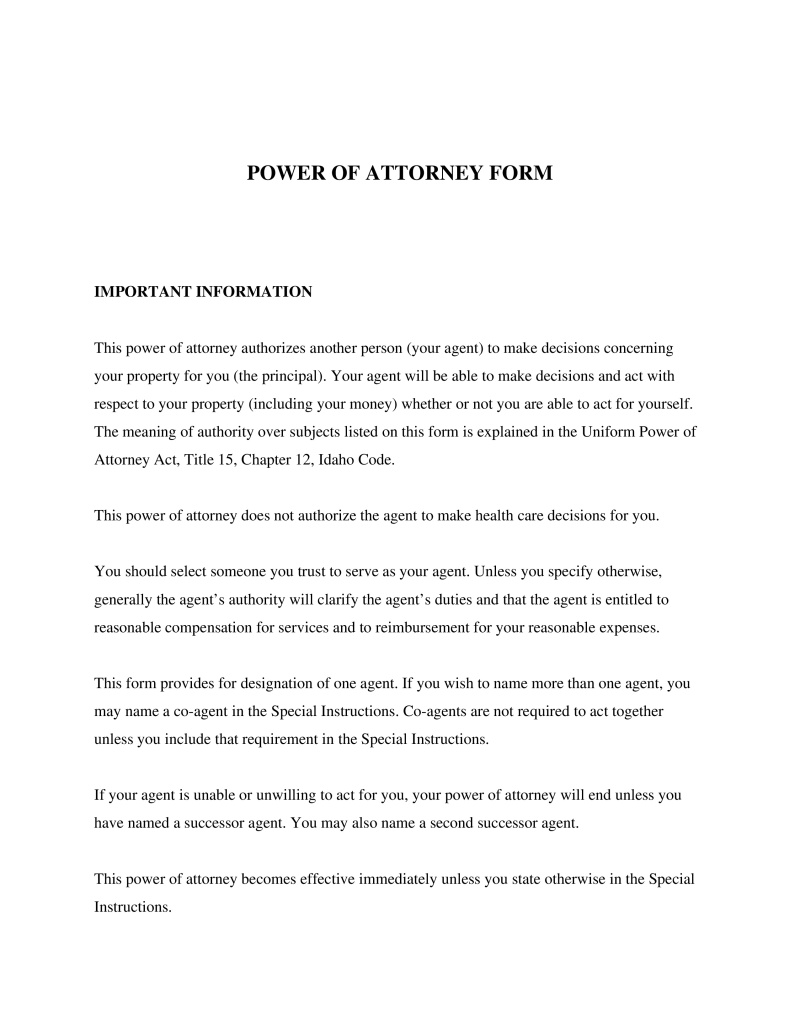
IMPORTANT INFORMATION

This power of attorney authorizes another person (your agent) to make decisions concerning your property for you (the principal). Your agent will be able to make decisions and act with respect to your property (including your money) whether or not you are able to act for yourself. The meaning of authority over subjects listed on this form is explained in the Uniform Power of Attorney Act, Title 15, Chapter 12, Idaho Code.

This power of attorney does not authorize the agent to make health care decisions for you.

You should select someone you trust to serve as your agent. Unless you specify otherwise, generally the agent’s authority will clarify the agent’s duties and that the agent is entitled to reasonable compensation for services and to reimbursement for your reasonable expenses.

This form provides for designation of one agent. If you wish to name more than one agent, you may name a co-agent in the Special Instructions. Co-agents are not required to act together unless you include that requirement in the Special Instructions.

If your agent is unable or unwilling to act for you, your power of attorney will end unless you have named a successor agent. You may also name a second successor agent.

This power of attorney becomes effective immediately unless you state otherwise in the Special Instructions.

If you have questions about the power of attorney or the authority you are granting to your agent, you should seek legal advice before signing this form.

I. DESIGNATION OF AGENT

I, , name the following person as my agent:

Name of Agent:
Agent’s Address:
Agent’s Telephone Number:

II. DESIGNATION OF SUCCESSOR AGENT(S) (OPTIONAL)

III. GRANT OF GENERAL AUTHORITY

I grant my agent and any successor agent general authority to act for me with respect to the following subjects as defined in the Uniform Power of Attorney Act, Title 15, Chapter 12, Idaho Code:

(Check the boxes of the subjects you want to include in the agent’s general authority. If you wish to grant general authority over all of the subjects you may check "All Preceding Subjects" instead of checking each subject.)

IV. GRANT OF SPECIFIC AUTHORITY (OPTIONAL)

My agent MAY NOT do any of the following specific acts for me UNLESS I have CHECKED the specific authority listed below:

(CAUTION: Granting any of the following will give your agent the authority to take actions that could significantly reduce your property or change how your property is distributed at your death.)

V. LIMITATION ON AGENT’S AUTHORITY

An agent that is not my ancestor, spouse, or descendant MAY NOT use my property to benefit the agent or a person to whom the agent owes an obligation of support unless I have included that authority in the Special Instructions.

VI. SPECIAL INSTRUCTIONS (OPTIONAL)

You may give special instructions on the following lines:

VII. EFFECTIVE DATE

This power of attorney is effective immediately unless I have stated otherwise in the Special Instructions.

VIII. NOMINATION OF CONSERVATOR (OPTIONAL)

IX. RELIANCE ON THIS POWER OF ATTORNEY

Any person, including my agent, may rely upon the validity of this power of attorney or a copy of it unless that person knows it has terminated or is invalid.

X. SIGNATURE AND ACKNOWLEDGMENT

Signature: _________________________
Date:
Print Name: _______________
Address:
Telephone Number:


IMPORTANT NOTICE TO AGENT

Agent’s Duties

When you accept the authority granted under this power of attorney, a special legal relationship is created between you and the principal. This relationship imposes upon you legal duties that continue until you resign or the power of attorney is terminated or revoked. You must:

1. Do what you know the principal reasonably expects you to do with the principal’s property or, if you do not know the principal’s expectations, act in the principal’s best interest;
2. Act in good faith;
3. Do nothing beyond the authority granted in this power of attorney; and
4. Disclose your identity as an agent whenever you act for the principal by writing or printing the name of the principal and signing your own name as "agent" in the following manner: (Principal’s Name) by (Your Signature) as Agent.

Unless the Special Instructions in this power of attorney state otherwise, you must also:

1. Act loyally for the principal’s benefit;
2. Avoid conflicts that would impair your ability to act in the principal’s best interest;
3. Act with care, competence, and diligence;
4. Keep a record of all receipts, disbursements, and transactions made on behalf of the principal;
5. Cooperate with any person that has authority to make health care decisions for the principal to do what you know the principal reasonably expects or, if you do not know the principal’s expectations, to act in the principal’s best interest; and
6. Attempt to preserve the principal’s estate plan if you know the plan and preserving the plan is consistent with the principal’s best interest.

Termination of Agent’s Authority

You must stop acting on behalf of the principal if you learn of any event that terminates this power of attorney or your authority under this power of attorney. Events that terminate a power of attorney or your authority to act under a power of attorney include:

1. Death of the principal;
2. The principal’s revocation of the power of attorney or your authority;
3. The occurrence of a termination event stated in the power of attorney;
4. The purpose of the power of attorney is fully accomplished; or
5. If you are married to the principal, a legal action is filed with a court to end your marriage, or for your legal separation, unless the Special Instructions in this power of attorney state that such an action will not terminate your authority.

Liability of Agent

The meaning of the authority granted to you is defined in the Uniform Power of Attorney Act, Title 15, Chapter 12, Idaho Code. If you violate the Uniform Power of Attorney Act, Title 15, Chapter 12, Idaho Code, or act outside the authority granted, you may be liable for any damages caused by your violation.

If there is anything about this document or your duties that you do not understand, you should seek legal advice.

What is an Idaho Power of Attorney Form?

An Idaho Power of Attorney Form is a legal instrument that authorizes an individual, known as the principal, to designate another person, referred to as the agent or attorney-in-fact, to manage their affairs. This delegation of authority allows the agent to make binding decisions regarding finances, property, business transactions, or healthcare depending on the specific scope of the document. These forms are essential components of estate planning, primarily used to ensure that a trusted individual can maintain the principal's obligations and welfare should they become incapacitated or unavailable. In Idaho, these documents are governed by specific state statutes that dictate how they must be drafted, signed, and executed to remain legally enforceable.

Legal Framework and Statutory Requirements

The governance of financial powers of attorney in the state falls under the Uniform Power of Attorney Act (UPOAA), codified in Idaho Code Title 15, Chapter 12. This legislation standardizes the creation and enforcement of these documents. According to Idaho Code § 15-12-105, for a power of attorney to be valid, it must be signed by the principal or in the principal's conscious presence by another individual directed by the principal to sign the principal's name. While the statute does not strictly require notarization for validity between the principal and agent, notarization is strongly recommended and practically required for the document to be accepted by third parties, such as banks, and is mandatory if the agent needs to record documents regarding real estate.

Healthcare directives operate under a different set of laws, specifically the Medical Consent and Natural Death Act found in Idaho Code Title 39, Chapter 45. These documents must ensure compliance with federal privacy regulations, specifically the Health Insurance Portability and Accountability Act (HIPAA), to allow agents access to protected health information.

Required Elements of a Valid Idaho Power of Attorney Form

To ensure the document is legally binding and accepted by financial institutions and medical providers, specific elements must be present within the instrument. Missing these components can render the delegation of authority void.

  • Identification of the principal and the agent with full legal names.
  • Clear language indicating the principal's intent to delegate authority.
  • Specification of powers granted, whether general or limited to specific acts.
  • Indication of durability, or a statement that the power generally terminates upon incapacity (if durability is not desired).
  • Signature of the principal, ideally acknowledged by a notary public.

How to Execute an Idaho Power of Attorney

Creating a valid power of attorney involves more than simply filling out a template. The process requires careful consideration of the agent's reliability and adherence to statutory formalities.

Step 1: Selection of an Agent – The principal must choose a trustworthy individual, as the agent will have significant control over assets or health. It is permissible to name a successor agent to act if the primary agent is unable or unwilling to serve.

Step 2: Drafting the Document – The principal must select the appropriate form (Financial or Healthcare) and define the scope of powers. Idaho provides a statutory form in Idaho Code § 15-12-301 that is widely accepted.

Step 3: Signing and Notarization – The principal must sign the document. For financial powers of attorney, having the signature acknowledged by a notary public presumes the signature is genuine, which protects third parties relying on the document.

Step 4: Distribution – Copies of the executed Idaho Power of Attorney Form should be provided to the agent, the principal's financial institutions, and relevant healthcare providers.

Agent Responsibilities and Fiduciary Duties

Accepting the role of an agent imposes strict fiduciary duties. Under the UPOAA, an agent must act in good faith, within the scope of authority granted, and according to the principal's reasonable expectations and best interests. The agent is required to keep their funds separate from the principal's funds (no commingling) and maintain accurate records of all receipts, disbursements, and transactions made on behalf of the principal. Violation of these duties can result in civil liability and potential criminal charges for exploitation.

Frequently Asked Questions

While Idaho law does not strictly require notarization for the document to be valid between the principal and agent, it is highly recommended. Notarization is required to record the document with the county for real estate transactions and helps ensure acceptance by banks and other financial institutions.
A Power of Attorney generally expires upon the death of the principal, the revocation of the document by the principal, or if the agent resigns or dies without a successor. A non-durable power of attorney also expires if the principal becomes incapacitated.
Yes, a principal may designate co-agents to act independently or jointly. However, appointing multiple agents can sometimes lead to disagreements or administrative difficulties if the document does not specify how disputes should be resolved.
A Living Will outlines specific end-of-life wishes regarding life support and resuscitation, whereas a Medical Power of Attorney designates a person to make healthcare decisions for you. In Idaho, these are often combined into a comprehensive healthcare directive.
No, an agent acting under a power of attorney generally cannot create, amend, revoke, or change the principal's Last Will and Testament. The authority granted is for management of assets during the principal's life, not the distribution of assets after death.
Generally, a power of attorney that is validly executed in Idaho is recognized in other states under the principle of comity and the UPOAA. However, third parties in other states may be hesitant to accept out-of-state forms, so it is often advisable to have documents reviewed if moving to a new jurisdiction.

Not the form you're looking for?

Try our legal document generator to create a custom document

Community Discussion

Share your experience and help others

0

Comments (0)

Leave a Comment

Your email will not be displayed publicly. It is used for validation purposes only and will never be used to send unwanted emails or sold to third parties.

No comments yet. Be the first to comment!

Legal Notice: Comments are personal opinions and do not constitute legal advice. Always consult a qualified attorney for matters specific to your situation.