Florida Power of Attorney Form
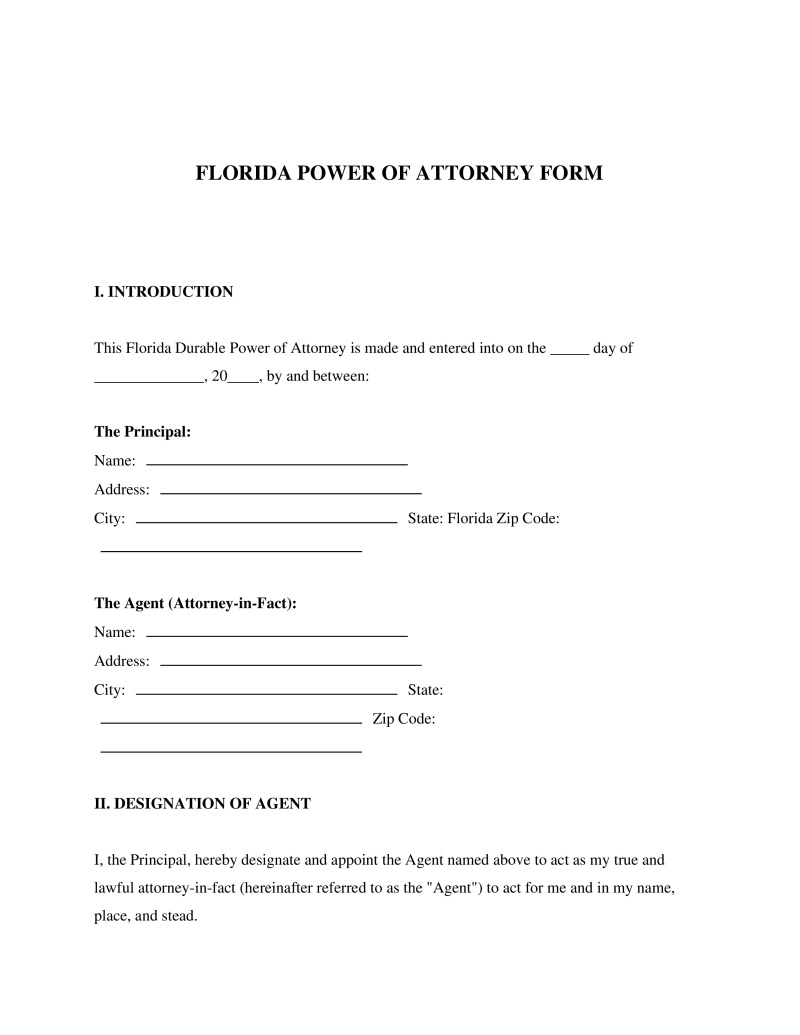
A Florida Power of Attorney Form is a legal document that authorizes one person to act on another's behalf in legal or financial matters in Florida.
Authority Effective Timing
Many powers of attorney are effective immediately. A springing power of attorney becomes effective only after a stated event, commonly the Principal's incapacity, but some jurisdictions impose special requirements for proving that event.
Use this only if the authority should not begin immediately and should start on a calendar date.
Describe the triggering event clearly, such as written certification of incapacity by one or two licensed physicians.
For springing authority, third parties often need clear proof before accepting the Agent's authority.
Use precise language so banks, healthcare providers, or other institutions can verify when the authority has begun.
Table of Contents
What is a Florida Power of Attorney Form?
A Florida Power of Attorney form is a legally binding document that permits an individual, known as the principal, to designate another person, referred to as the agent or attorney-in-fact, to manage financial, business, medical, or personal affairs on their behalf. This document serves as a critical tool for estate planning, business management, and healthcare coordination, ensuring that an individual's affairs can be managed if they become incapacitated or are otherwise unavailable. Individuals across Florida utilize these forms to establish trusted representation for various legal and financial transactions.
Types of Florida Power of Attorney
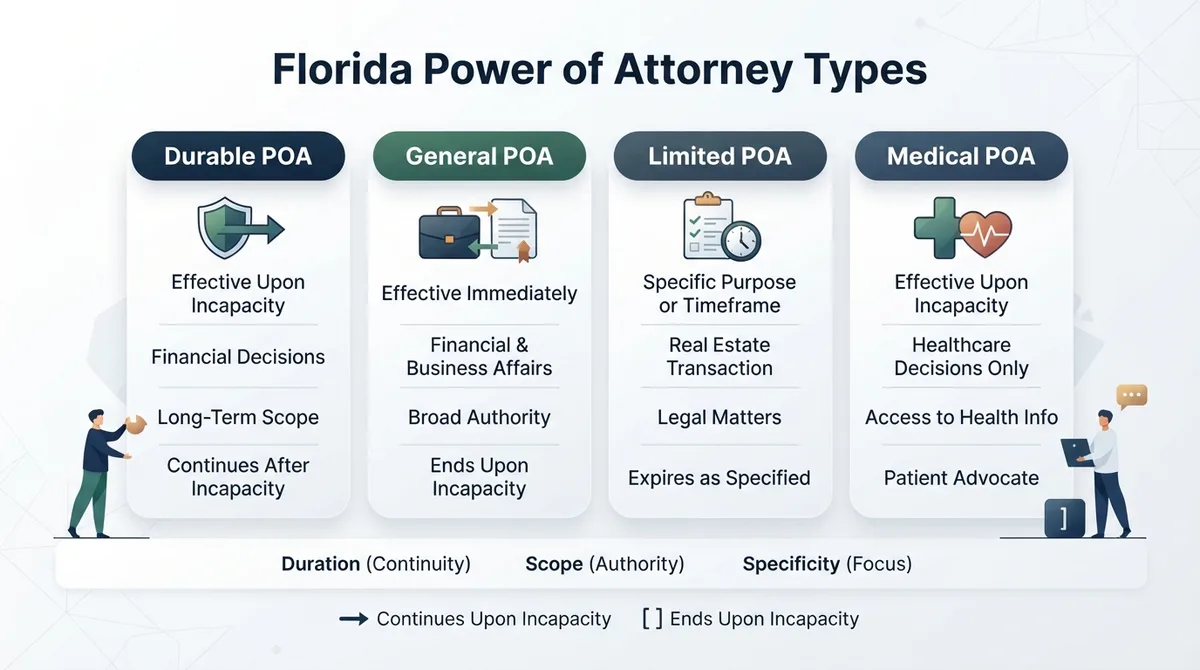
Florida law recognizes several distinct variations of power of attorney documents, each tailored to specific circumstances and durations of authority:
- Durable Power of Attorney - Remains in effect even if the principal becomes mentally incapacitated or physically unable to make decisions.
- General Power of Attorney - Grants broad financial and legal authority to the agent, but automatically terminates if the principal becomes incapacitated or dies.
- Limited or Special Power of Attorney - Restricts the agent's authority to specific tasks or a defined timeframe, such as handling a single real estate transaction.
- Medical Power of Attorney - Designates a healthcare surrogate to make medical decisions on behalf of the principal when they are unable to communicate their wishes.
Florida Legal Requirements and Execution Guidelines
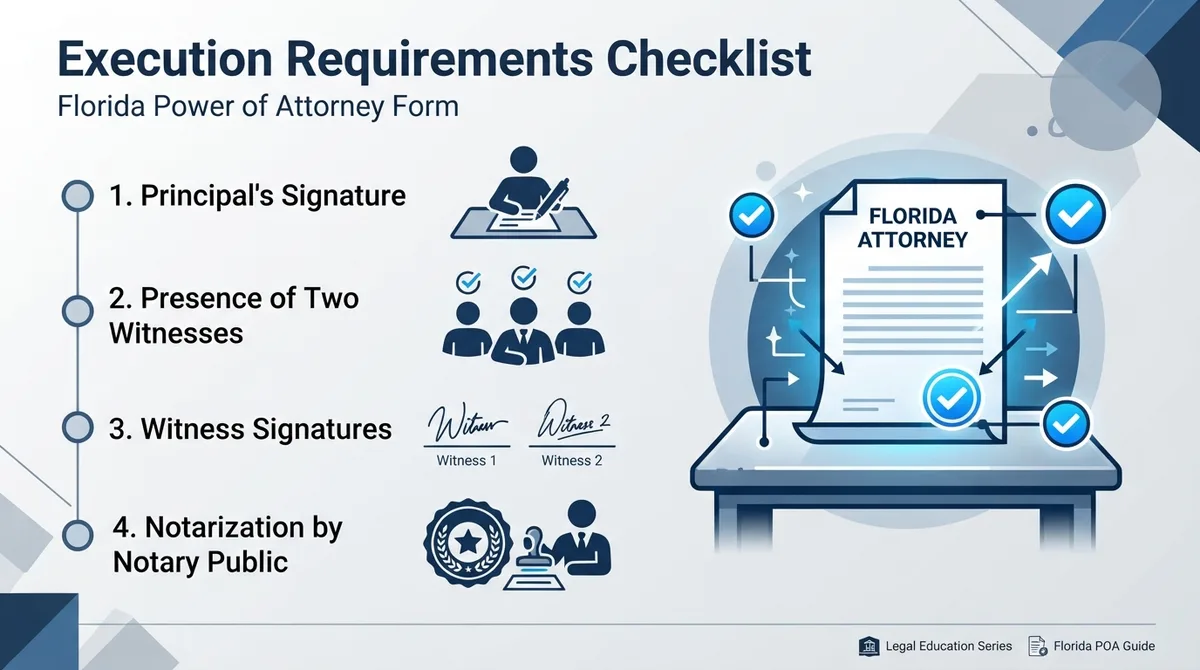
To ensure validity, a Florida Power of Attorney must conform to specific statutory guidelines governing execution and acknowledgment:
- Signature Requirements - The principal must sign the document in the presence of two witnesses and a notary public (Fla. Stat. § 709.2105).
- Witness Qualifications - Two competent adults must witness the principal signing the form and sign the document themselves (Fla. Stat. § 709.2105).
- Notarization Mandate - The document must be acknowledged by the principal before a notary public to establish its legal validity (Fla. Stat. § 709.2105).
- Agent Acknowledgment - While not always required for execution, agents must sign an acknowledgment of their fiduciary duties before exercising certain powers.
Fiduciary Duties of an Agent in Florida
Agents appointed under a Florida Power of Attorney are bound by strict fiduciary duties to protect the principal's interests:
- Duty of Care and Loyalty - Agents must act in good faith, solely in the interest of the principal, and avoid conflicts of interest (Fla. Stat. § 709.2114).
- Record Keeping - The agent must maintain accurate and detailed records of all transactions, receipts, and disbursements made on behalf of the principal.
- Cooperation with Healthcare Surrogates - If a separate healthcare surrogate is appointed, the financial agent must cooperate to ensure medical expenses are paid.
- Preservation of Estate Plan - Agents must attempt to preserve the principal's estate plan if they have knowledge of its provisions.
Key Elements of the Form
A comprehensive Florida Power of Attorney document contains several essential sections to clearly define the scope of authority:
- Principal and Agent Identity - Clear identification of the principal and the designated agent, including full names and contact information.
- Grant of Powers - Specific listing of the authorities granted, such as banking transactions, real estate management, tax filings, or business operations.
- Co-Agent Provisions - Instructions regarding whether multiple agents must act jointly or can act independently.
- Durability Provision - Explicit language stating whether the document survives the subsequent incapacity of the principal.
Revocation and Termination of Authority
The authority granted under a Florida Power of Attorney can be terminated through several legal mechanisms:
- Written Revocation - The principal can revoke the document at any time by executing a written revocation and delivering it to the agent and relevant third parties (Fla. Stat. § 709.2110).
- Execution of a New Power of Attorney - Creating a subsequent power of attorney that explicitly revokes all prior versions terminates previous designations (Fla. Stat. § 709.2110).
- Death of the Principal - All power of attorney designations automatically terminate upon the death of the principal, shifting authority to the estate executor.
- Incapacity of the Principal - Non-durable powers of attorney immediately terminate if the principal is declared incapacitated.
Frequently Asked Questions
Power of Attorney in other states
Already have a Power of Attorney?
Get it reviewed free — checked against your state's laws in about a minute.
Not the form you're looking for?
Try our legal document generator to create a custom document
Disclaimer: The templates available on this website are provided for general informational purposes only and do not constitute legal advice. They are not intended to be, and should not be interpreted as, compliant with any specific legal, regulatory, or privacy requirements. These templates are not a replacement for professional legal guidance and should not be relied upon for any particular matter or circumstance. Users are strongly encouraged to seek advice from a qualified attorney licensed in their jurisdiction before using, modifying, or relying on any template.
All templates are provided on an "as is," "with all faults," and "as available" basis. The provider disclaims any and all warranties of any kind, whether express, implied, statutory, or otherwise, including without limitation warranties of merchantability, fitness for a particular purpose, title, or non-infringement.
LegalTemplates.com makes no guarantees or representations regarding the accuracy, completeness, expected outcomes, or reliability of the materials contained in these templates or any materials referenced or linked from them.