Delaware Power of Attorney Form Create a Delaware Power of Attorney Form

Delaware Power of Attorney Form

Updated Dec 06, 2025
0 Comments
2 Downloads

A Delaware Power of Attorney Form is a legal document that grants one individual the authority to act on behalf of another in Delaware.

Poa Type

Select the type of authority you wish to grant. 'General' grants broad powers; 'Limited/Special' restricts authority to specific acts; 'Durable' remains in effect if the Principal becomes incapacitated; 'Springing' only becomes effective upon a specified event.

Table of Contents

0% Complete 0/0 Fields

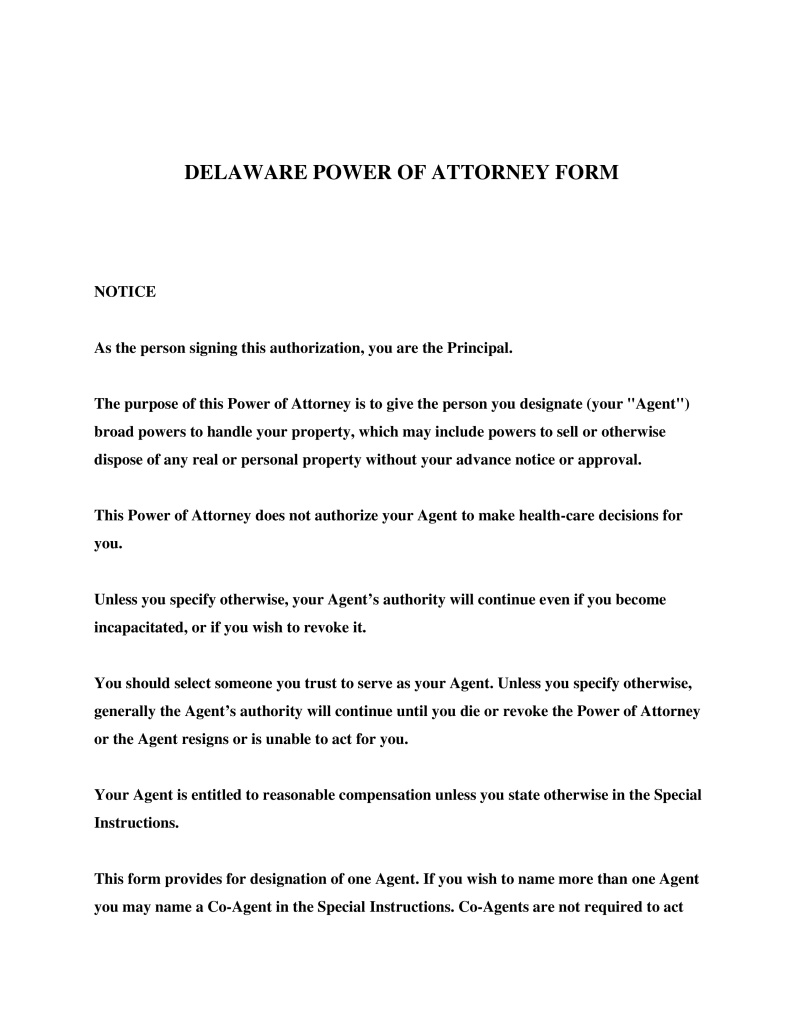
DELAWARE POWER OF ATTORNEY FORM

NOTICE

As the person signing this authorization, you are the Principal.

The purpose of this Power of Attorney is to give the person you designate (your "Agent") broad powers to handle your property, which may include powers to sell or otherwise dispose of any real or personal property without your advance notice or approval.

This Power of Attorney does not authorize your Agent to make health-care decisions for you.

Unless you specify otherwise, your Agent’s authority will continue even if you become incapacitated, or if you wish to revoke it.

You should select someone you trust to serve as your Agent. Unless you specify otherwise, generally the Agent’s authority will continue until you die or revoke the Power of Attorney or the Agent resigns or is unable to act for you.

Your Agent is entitled to reasonable compensation unless you state otherwise in the Special Instructions.

This form provides for designation of one Agent. If you wish to name more than one Agent you may name a Co-Agent in the Special Instructions. Co-Agents are not required to act together unless you include that requirement in the Special Instructions.

If your Agent is unable or unwilling to act for you, your Power of Attorney will end unless you have named a Successor Agent. You may also name a second Successor Agent.

This Power of Attorney becomes effective immediately unless you state otherwise in the Special Instructions.

If you have questions about the Power of Attorney or the authority you are granting to your Agent, you should seek legal advice before signing this form.

I. DESIGNATION OF AGENT

I, , of (Principal's Address), name the following person as my Agent:

Name of Agent:
Agent's Address:
Agent's Telephone Number:

II. DESIGNATION OF SUCCESSOR AGENT (OPTIONAL)

III. GRANT OF GENERAL AUTHORITY

I grant my Agent and any Successor Agent general authority to act for me with respect to the following subjects as defined in the Durable Personal Power of Attorney Act, Delaware Code Title 12, Chapter 49A.

(Check the boxes of the subjects you want to include in the Agent’s general authority. If you wish to grant general authority over all of the subjects you may check "All Preceding Subjects" instead of checking each subject.)

IV. GRANT OF SPECIFIC AUTHORITY (OPTIONAL)

My Agent MAY NOT do any of the following specific acts for me UNLESS I have checked the specific box below.

(Caution: Granting any of the following will give your Agent the authority to take actions that could significantly reduce your property or change how your property is distributed at your death.)

V. LIMITATION ON AGENT’S AUTHORITY

An Agent that is not my ancestor, spouse, or descendant MAY NOT use my property to benefit the Agent or a person to whom the Agent owes an obligation of support unless I have included that authority in the Special Instructions.

VI. SPECIAL INSTRUCTIONS (OPTIONAL)

You may give special instructions on the following lines:

VII. EFFECTIVE DATE

This Power of Attorney is effective immediately unless I have stated otherwise in the Special Instructions.

VIII. NOMINATION OF GUARDIAN (OPTIONAL)

IX. RELIANCE ON THIS POWER OF ATTORNEY

Any person, including my Agent, may rely upon the validity of this Power of Attorney or a copy of it unless that person knows it has terminated or is invalid.

X. SIGNATURE AND ACKNOWLEDGMENT

I, the Principal, sign my name to this Power of Attorney on the date indicated below.

Signature: _________________________
Date:
Print Name: _______________

XI. STATEMENT OF WITNESS

(Note: Delaware law requires one witness. The witness cannot be: (1) Related to the principal by blood, marriage, or adoption; (2) The Agent or a relative of the Agent; or (3) Entitled to any portion of the Principal's estate upon death.)

I, the witness, swear that I am not related to the Principal by blood, marriage, or adoption; and that I am not entitled to any portion of the estate of the Principal under the Principal's current will or under the laws of intestate succession of this jurisdiction.

Signature: _________________________
Date:
Print Name:
Address:


IMPORTANT INFORMATION FOR AGENT

Agent’s Duties

When you accept the authority granted under this Power of Attorney, a special legal relationship is created between you and the Principal. This relationship imposes upon you legal duties that continue until you resign or the Power of Attorney is terminated or revoked. You must:

  1. Do what you know the Principal reasonably expects you to do with the Principal’s property or, if you do not know the Principal’s expectations, act in the Principal’s best interest;
  2. Act in good faith;
  3. Do nothing beyond the authority granted in this Power of Attorney; and
  4. Disclose your identity as an Agent whenever you act for the Principal by writing or printing the name of the Principal and signing your own name as "Agent" in the following manner: (Principal’s Name) by (Your Signature) as Agent.

Unless the Special Instructions in this Power of Attorney state otherwise, you must also:

  1. Act loyally for the Principal’s benefit;
  2. Avoid conflicts that would impair your ability to act in the Principal’s best interest;
  3. Act with care, competence, and diligence;
  4. Keep a record of all receipts, disbursements, and transactions made on behalf of the Principal;
  5. Cooperate with any person that has authority to make health-care decisions for the Principal to do what you know the Principal reasonably expects or, if you do not know the Principal’s expectations, to act in the Principal’s best interest; and
  6. Attempt to preserve the Principal’s estate plan if you know the plan and preserving the plan is consistent with the Principal’s best interest.

Termination of Agent’s Authority

You must stop acting on behalf of the Principal if you learn of any event that terminates this Power of Attorney or your authority under this Power of Attorney. Events that terminate a Power of Attorney or your authority to act under a Power of Attorney include:

  1. Death of the Principal;
  2. The Principal’s revocation of the Power of Attorney or your authority;
  3. The occurrence of a termination event stated in the Power of Attorney;
  4. The purpose of the Power of Attorney is fully accomplished; or
  5. If you are married to the Principal, a legal action is filed with a court to end your marriage, or for your legal separation, unless the Special Instructions in this Power of Attorney state that such an action will not terminate your authority.

Liability of Agent

The meaning of the authority granted to you is defined in the Durable Personal Power of Attorney Act, Delaware Code Title 12, Chapter 49A. If you violate the Durable Personal Power of Attorney Act, Delaware Code Title 12, Chapter 49A, or act outside the authority granted, you may be liable for any damages caused by your violation.

If there is anything about this document or your duties that you do not understand, you should seek legal advice.


AGENT'S CERTIFICATION

I, _______________ (Name of Agent), have read the attached Power of Attorney and I am the person identified as the Agent for the Principal. I hereby acknowledge that when I act as Agent:

I shall act in accordance with the Principal's reasonable expectations to the extent actually known by me and, otherwise, in the Principal's best interest; act in good faith; and act only within the scope of authority granted in the Power of Attorney.

Signature: _________________________
Date:
Print Name: _______________

What is a Delaware Power of Attorney Form?

A Delaware Power of Attorney Form is a legal instrument that allows an individual, known as the principal, to delegate legal authority to another person, referred to as the agent or attorney-in-fact. This document serves as a mechanism for estate planning and incapacity management, permitting the agent to manage financial, property, or healthcare affairs on the principal's behalf. The scope of authority granted within this document can range from specific, limited transactions to broad, comprehensive management of all legal affairs. In Delaware, these forms are strictly regulated by state statutes to ensure the protection of the principal, particularly when the document is durable, meaning it remains effective even if the principal becomes incapacitated.

Delaware Durable Personal Power of Attorney Act

The primary legislation governing financial powers of attorney in the state is the Delaware Durable Personal Power of Attorney Act, found in Title 12, Chapter 49A of the Delaware Code. This statute outlines the creation, validity, and modification of power of attorney documents. Under this act, a power of attorney is presumed to be durable unless the document expressly states otherwise. This means that the authority granted to the agent continues to exist notwithstanding the subsequent incapacity of the principal. The Act was designed to align closely with the Uniform Power of Attorney Act (UPOAA), providing standardized definitions and duties to reduce ambiguity in legal proceedings.

Distinction Between Financial and Medical Powers

Delaware law separates the delegation of financial authority from healthcare decision-making. While a standard Delaware Power of Attorney Form typically covers assets, banking, real estate, and business operations under Title 12, healthcare decisions are governed by Title 16, Chapter 25 of the Delaware Code. The medical equivalent is formally known as an Advance Health Care Directive. This document combines a medical power of attorney with a living will, appointing a healthcare surrogate to make medical decisions if the principal cannot communicate. It is legally distinct from the financial power of attorney, and separate forms are required to cover both areas of authority effectively.

Required Elements of a Valid Delaware Power of Attorney Form

To be legally enforceable under Delaware statutes, a Durable Personal Power of Attorney must adhere to strict execution formalities. Failure to include specific mandatory notices or signatures can render the document void. The following elements are required for a standard financial power of attorney:

  • Written Instrument: The power of attorney must be in writing and contain the date of its execution.
  • Principal's Capacity: The principal must be an adult of sound mind at the time of signing.
  • Notarization: The principal's signature must be acknowledged before a Notary Public.
  • Witness Requirement: In addition to the notary, the document must be signed in the presence of one disinterested witness. The witness cannot be related to the principal by blood, marriage, or adoption, and cannot be the designated agent.
  • Notice to Principal: The document must contain a specific explanatory notice (in capital letters) detailing the powers being granted, as prescribed by Delaware Code Section 49A-105.
  • Agent's Certification: The agent must sign an optional but recommended certification acknowledging their fiduciary duties and the scope of their authority.

Fiduciary Duties and Agent Obligations

When a Delaware Power of Attorney Form is executed, the designated agent assumes a fiduciary relationship with the principal. This legal standing imposes a duty of loyalty, requiring the agent to act solely in the principal's best interest. According to Delaware law, the agent must avoid conflicts of interest and must keep the principal's assets separate from their own. Furthermore, the agent is required to maintain accurate records of all transactions, receipts, and disbursements made on behalf of the principal. If an agent breaches these duties, they may be held liable for restoring the value of the principal's property and may face civil or criminal penalties depending on the severity of the mismanagement or exploitation.

Revocation and Termination of Authority

A principal retains the right to revoke a Delaware Power of Attorney Form at any time, provided they maintain the mental capacity to do so. Revocation is typically achieved by executing a new power of attorney that expressly revokes prior instruments or by signing a formal revocation of power of attorney document. Additionally, authority automatically terminates upon the death of the principal. In the context of family law, the filing of an action for divorce, annulment, or legal separation automatically suspends a spouse's authority as an agent, unless the power of attorney document explicitly states otherwise. Third parties, such as banks, generally require written notice of revocation to stop honoring the agent's authority.

FAQs

Generally, a power of attorney does not need to be recorded with the government to be valid. However, if the agent intends to use the document to buy, sell, or transfer real estate, the power of attorney must be recorded with the Recorder of Deeds in the county where the property is located.
An agent may only make gifts of the principal's property if the power of attorney document expressly grants that specific authority. General language authorizing the agent to perform all acts is usually insufficient to authorize gifting under Delaware law.
A springing power of attorney is a document that only becomes effective upon the occurrence of a specific future event, typically the incapacity of the principal. The document must clearly define how that incapacity is determined, usually requiring written certification by a physician.
The witness must be an adult who is not related to the principal by blood, marriage, or adoption. Additionally, the appointed agent cannot serve as the witness. This requirement ensures the principal is signing the document voluntarily and without undue influence.
While most states recognize a power of attorney that was validly executed in another state, it is often recommended to update the document to comply with the laws of the new state of residence. This minimizes potential delays or rejection by third parties in the new jurisdiction.

Not the form you're looking for?

Try our legal document generator to create a custom document

Community Discussion

Share your experience and help others

0

Comments (0)

Leave a Comment

Your email will not be displayed publicly. It is used for validation purposes only and will never be used to send unwanted emails or sold to third parties.

No comments yet. Be the first to comment!

Legal Notice: Comments are personal opinions and do not constitute legal advice. Always consult a qualified attorney for matters specific to your situation.