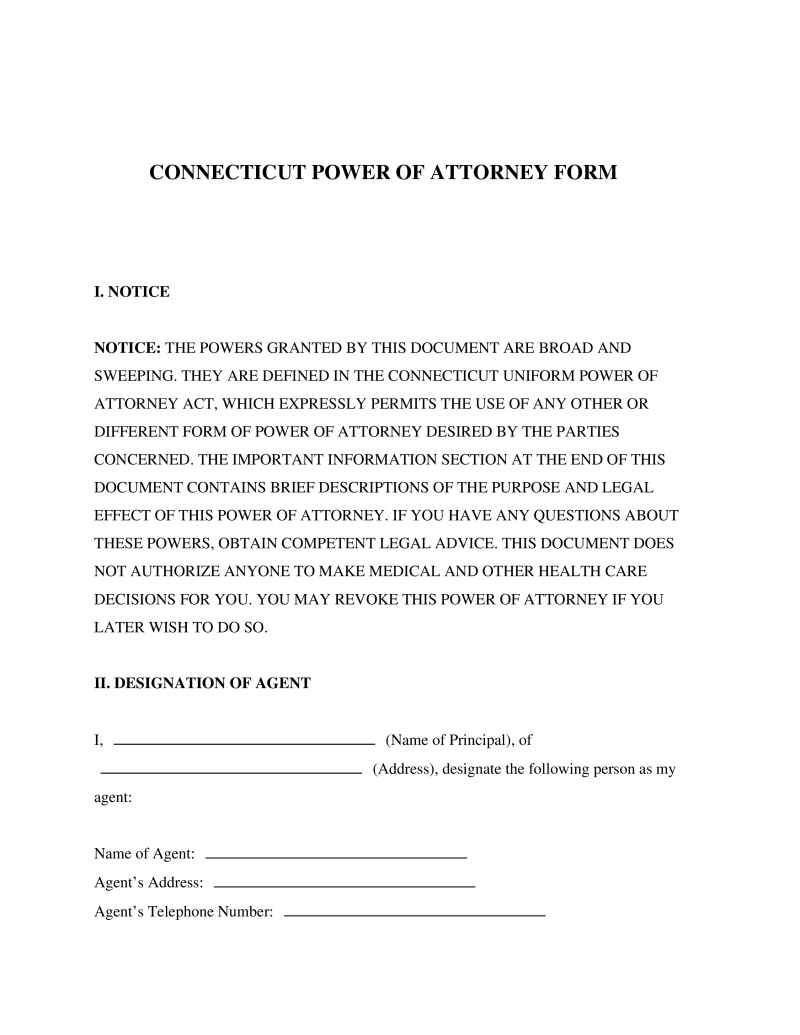
Connecticut Power of Attorney Form
A Connecticut Power of Attorney Form is a legal document that authorizes one person to act on another's behalf in legal or financial matters.
Authority Effective Timing
Many powers of attorney are effective immediately. A springing power of attorney becomes effective only after a stated event, commonly the Principal's incapacity, but some jurisdictions impose special requirements for proving that event.
Use this only if the authority should not begin immediately and should start on a calendar date.
Describe the triggering event clearly, such as written certification of incapacity by one or two licensed physicians.
For springing authority, third parties often need clear proof before accepting the Agent's authority.
Use precise language so banks, healthcare providers, or other institutions can verify when the authority has begun.
Table of Contents
What is a Connecticut Power of Attorney Form?
A Connecticut Power of Attorney Form is a legal instrument used to delegate authority from one individual, known as the principal, to another trusted person, referred to as the agent or attorney-in-fact. This document allows the agent to manage the principal's financial, legal, and property affairs, particularly in situations where the principal is unable to do so themselves due to absence or incapacity. Governed by the Connecticut Uniform Power of Attorney Act, this form serves as a critical component of estate planning, ensuring that a designated representative can pay bills, manage investments, and handle real estate transactions without court intervention. While typically used for financial matters, separate documents are generally required for medical directives.
Legal Framework and Statutory Requirements
The validity and execution of power of attorney documents in the state are governed by the Connecticut Uniform Power of Attorney Act (Connecticut General Statutes Title 1, Chapter 15c). This legislation, which aligns Connecticut law with national standards, establishes the specific requirements for creating a legally binding delegation of authority. Under C.G.S. § 1-350 et seq., a power of attorney must be signed by the principal or in the principal's conscious presence by another individual directed by the principal to sign the principal's name.
For the document to be valid in Connecticut, the signature must be acknowledged by a notary public or a commissioner of the superior court. Furthermore, the document requires the signatures of two witnesses. The notary public may serve as one of the two required witnesses. The statutes also provide a "Statutory Short Form Power of Attorney," which is a standardized template that residents may use to ensure compliance with state laws. If a document substantially follows this statutory form, third parties such as banks are generally mandated to accept it.
Types of Power of Attorney in Connecticut
State laws recognize several variations of this legal device, each serving a distinct purpose based on the duration of authority and the scope of powers granted. The selection of the specific type depends on the principal's intent and current circumstances.
Durable Power of Attorney
Under the current Connecticut Uniform Power of Attorney Act, a power of attorney is presumed to be durable unless the document explicitly states otherwise. A durable power of attorney remains effective even if the principal becomes incapacitated or mentally incompetent. This feature makes it a fundamental tool for long-term disability planning, as it prevents the need for a court-appointed conservator to manage the principal's assets.
General vs. Limited Power of Attorney
A general power of attorney grants the agent broad authority to handle almost all financial and legal affairs of the principal. Conversely, a limited or special power of attorney restricts the agent's authority to specific transactions or a set period. For example, a principal might execute a limited Connecticut Power of Attorney Form solely for the purpose of closing a real estate sale while they are out of the country.
Springing Power of Attorney
A springing power of attorney is designed to become effective only upon the occurrence of a specified future event or contingency, most commonly the incapacity of the principal. The document must clearly define how that incapacity is determined, often requiring certification by a medical physician.
How to Complete a Connecticut Power of Attorney Form
Executing this document requires adherence to specific procedural steps to ensuring it is legally binding and recognized by financial institutions.
- Step 1: Select an Agent - The principal must choose a competent and trustworthy individual to act as the agent. Connecticut law allows for the appointment of co-agents who may act independently or jointly, as well as successor agents who take over if the primary agent is unable to serve.
- Step 2: Define the Scope of Authority - Using the statutory form, the principal generally initials specific categories of authority they wish to grant, such as "Real Property," "Banks and Other Financial Institutions," or "Taxes." Alternatively, the principal may grant all listed powers.
- Step 3: Draft Special Instructions - The principal may include limitations or specific instructions in the designated section of the form to restrict the agent's powers or provide guidance on how assets should be managed.
- Step 4: Execute the Document - The principal must sign the document in the presence of two witnesses and a notary public. The witnesses must also sign the document, and the notary must acknowledge the principal's signature.
- Step 5: Agent Acknowledgement - While not strictly required for the validity of the principal's signature, it is best practice for the agent to sign an acknowledgement form accepting their duties and understanding their fiduciary responsibilities.
Fiduciary Duties and Agent Responsibilities
When a person accepts the role of an agent under a Connecticut Power of Attorney Form, they assume a fiduciary relationship with the principal. This legal standard requires the agent to act in good faith, within the scope of authority granted, and solely in the best interest of the principal. The agent is legally obligated to keep the principal's property separate from their own, maintain detailed records of all transactions, and avoid conflicts of interest.
If an agent violates these duties—for instance, by using the principal's funds for personal gain—they can be held liable for civil damages and may face criminal charges for embezzlement or exploitation. The Connecticut Probate Court has jurisdiction to review the conduct of an agent and can compel them to provide an accounting of their actions if misconduct is suspected.
Distinction Between Financial and Medical Authority
It is important to distinguish between financial authority and healthcare decision-making. The standard Connecticut Power of Attorney Form typically covers financial, business, and legal matters. It does not automatically grant the authority to make medical decisions. To designate a representative for healthcare decisions, an individual must execute a separate document known as an Appointment of Health Care Representative. While these documents are often created simultaneously during estate planning, they are distinct legal instruments governed by different sections of the Connecticut General Statutes.
FAQs
Already have a Power of Attorney?
Get it reviewed free — checked against your state's laws in about a minute.
Not the form you're looking for?
Try our legal document generator to create a custom document
Disclaimer: The templates available on this website are provided for general informational purposes only and do not constitute legal advice. They are not intended to be, and should not be interpreted as, compliant with any specific legal, regulatory, or privacy requirements. These templates are not a replacement for professional legal guidance and should not be relied upon for any particular matter or circumstance. Users are strongly encouraged to seek advice from a qualified attorney licensed in their jurisdiction before using, modifying, or relying on any template.
All templates are provided on an "as is," "with all faults," and "as available" basis. The provider disclaims any and all warranties of any kind, whether express, implied, statutory, or otherwise, including without limitation warranties of merchantability, fitness for a particular purpose, title, or non-infringement.
LegalTemplates.com makes no guarantees or representations regarding the accuracy, completeness, expected outcomes, or reliability of the materials contained in these templates or any materials referenced or linked from them.