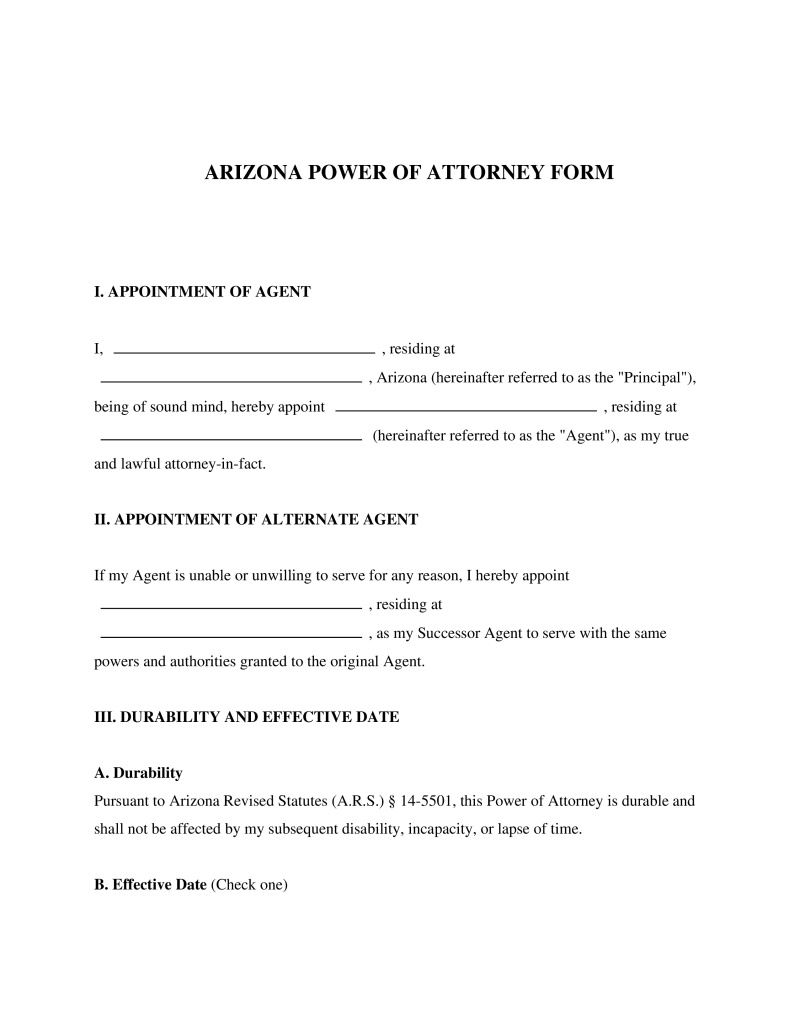
Arizona Power of Attorney Form
An Arizona Power of Attorney Form is a legal document granting authority to another to act on one's behalf in specified matters in the state of AZ.
Authority Effective Timing
Many powers of attorney are effective immediately. A springing power of attorney becomes effective only after a stated event, commonly the Principal's incapacity, but some jurisdictions impose special requirements for proving that event.
Use this only if the authority should not begin immediately and should start on a calendar date.
Describe the triggering event clearly, such as written certification of incapacity by one or two licensed physicians.
For springing authority, third parties often need clear proof before accepting the Agent's authority.
Use precise language so banks, healthcare providers, or other institutions can verify when the authority has begun.
Table of Contents
What is a Arizona Power of Attorney Form?
An Arizona Power of Attorney form is a legally binding instrument that allows an individual, referred to as the principal, to designate another person, known as the agent or attorney-in-fact, to manage their affairs. This document is primarily used to ensure that financial, legal, or healthcare decisions can be made efficiently if the principal becomes incapacitated, unavailable, or simply prefers to delegate these responsibilities. The scope of the authority granted within the document can be broad, covering all financial transactions, or limited to specific acts such as selling real estate or managing a business account. Individuals utilizing this legal tool must adhere to specific state statutes to ensure the delegation of power is recognized by third parties such as banks, hospitals, and government agencies.
Types of Power of Attorney in Arizona
Arizona law recognizes several distinct categories of power of attorney arrangements, each designed to serve specific needs.
- A General Power of Attorney grants the agent comprehensive authority to handle the principal's financial and legal matters.
- A standard general power of attorney typically becomes invalid if the principal becomes mentally incapacitated. To address this, the Durable Power of Attorney is frequently utilized. A durable clause ensures that the agent's authority continues or takes effect specifically when the principal becomes incapacitated, providing a safety net for long-term planning.
- In the realm of medical care, the state utilizes a specific document known as the Healthcare Power of Attorney. This document is distinct from financial directives and is governed by different statutes. It authorizes an agent to make medical decisions, access medical records, and consent to or refuse treatment on behalf of the principal. Additionally, Arizona recognizes a Mental Health Power of Attorney, which specifically addresses decisions regarding mental health treatment and inpatient admission, a distinction not found in all jurisdictions.
Legal Requirements and Statutes
The validity of an Arizona Power of Attorney form is strictly governed by state laws, primarily found in the Arizona Revised Statutes (A.R.S.). For financial powers of attorney, A.R.S. Title 14, Chapter 5, Article 5 outlines the necessary legal formalities. According to A.R.S. § 14-5501, a durable power of attorney must be in writing, signed by the principal, and witnessed by a person other than the agent, the agent's spouse, or the agent's children. Furthermore, the signature must be notarized to be legally effective. Failure to adhere to these witnessing and notarization protocols can render the document void.
Healthcare directives operate under A.R.S. Title 36, Chapter 32. Unlike financial documents, a Healthcare Power of Attorney in Arizona requires either the signature of a notary public or the signature of at least one witness. The witness cannot be involved in the principal's care, related by blood or marriage, or be a beneficiary of the principal's estate. These strict statutory requirements exist to prevent fraud and undue influence over vulnerable individuals.
Fiduciary Duties of the Agent
When a person accepts the role of an agent under an Arizona Power of Attorney form, they assume a fiduciary duty to the principal. This is a high legal standard that requires the agent to act with the utmost good faith, loyalty, and honesty. The agent is legally obligated to act solely in the principal's best interest and must avoid any conflicts of interest. Under Arizona law, an agent must keep a record of all receipts, disbursements, and significant actions taken on behalf of the principal.
If an agent breaches these duties—for example, by commingling funds or using the principal's assets for personal gain—they can be held civilly and potentially criminally liable. The law provides mechanisms for family members or interested parties to petition the court to review the agent's conduct and, if necessary, remove the agent and seek restitution for any financial losses incurred by the principal.
Required Elements of a Valid Arizona Financial Power of Attorney
- Principal Identification: The full legal name and address of the person granting authority.
- Agent Designation: Clear identification of the primary agent and any successor agents who will act if the primary is unavailable.
- Grant of Authority: Specific language defining whether the powers are general or limited to certain transactions (e.g., real estate, banking, tax matters).
- Durability Clause: Explicit language stating that the authority survives the principal's incapacity, if intended.
- Signature and Notarization: The principal must sign the document in the presence of a notary public and a valid witness.
Revocation of Authority
A principal retains the right to revoke an Arizona Power of Attorney form at any time, provided they are of sound mind. Revocation is typically achieved by executing a new power of attorney document that explicitly revokes prior ones or by creating a written revocation of power of attorney form. It is crucial that the principal notifies the agent and any third parties acting on the document, such as financial institutions, that the authority has been withdrawn. Additionally, under Arizona law, the authority of a spouse acting as an agent is automatically terminated upon the filing of a petition for divorce or legal separation, unless the power of attorney expressly states otherwise.
Frequently Asked Questions
Already have a Power of Attorney?
Get it reviewed free — checked against your state's laws in about a minute.
Not the form you're looking for?
Try our legal document generator to create a custom document
Disclaimer: The templates available on this website are provided for general informational purposes only and do not constitute legal advice. They are not intended to be, and should not be interpreted as, compliant with any specific legal, regulatory, or privacy requirements. These templates are not a replacement for professional legal guidance and should not be relied upon for any particular matter or circumstance. Users are strongly encouraged to seek advice from a qualified attorney licensed in their jurisdiction before using, modifying, or relying on any template.
All templates are provided on an "as is," "with all faults," and "as available" basis. The provider disclaims any and all warranties of any kind, whether express, implied, statutory, or otherwise, including without limitation warranties of merchantability, fitness for a particular purpose, title, or non-infringement.
LegalTemplates.com makes no guarantees or representations regarding the accuracy, completeness, expected outcomes, or reliability of the materials contained in these templates or any materials referenced or linked from them.