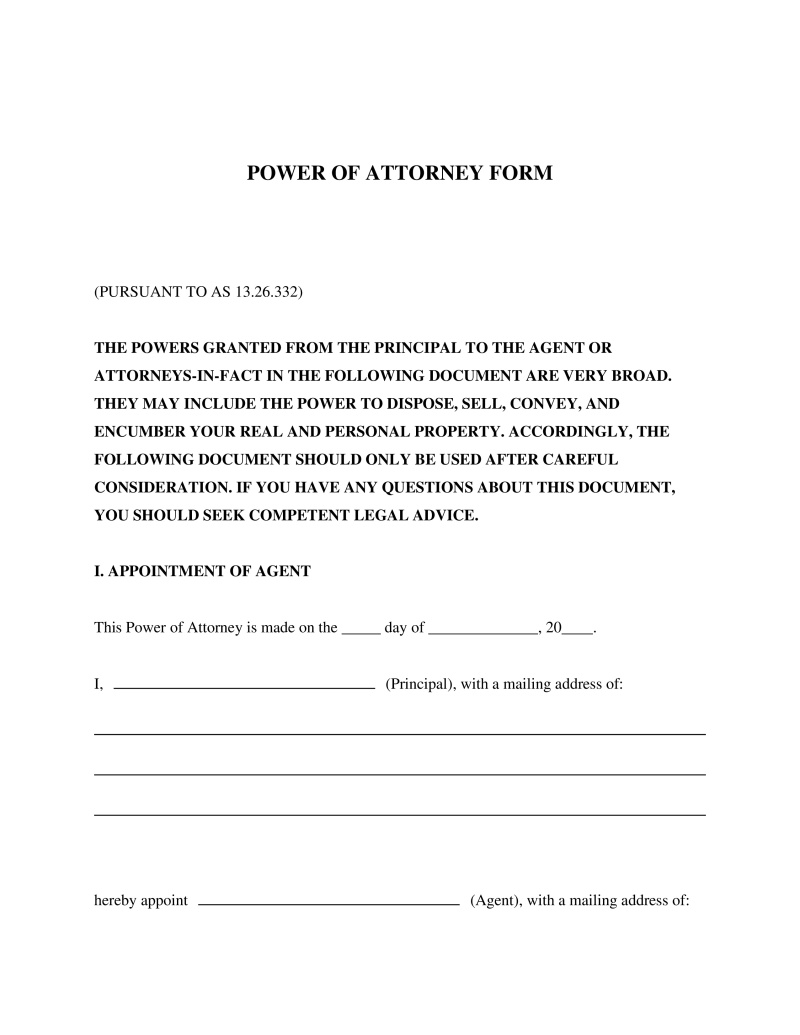
Alaska Power of Attorney
An Alaska Power of Attorney is a legal instrument that confers upon a designated agent the authority to act on behalf of a principal in specified matters.
Authority Effective Timing
Many powers of attorney are effective immediately. A springing power of attorney becomes effective only after a stated event, commonly the Principal's incapacity, but some jurisdictions impose special requirements for proving that event.
Use this only if the authority should not begin immediately and should start on a calendar date.
Describe the triggering event clearly, such as written certification of incapacity by one or two licensed physicians.
For springing authority, third parties often need clear proof before accepting the Agent's authority.
Use precise language so banks, healthcare providers, or other institutions can verify when the authority has begun.
Table of Contents
What is an Alaska Power of Attorney?
An Alaska Power of Attorney is a legal document used to grant one person (the "agent" or "attorney-in-fact") the authority to act on behalf of another person (the "principal") in specified matters. This document allows the principal to delegate decision-making power for financial, medical, or parental affairs to a trusted individual. The principal must possess the legal capacity to make such decisions at the time of signing, and the document explicitly outlines the scope of authority granted to the agent.
Types of Alaska Powers of Attorney
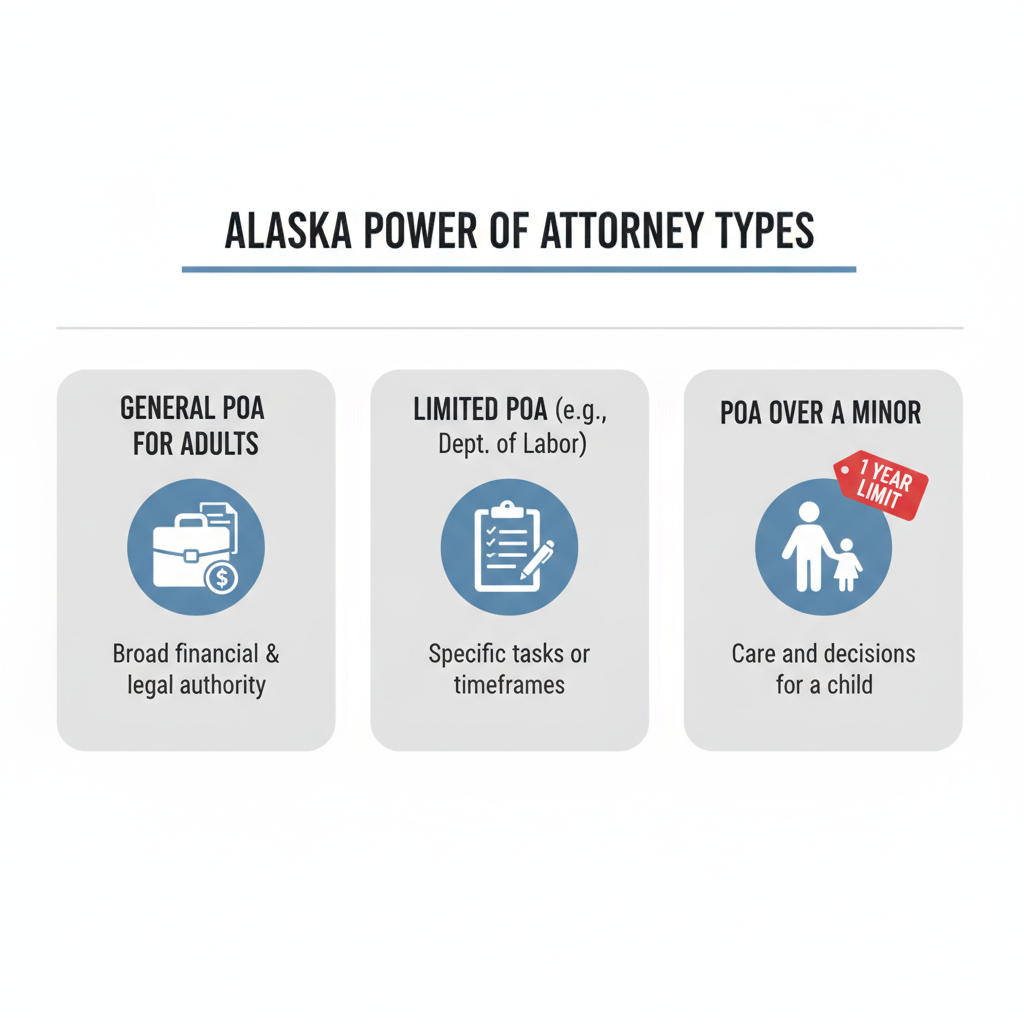
Alaska law recognizes several types of Powers of Attorney, each designed for specific situations and granting varying levels of authority. The choice of document depends on the principal's needs and the nature of the powers they wish to delegate:
- General Power of Attorney - This document typically grants broad authority to an agent to handle various financial and legal matters on behalf of an adult principal. The Alaska Legal Services Corporation provides forms and instructions for this type of power of attorney, assisting individuals in delegating comprehensive financial management responsibilities.
- Limited or Specific Power of Attorney - This type grants the agent authority for a very defined set of actions or for a specific period. An example is the Power of Attorney form used for representation before the Alaska Department of Labor and Workforce Development, which allows an agent to act on behalf of an individual in matters related to unemployment insurance and other employment services.
- Power of Attorney Over a Minor By Parent or Guardian - This specialized power of attorney allows a parent or legal guardian to delegate parental rights and responsibilities to another person for a temporary period. The Alaska Court System offers a specific form for this purpose (Form PG-701), with the delegation typically valid for up to one year.
Key Parties and Their Roles
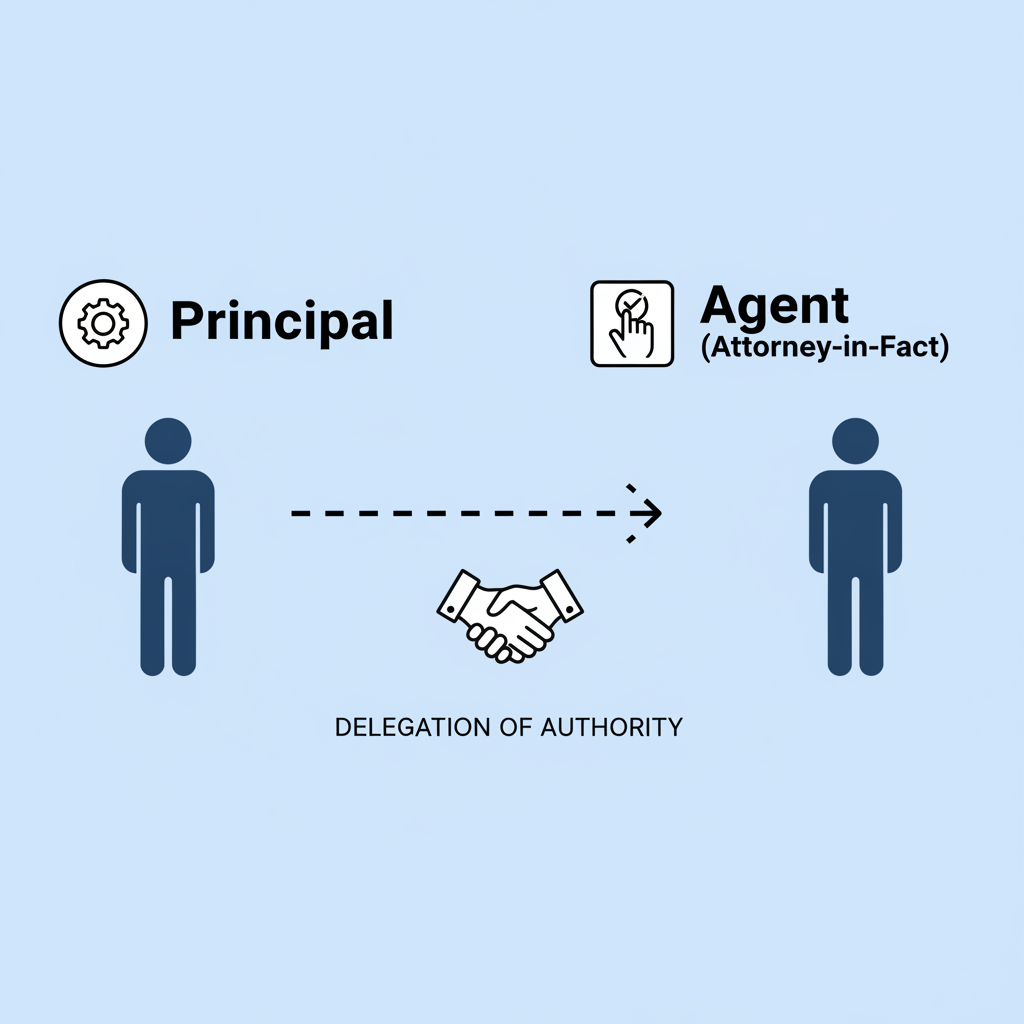
Understanding the roles of the individuals involved in an Alaska Power of Attorney is essential for its proper execution and function. Each party has distinct responsibilities and rights defined by the document:
- Principal - The individual who creates the Power of Attorney and grants authority to another person. The principal must be of sound mind and have the legal capacity to understand the implications of the document at the time of signing.
- Agent (or Attorney-in-Fact) - The individual appointed by the principal to act on their behalf. The agent has a fiduciary duty to act in the principal's best interest, within the scope of authority granted by the Power of Attorney.
Creating an Alaska Power of Attorney
The creation of an Alaska Power of Attorney involves several key steps to ensure its legal validity and effectiveness. While specific forms are available for certain purposes, the general principles of creation apply:
- Capacity of the Principal - The person granting the power must have the mental capacity to make that decision. This means they must understand the nature and effect of the document they are signing.
- Written Document - A Power of Attorney must be in writing. The Alaska Court System provides a Power of Attorney booklet that includes the official Alaska form for general use, along with instructions to assist in its completion.
- Specific Scope of Authority - The document must clearly state which specific issues or powers the agent can act on behalf of the principal. This can range from broad financial management to very limited, specific transactions.
- Signature and Notarization - While the specific requirements for witnesses may vary by the type of power of attorney or the institution where it will be used, it is a common practice for the principal to sign the document in the presence of a notary public. Notarization verifies the principal's identity and confirms that the signature is authentic.
Scope and Limitations of Authority
The authority granted through an Alaska Power of Attorney is not unlimited and is strictly defined by the document itself. Principals must carefully consider the powers they wish to delegate:
- Defined Powers - The agent's authority is limited to the specific powers enumerated in the Power of Attorney document. If a power is not explicitly granted, the agent cannot exercise it.
- Fiduciary Duty - The agent is legally obligated to act in the principal's best interest, avoiding conflicts of interest and managing assets responsibly.
- Time Limits - Some Powers of Attorney, such as the Power of Attorney Over a Minor By Parent or Guardian, have statutory time limits, typically no more than one year, after which they expire unless renewed.
- Misuse of Authority - The Office of Public Advocacy offers forms related to financial exploitation, including instances where a Power of Attorney may be misused. This highlights the importance of appointing a trustworthy agent and understanding the limitations of their role.
Termination and Revocation
An Alaska Power of Attorney is not necessarily permanent and can terminate under various circumstances. It is important for all parties to understand how and when a Power of Attorney ceases to be effective:
- Automatic Termination - A Power of Attorney generally terminates automatically upon the death of the principal. If the Power of Attorney is not designated as "durable," it may also terminate if the principal becomes incapacitated.
- Revocation by Principal - A principal who has the mental capacity to do so may revoke a Power of Attorney at any time. This should ideally be done in writing, with notice provided to the agent and any third parties who have acted in reliance on the Power of Attorney.
- Expiration Date - If the Power of Attorney specifies an expiration date or a particular event that triggers its termination, it will cease to be effective on that date or upon the occurrence of that event.
- Court Order - A court may terminate a Power of Attorney if it finds that the agent is abusing their authority or that the principal lacked capacity when signing the document.
Frequently Asked Questions
Sources
- Powers of Attorney & Health Care Directives - Provides information on powers of attorney, including forms and instructions.
- Power of Attorney Booklet - Contains the Alaska form for a Power of Attorney, with general information to assist in its completion.
- Forms by Topic & Number (A - I) - Provides access to various forms, including those related to powers of attorney.
- Power of Attorney Form - A Power of Attorney form for representation before the Alaska Department of Labor and Workforce Development.
- Financial Exploitation Forms - Provides forms related to financial exploitation, including misuse of powers of attorney.
Already have a Power of Attorney?
Get it reviewed free — checked against your state's laws in about a minute.
Not the form you're looking for?
Try our legal document generator to create a custom document
Disclaimer: The templates available on this website are provided for general informational purposes only and do not constitute legal advice. They are not intended to be, and should not be interpreted as, compliant with any specific legal, regulatory, or privacy requirements. These templates are not a replacement for professional legal guidance and should not be relied upon for any particular matter or circumstance. Users are strongly encouraged to seek advice from a qualified attorney licensed in their jurisdiction before using, modifying, or relying on any template.
All templates are provided on an "as is," "with all faults," and "as available" basis. The provider disclaims any and all warranties of any kind, whether express, implied, statutory, or otherwise, including without limitation warranties of merchantability, fitness for a particular purpose, title, or non-infringement.
LegalTemplates.com makes no guarantees or representations regarding the accuracy, completeness, expected outcomes, or reliability of the materials contained in these templates or any materials referenced or linked from them.