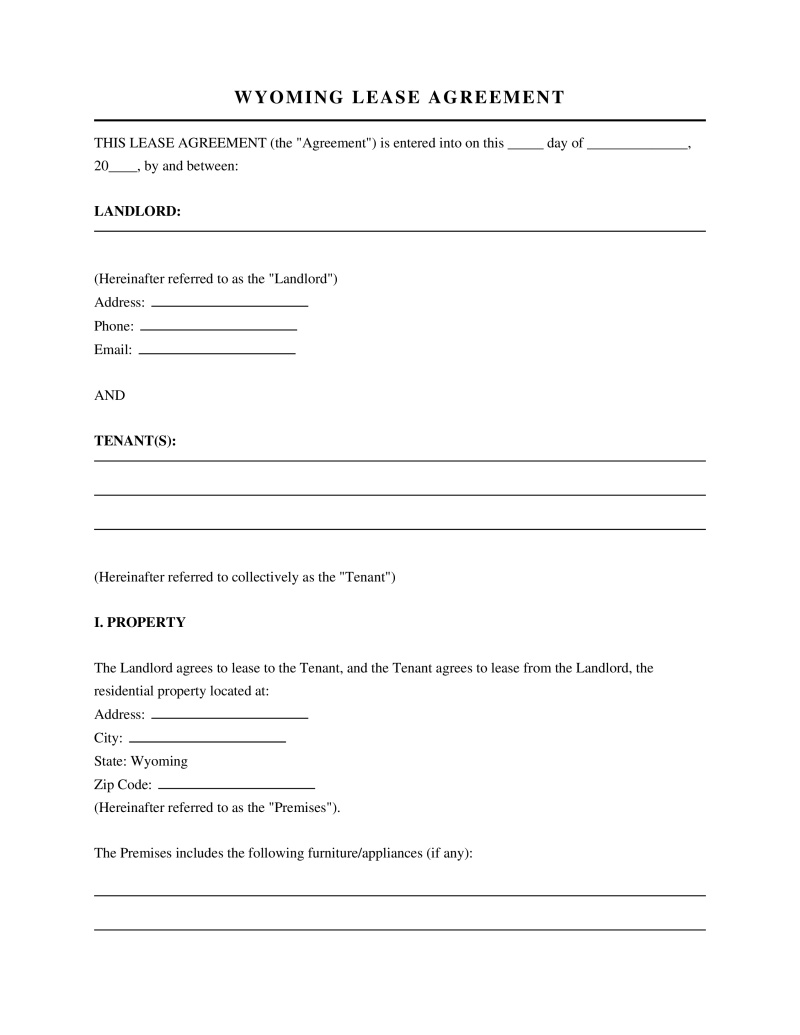
Wyoming Lease Agreement
A Wyoming Lease Agreement is a legally binding contract between a landlord and a tenant that outlines the terms of renting property in the state of Wyoming.
Residential Property Type
Select the residential property category that best describes the rental premises.
Use this if the rental property does not fit one of the listed categories.
Table of Contents
What is a Wyoming Lease Agreement?
A Wyoming Lease Agreement is a legally binding contract executed between a landlord and a tenant to outline the terms and conditions regarding the rental of a residential or commercial property within the state. This document serves as the primary governance for the tenancy, establishing the rights, responsibilities, and obligations of both parties for a specified duration. It details critical financial arrangements, such as the monthly rent amount, security deposit requirements, and payment schedules, while also defining rules regarding property maintenance and usage. By signing this agreement, both the lessor and lessee consent to adhere to the stipulations provided, providing a legal basis for dispute resolution should conflicts arise.
Legal Framework and Statutory Requirements
The landlord-tenant relationship in Wyoming is primarily governed by Title 1, Chapter 21, Article 12 of the Wyoming Statutes, known as the Residential Rental Property Act. Unlike many other jurisdictions, Wyoming law is often characterized as landlord-friendly due to fewer restrictions on rental terms and limited statutory protections for tenants compared to heavily regulated states. However, the statutes strictly enforce specific obligations regarding habitability and the handling of security deposits.
Under Wyoming Statute § 1-21-1202, landlords are required to maintain the rental unit in a safe and sanitary condition, ensuring that electrical, plumbing, and heating systems are functional. While the state does not impose rent control measures, allowing landlords to charge market rates, the lease document must comply with federal housing regulations, including the Fair Housing Act, which prohibits discrimination based on race, color, national origin, religion, sex, familial status, or disability.
Security Deposit Regulations
One of the most regulated aspects of a Wyoming Lease Agreement involves the collection and return of security deposits. According to Wyoming Statute § 1-21-1208, landlords are permitted to deduct funds from the deposit to cover accrued rent, damages beyond normal wear and tear, and costs associated with cleaning the unit. The law emphasizes that "normal wear and tear" refers to the expected deterioration of a property that occurs over time with regular use, for which the tenant cannot be penalized.
The timeline for returning the security deposit is strictly defined. Landlords must return the remaining balance of the deposit, along with an itemized list of deductions, within 30 days after the lease terminates or the tenant vacates the premises, whichever occurs later. If there is damage to the premises, this period may be extended to 60 days. However, if the tenant fails to provide a forwarding address, the timeline rules may shift slightly, but the landlord is still obligated to handle the funds in accordance with state law. Failure to comply with these statutes can result in the landlord being liable for the full amount of the deposit plus court costs.
Required Disclosures and Addendums
While Wyoming requires fewer disclosures than many other states, a valid Wyoming Lease Agreement must still contain specific information to be compliant with both state and federal laws. Inclusion of these elements ensures transparency and reduces the liability of the property owner.
- Non-Refundable Fees: Under Wyoming Statute § 1-21-1207, if any portion of a deposit or fee is non-refundable, this must be clearly stated in the written lease agreement. Without this explicit disclosure, the law generally presumes that all deposits are refundable.
- Lead-Based Paint Disclosure: For any property constructed prior to 1978, federal law (42 U.S. Code § 4852d) mandates that the landlord provide a warning statement regarding the existence of lead-based paint and supply the tenant with an EPA-approved information pamphlet.
- Identity of Owner or Agent: The tenant must be informed in writing of the name and address of the property owner or the person authorized to manage the premises and receive legal notices.
Essential Components of a Valid Lease
To ensure the document is enforceable in a court of law, a Wyoming Lease Agreement should comprehensively cover the logistical and legal aspects of the tenancy. Missing information can lead to ambiguity and potential legal challenges.
- Party Identification: Full legal names of the landlord and all adult tenants responsible for the lease.
- Property Description: The complete physical address of the rental unit, including unit numbers where applicable.
- Term of Tenancy: Specific start and end dates for fixed-term leases, or the commencement date for month-to-month arrangements.
- Rent Details: The exact amount of rent, the due date, acceptable payment methods, and the address where rent should be sent.
- Signatures: The document must be signed and dated by the landlord and all named tenants to demonstrate mutual assent.
Termination and Eviction Procedures
The protocols for ending a tenancy in Wyoming differ based on the type of agreement and the reason for termination. For month-to-month tenancies, the law generally requires a 30-day notice to vacate from the landlord or the tenant, unless otherwise specified in the lease. However, in cases of lease violations, the process is accelerated.
If a tenant fails to pay rent or violates the terms of the Wyoming Lease Agreement, the landlord may initiate eviction proceedings. Pursuant to Wyoming Statute § 1-21-1003, the landlord must provide a specific three-day notice to quit. This notice informs the tenant that they must vacate the property within three days. If the tenant remains on the property after this period, the landlord may file a forcible entry and detainer action in the circuit court to regain possession of the property.
Frequently Asked Questions
Wyoming Lease Agreement Sample
Already have a Lease Agreement?
Get it reviewed free — checked against your state's laws in about a minute.
Not the form you're looking for?
Try our legal document generator to create a custom document
Disclaimer: The templates available on this website are provided for general informational purposes only and do not constitute legal advice. They are not intended to be, and should not be interpreted as, compliant with any specific legal, regulatory, or privacy requirements. These templates are not a replacement for professional legal guidance and should not be relied upon for any particular matter or circumstance. Users are strongly encouraged to seek advice from a qualified attorney licensed in their jurisdiction before using, modifying, or relying on any template.
All templates are provided on an "as is," "with all faults," and "as available" basis. The provider disclaims any and all warranties of any kind, whether express, implied, statutory, or otherwise, including without limitation warranties of merchantability, fitness for a particular purpose, title, or non-infringement.
LegalTemplates.com makes no guarantees or representations regarding the accuracy, completeness, expected outcomes, or reliability of the materials contained in these templates or any materials referenced or linked from them.