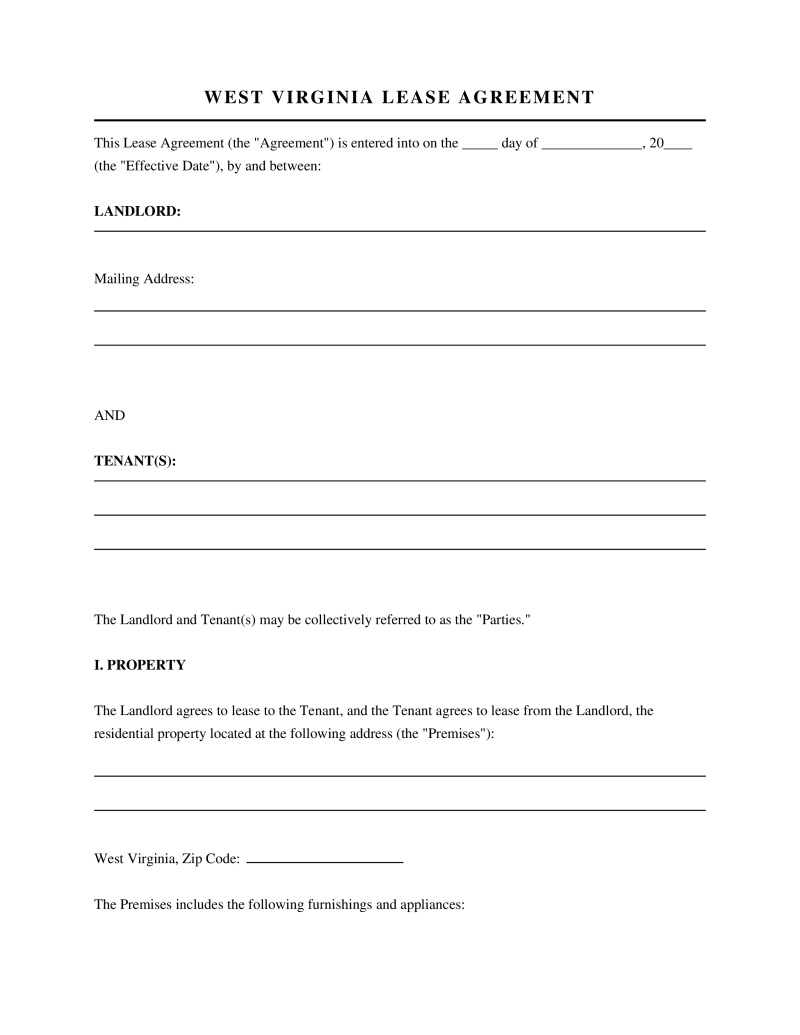
West Virginia Lease Agreement
A West Virginia Lease Agreement is a binding legal contract between a landlord and tenant that outlines the terms for renting property within the state.
Residential Property Type
Select the residential property category that best describes the rental premises.
Use this if the rental property does not fit one of the listed categories.
Table of Contents
What is a West Virginia Lease Agreement?
A West Virginia Lease Agreement is a legally binding contract entered into by a landlord and a tenant for the rental of residential or commercial property within the state. This document establishes the terms and conditions of the tenancy, outlining the rights and responsibilities of both parties regarding the use of the premises. It serves as the primary governing instrument for the landlord-tenant relationship, detailing critical elements such as the monthly rent amount, payment due dates, security deposit requirements, and rules concerning property maintenance. By signing this agreement, both the lessor and lessee agree to adhere to the stipulations set forth, which must comply with West Virginia state laws regarding real property and contracts.
Statutory Regulations and Legal Framework
The landlord-tenant relationship in West Virginia is primarily governed by Chapter 37 of the West Virginia Code. Specifically, Article 6 covers Landlord and Tenant regulations, while Article 6A addresses Residential Security Deposits. Unlike some jurisdictions that have adopted the Uniform Residential Landlord and Tenant Act (URLTA), West Virginia relies on its specific state statutes and common law. These laws provide the baseline for what can and cannot be included in a rental contract. For instance, while the state allows for significant freedom of contract, provisions that attempt to waive a tenant’s basic rights or conflict with state health and safety codes are generally considered void and unenforceable. Federal laws, such as the Fair Housing Act, also apply, prohibiting discrimination based on race, color, national origin, religion, sex, familial status, or disability.
Required Elements of a Valid West Virginia Lease Agreement
For a rental contract to be enforceable in a court of law, it must contain specific components that clearly define the agreement between the parties. While oral agreements for tenancies of less than one year can be valid, written contracts are standard for clarity and legal security. The following elements are essential for a comprehensive document:
- Identification of Parties: The full legal names of the landlord (lessor) and the tenant (lessee).
- Property Description: The complete physical address of the rental unit, including unit numbers if applicable.
- Term of Tenancy: The start and end dates of the lease, or specifications for a month-to-month arrangement.
- Rent Specifics: The amount of rent, the due date, acceptable payment methods, and the address where rent should be sent.
- Security Deposit Terms: The amount of the deposit and the conditions for its return or deduction.
- Signatures: The dated signatures of all adults named on the lease.
Security Deposit Regulations
West Virginia has specific statutes regarding the handling of security deposits under West Virginia Code § 37-6A-1 et seq. Unlike some states that place a cap on the amount a landlord can charge, West Virginia law does not explicitly limit the maximum security deposit amount. However, the law is strict regarding the return of these funds. Upon the termination of the tenancy, the landlord must return the security deposit, minus any lawful deductions for damages or unpaid rent. This must occur within 60 days of the termination of the tenancy or within 45 days of the occupancy by a subsequent tenant, whichever period is shorter. If a landlord fails to comply with these timelines, they may be liable for damages amounting to one and a half times the amount of the deposit.
Landlord Access and Tenant Privacy
West Virginia statutes are notably silent regarding a landlord's right of entry. Unlike states that mandate a specific notice period (such as 24 or 48 hours) before a landlord can enter a rental unit, West Virginia code does not explicitly define these parameters. Consequently, the terms of access are usually defined within the lease document itself. In the absence of a specific lease clause, common law suggests that landlords should provide reasonable notice before entering the property for non-emergency reasons, such as inspections or repairs. Immediate entry is generally accepted in cases of emergency where property or safety is at risk. To avoid disputes, it is standard practice to include a clause specifying required notice periods for routine maintenance.
How to Execute a West Virginia Lease Agreement
Finalizing a rental arrangement involves more than simply signing a paper. To ensure the document is legally sound and the tenancy begins smoothly, parties generally follow a structured process.
Step 1: Drafting and Review - The landlord prepares the document, ensuring all terms comply with West Virginia Code Chapter 37. Both parties should review the text to verify that rent amounts, dates, and responsibilities are accurately reflected.
Step 2: Required Disclosures - The landlord must provide any federally required disclosures. The most common is the Lead-Based Paint Disclosure for any property built prior to 1978, as mandated by federal law (Title X).
Step 3: Walk-Through Inspection - Before signing, the landlord and tenant should conduct a move-in inspection. Documenting the current condition of the premises helps prevent disputes regarding security deposit deductions later.
Step 4: Signing and Payment - All parties sign the document. At this time, the tenant typically pays the first month's rent and the security deposit.
Step 5: Distribution of Copies - The landlord must provide the tenant with a copy of the signed agreement for their records.
Termination and Eviction Rules
The process for ending a tenancy depends on the type of lease and the reason for termination. For a standard fixed-term lease, the tenancy ends on the date specified in the contract without need for further notice, unless the lease states otherwise. For month-to-month tenancies, West Virginia Code § 37-6-5 requires a notice of at least one full rental period prior to termination. In cases where a tenant fails to pay rent or breaches the contract, the landlord may pursue eviction. West Virginia allows for an "Immediate Petition for Eviction" in certain circumstances, but landlords must follow due process through the magistrate or circuit court and cannot engage in "self-help" evictions, such as changing locks or shutting off utilities without a court order.
FAQs
Already have a Lease Agreement?
Get it reviewed free — checked against your state's laws in about a minute.
Not the form you're looking for?
Try our legal document generator to create a custom document
Disclaimer: The templates available on this website are provided for general informational purposes only and do not constitute legal advice. They are not intended to be, and should not be interpreted as, compliant with any specific legal, regulatory, or privacy requirements. These templates are not a replacement for professional legal guidance and should not be relied upon for any particular matter or circumstance. Users are strongly encouraged to seek advice from a qualified attorney licensed in their jurisdiction before using, modifying, or relying on any template.
All templates are provided on an "as is," "with all faults," and "as available" basis. The provider disclaims any and all warranties of any kind, whether express, implied, statutory, or otherwise, including without limitation warranties of merchantability, fitness for a particular purpose, title, or non-infringement.
LegalTemplates.com makes no guarantees or representations regarding the accuracy, completeness, expected outcomes, or reliability of the materials contained in these templates or any materials referenced or linked from them.