Washington Lease Agreement Create a Washington Lease Agreement

Washington Lease Agreement

Published Dec 15, 2025
0 Comments
1 Downloads

A Washington Lease Agreement is a legal contract between a landlord and tenant that outlines the terms of a rental arrangement within the state jurisdiction.

Lease Type

Select the lease structure that best fits your rental arrangement. 'Fixed Term' leases have a set end date, while 'Month-to-Month' leases renew automatically each month.

Table of Contents

0% Complete 0/0 Fields

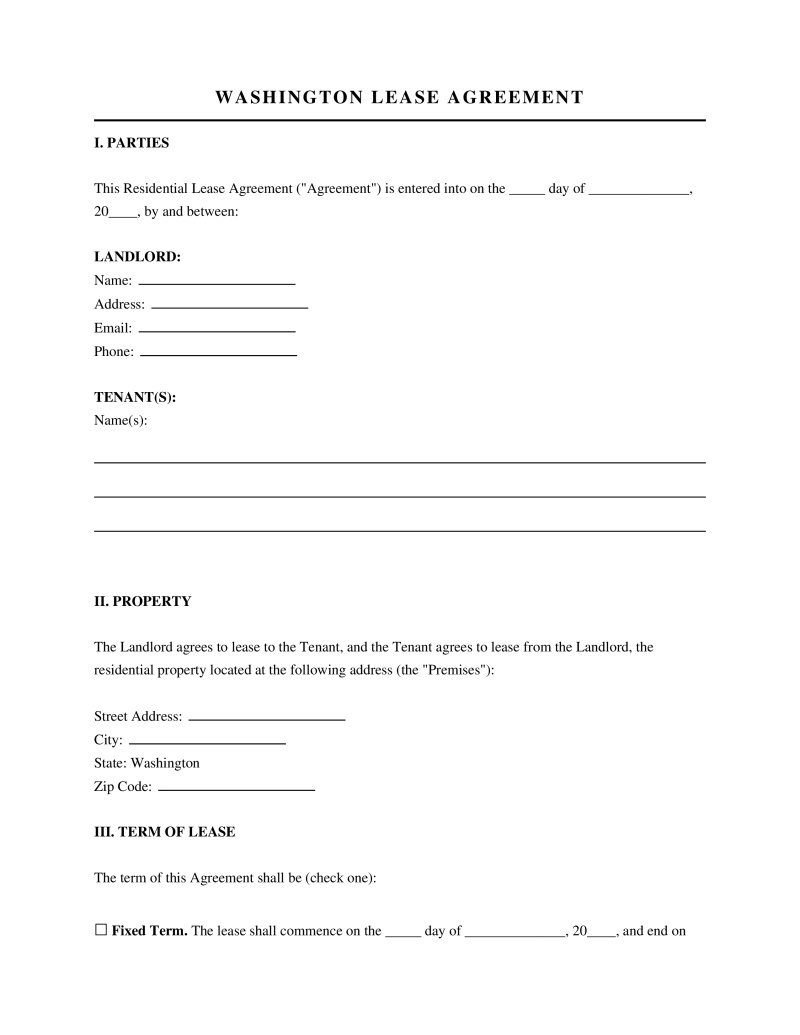
WASHINGTON LEASE AGREEMENT

I. PARTIES

This Residential Lease Agreement ("Agreement") is entered into on , by and between:

LANDLORD:
Name:
Address:
Email:
Phone:

TENANT(S):
Name(s):

II. PROPERTY

The Landlord agrees to lease to the Tenant, and the Tenant agrees to lease from the Landlord, the residential property located at the following address (the "Premises"):

III. TERM OF LEASE

The term of this Agreement shall be (check one):

IV. RENT

The Tenant agrees to pay the Landlord rent in the amount of $ per month.

Due Date: Rent is due on the day of each month.

First Month's Rent: The Tenant shall pay the first month's rent in the amount of $ upon the execution of this Agreement.

Payment Method: Rent shall be paid by:

Payment Address (if different from Landlord address):

Late Fee: If rent is not received by the day of the month, a late fee of $ shall be charged. (Note: Pursuant to RCW 59.18.170, late fees must be reasonable and may not be charged until rent is at least 5 days past due).

V. SECURITY DEPOSIT

Upon execution of this Agreement, the Tenant shall deposit with the Landlord the sum of $ as a security deposit.

Location of Deposit (REQUIRED BY RCW 59.18.270):
In accordance with Washington law, the security deposit will be held in a trust account at the following financial institution:

Name of Bank/Institution:
Address of Bank/Institution:

Move-In Checklist (REQUIRED BY RCW 59.18.260):
The Tenant acknowledges that a written checklist or statement specifically describing the condition and cleanliness of or existing damages to the Premises and furnishings, including, but not limited to, walls, floors, countertops, carpets, drapes, furniture, and appliances, has been provided by the Landlord and signed by both parties. No security deposit may be collected unless this checklist is completed.

Return of Deposit:
Pursuant to RCW 59.18.280, the Landlord shall, within thirty (30) days after the termination of the rental agreement and vacation of the premises, mail the full amount of the deposit to the Tenant, or a written statement explaining the basis for retaining any portion of the deposit along with the remainder of the deposit.

VI. UTILITIES AND SERVICES

Responsibility for payment of utilities and services shall be as follows:

Electricity:

Water/Sewer:

Gas/Oil:

Trash/Recycling:

Internet/Cable:

Landscaping/Lawn Care:

VII. OCCUPANTS AND GUESTS

The Premises shall be occupied only by the Tenant(s) listed in Section I and the following additional occupants (including minors):

Guests staying more than consecutive days or days in a twelve-month period require the Landlord's written consent.

VIII. PETS

IX. USE OF PREMISES

The Premises shall be used exclusively as a private residence. The Tenant shall comply with all applicable laws, ordinances, and regulations. The Tenant shall not engage in any illegal activity on the Premises, including but not limited to the use, possession, manufacture, or distribution of illegal drugs.

X. MAINTENANCE AND REPAIRS

Landlord's Duties (RCW 59.18.060):
The Landlord shall maintain the Premises in a fit and habitable condition, including maintaining structural components, plumbing, heating, and electrical systems, and providing appropriate locks and keys.

Tenant's Duties (RCW 59.18.130):
The Tenant shall keep the Premises clean and sanitary, properly use all appliances and facilities, and not deliberately or negligently destroy, deface, damage, impair, or remove any part of the Premises.

Alterations:
The Tenant shall not paint, wallpaper, or make any structural alterations to the Premises without the Landlord's prior written consent.

XI. RIGHT OF ENTRY

Pursuant to RCW 59.18.150, the Landlord shall provide the Tenant with at least two (2) days' written notice before entering the Premises for maintenance, repairs, or inspections. The Landlord shall provide one (1) day's notice before entering to show the dwelling to prospective or actual purchasers or tenants.

The Landlord may enter the Premises without notice in the event of an emergency or if the Tenant has abandoned the Premises.

XII. REQUIRED WASHINGTON DISCLOSURES

1. Lead-Based Paint Disclosure:

2. Mold Disclosure (RCW 59.18.060(13)):
The Tenant acknowledges receipt of the Department of Health's information regarding the health hazards associated with exposure to indoor mold.

3. Fire Safety and Protection (RCW 59.18.060(12)):
The Premises is equipped with working smoke detection devices. The Tenant acknowledges that it is their responsibility to maintain the smoke detectors in working order (including battery replacement) during the tenancy.

The building has a fire sprinkler system:

The building has a fire alarm system:

The building has a smoking policy:

4. Voter Registration (RCW 59.18.055):
The Landlord advises the Tenant that information regarding voter registration is available from the Washington Secretary of State and local county officials.

XIII. DEFAULT AND TERMINATION

Non-Payment of Rent:
If rent is unpaid when due, the Landlord may issue a 14-Day Notice to Pay or Vacate pursuant to RCW 59.18.057.

Lease Violations:
For non-compliance with the lease terms (other than non-payment of rent), the Landlord may issue a 10-Day Notice to Comply or Vacate pursuant to RCW 59.18.190.

XIV. ABANDONMENT

If the Tenant defaults in rent and reasonably indicates by words or actions the intention not to resume tenancy, the Tenant shall be liable for the following as provided in RCW 59.18.310: rent due, and the lesser of the actual damages or rent for the remainder of the term (subject to the Landlord's duty to mitigate).

XV. GOVERNING LAW

This Agreement shall be governed by and construed in accordance with the laws of the State of Washington, specifically the Residential Landlord-Tenant Act (RCW 59.18).

XVI. ENTIRE AGREEMENT

This Agreement constitutes the entire agreement between the parties and supersedes all prior understandings, whether written or oral. No amendment or modification of this Agreement shall be valid unless in writing and signed by both parties.

XVII. ADDITIONAL PROVISIONS

XVIII. SIGNATURES

IN WITNESS WHEREOF, the parties have executed this Agreement on the date first written above.

LANDLORD:
Signature: _________________________
Print Name: _______________
Date:

TENANT(S):
Signature: _________________________
Print Name: _______________
Date:

What is a Washington Lease Agreement?

A Washington Lease Agreement is a legally binding contract executed between a landlord and a tenant to establish the terms for renting property within the state. This document outlines critical details such as the monthly rental amount, the duration of the tenancy, and the specific responsibilities assigned to each party regarding maintenance and utilities. It serves as the primary legal framework governing the landlord-tenant relationship, ensuring that both parties adhere to the Revised Code of Washington (RCW) regarding residential or commercial tenancies.

Legal Framework and Statutory Requirements

The primary statutory framework governing rental contracts in the state is the Residential Landlord-Tenant Act, found under Title 59 of the Revised Code of Washington (RCW 59.18). This legislation establishes minimum standards for habitable housing, security deposit regulations, and eviction procedures. Unlike some jurisdictions that rely heavily on common law, Washington provides a comprehensive statutory code that supersedes conflicting lease terms; any provision in a lease that attempts to waive rights guaranteed by the Act is generally considered void and unenforceable. Furthermore, specific municipalities, such as Seattle, have enacted additional ordinances that provide enhanced protections for tenants, requiring landlords to navigate both state and local regulations when drafting these documents.

Mandatory Disclosures in Washington

To ensure a Washington Lease Agreement is valid and enforceable, landlords must include specific disclosures mandated by state and federal law. Failure to include these items can lead to legal penalties or the inability to withhold security deposits.

  • Fire Safety and Protection: Landlords must provide a written notice describing the fire safety and protection information, including whether the unit has a smoking policy, if it has a fire sprinkler system, and where smoke detectors are located.
  • Mold Handout: Under RCW 59.18.060, a handout provided by the Department of Health regarding the dangers of mold and how to minimize it must be distributed to tenants.
  • Lead-Based Paint: For any property built before 1978, federal law requires the disclosure of known lead-based paint hazards and the provision of an EPA-approved information pamphlet.
  • Security Deposit Receipt: The name and address of the financial institution where the security deposit is held must be disclosed in the agreement.
  • Move-In Checklist: A signed statement detailing the condition of the unit is required if a security deposit is collected, per RCW 59.18.260. Without this checklist, the landlord is liable for the entire deposit amount.
  • Voter Registration: In Seattle specifically, landlords are often required to provide voter registration information to new tenants.

Security Deposits and Financial Regulations

Washington law imposes strict regulations on how security deposits are handled to prevent misappropriation of funds. Landlords are required to hold security deposits in a trust account separate from their personal funds, and they must provide the tenant with the location of these funds. Upon the termination of a Washington Lease Agreement, the landlord has 21 days to return the deposit or provide a written statement explaining why any portion was retained. If a landlord fails to adhere to the move-in checklist requirement or the 21-day return window, they may be liable for the full amount of the deposit plus potential legal costs. Non-refundable fees, such as cleaning fees, must be clearly distinguished from refundable deposits in the written contract to avoid confusion.

Lease Termination and Eviction Procedures

The termination of a tenancy depends heavily on the type of lease structure, such as a fixed-term versus a month-to-month arrangement. For month-to-month tenancies, Washington state law traditionally required a 20-day written notice from the landlord to terminate the agreement without cause, although recent legislative changes and local ordinances have introduced "just cause" eviction requirements in many areas. Fixed-term leases typically expire automatically at the end of the specified period unless the contract states otherwise. In cases of non-payment of rent, landlords must issue a 14-day notice to pay or vacate before commencing formal eviction proceedings. This period allows the tenant time to cure the default before the landlord can file an unlawful detainer action.

Landlord and Tenant Duties

Under the warranty of habitability implied in every residential lease, landlords are obligated to keep the premises fit for human habitation. This includes maintaining structural components, plumbing, heating, and electrical systems in good working order. Tenants, conversely, are responsible for maintaining the unit in a sanitary condition, paying rent on time, and refraining from causing intentional damage to the property. If a landlord fails to make necessary repairs within a statutory timeframe after receiving written notice, tenants may have legal remedies, including the right to repair and deduct the cost from rent or, in severe cases, terminate the lease without penalty.

Frequently Asked Questions

Yes, verbal rental agreements are generally valid in Washington for tenancies lasting less than one year. However, without a written Washington Lease Agreement, it is difficult to prove specific terms in court, and landlords cannot collect a security deposit without a written contract and move-in checklist.
State law requires landlords to provide at least two days' written notice before entering a rental unit for non-emergency reasons, such as inspections or repairs. For showing the unit to prospective tenants or buyers, only one day of notice is required.
Washington state statutes do not impose a specific cap on the amount a landlord can charge for a security deposit. However, local ordinances in cities like Seattle may limit the total move-in costs a tenant can be required to pay.
In a fixed-term lease, the rent cannot be increased until the lease expires and a new agreement is signed. For month-to-month tenancies, landlords must generally provide 60 days' written notice before a rent increase takes effect.
If a tenant breaks a fixed-term lease without legal justification, they may be liable for the rent for the remainder of the term or until the unit is re-rented. The landlord has a duty to mitigate damages by making reasonable efforts to find a new tenant.
Yes, landlords can charge late fees if the terms are clearly outlined in the rental agreement. However, these fees must be reasonable and cannot be charged until the rent is legally considered late.

Not the form you're looking for?

Try our legal document generator to create a custom document

Community Discussion

Share your experience and help others

0

Comments (0)

Leave a Comment

Your email will not be displayed publicly. It is used for validation purposes only and will never be used to send unwanted emails or sold to third parties.

No comments yet. Be the first to comment!

Legal Notice: Comments are personal opinions and do not constitute legal advice. Always consult a qualified attorney for matters specific to your situation.