Utah Lease Agreement
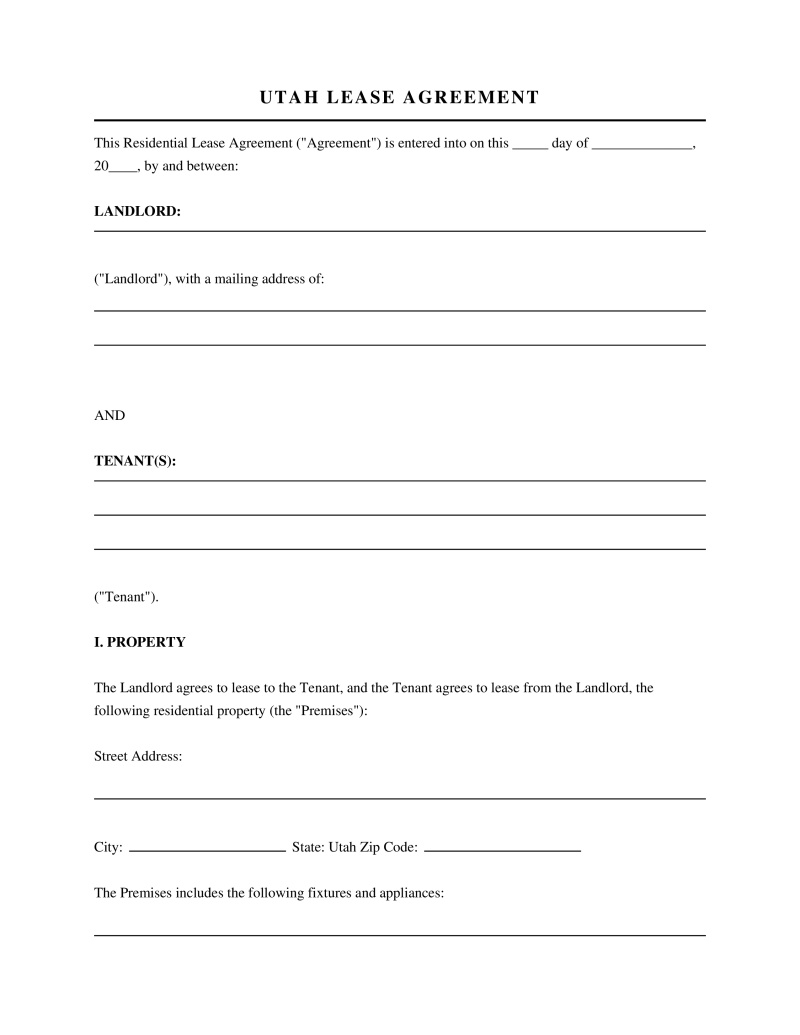
A Utah Lease Agreement is a legally binding contract between a landlord and tenant establishing terms for property rental in compliance with state laws.
Residential Property Type
Select the residential property category that best describes the rental premises.
Use this if the rental property does not fit one of the listed categories.
Table of Contents
What is a Utah Lease Agreement?
A Utah Lease Agreement is a legally binding contract executed between a landlord (lessor) and a tenant (lessee) regarding the rental of property within the state of Utah. This document outlines the specific terms and conditions of the tenancy, including the duration of the lease, the monthly rent amount, security deposit requirements, and the responsibilities of both parties regarding maintenance and utilities. It serves as the governing instrument for the landlord-tenant relationship, ensuring that both parties understand their rights and obligations under Utah state law and providing a clear framework for dispute resolution should issues arise during the occupancy.
Legal Framework and Statutory Requirements
The governance of rental contracts in this jurisdiction is primarily dictated by the Utah Code, specifically Title 57, Real Estate. Within this title, Chapter 17 covers the regulation of security deposits, while Chapter 22 constitutes the Utah Fit Premises Act. These statutes establish the baseline requirements for habitability, mandating that landlords provide safe and sanitary housing conditions. Unlike some jurisdictions, Utah does not impose rent control, allowing landlords discretion in setting rental rates, provided they adhere to the terms agreed upon in the signed contract.
Required Disclosures in Utah
For a residential tenancy document to be fully compliant, state and federal laws mandate specific disclosures. These ensure that the tenant is fully informed about the condition of the property and the identity of the management before taking possession.
- Methamphetamine Contamination Disclosure: Under Utah Code, if a property has been contaminated by methamphetamine use or production and has not been decontaminated to specific standards, the landlord must disclose this information to potential tenants.
- Owner/Agent Identification: The agreement must disclose the name and address of the property owner or the person authorized to manage the premises and receive legal notices.
- Lead-Based Paint Disclosure: Pursuant to federal law, any housing built prior to 1978 must include a warning statement and disclosure regarding the presence of lead-based paint.
- Move-in Checklist: While not a disclosure in the traditional sense, Utah law requires landlords to provide a condition checklist if a security deposit is collected, allowing tenants to document existing damages.
Security Deposits and Financial Regulations
Financial interactions between landlords and tenants are strictly regulated to prevent exploitation. Utah does not set a statutory limit on the maximum amount a landlord can charge for a security deposit. However, the law is explicit regarding the transparency and return of these funds. If any portion of a deposit is intended to be non-refundable, such as a cleaning fee or pet fee, this must be clearly stated in the written Utah Lease Agreement. If the non-refundable nature is not explicitly drafted, the law presumes the full deposit is refundable.
Upon the termination of the tenancy, the landlord is required to return the security deposit, minus any lawful deductions for damages or unpaid rent, within 30 days. Failure to comply with this timeframe or to provide an itemized list of deductions can result in the landlord being liable for the full deposit amount plus statutory penalties.
How to Execute a Valid Utah Lease Agreement
Creating and finalizing a rental contract involves several distinct steps to ensuring the document is enforceable in court.
Step 1: Drafting the Terms – The landlord prepares the document, ensuring all state-specific clauses regarding entry, repairs, and deposits are included and that no illegal provisions (such as waiving the right to a habitable premise) are present.
Step 2: Tenant Review and Negotiation – The prospective tenant reviews the terms. This is the stage where parties may negotiate rent amounts, lease duration, or specific rules regarding pets and subletting.
Step 3: Conducting the Walkthrough – Both parties should inspect the property together using a move-in checklist to document the current condition of the premises, which protects the tenant's security deposit.
Step 4: Signing and Dating – All parties named in the agreement must sign and date the document. While notarization is not required for a standard lease, providing a copy to all signatories is standard legal practice.
Rights of Entry and Privacy
Tenant privacy is protected under state statutes, although landlords retain the right to enter the premises for legitimate business purposes. These purposes typically include inspections, necessary repairs, or showing the unit to prospective buyers or future tenants. Unless it is an emergency, Utah law generally requires landlords to provide at least 24 hours of notice before entering the rental unit. The entry must also occur at reasonable times. A lease agreement may specify different notice periods, but these clauses must not be unconscionable or violate the tenant's right to quiet enjoyment of the property.
Applicable Laws and Penalties
The enforcement of a Utah Lease Agreement is backed by both the Utah Code and federal statutes. The Utah Fair Housing Act prohibits discrimination in the rental market based on race, color, religion, sex, national origin, familial status, source of income, disability, sexual orientation, or gender identity. Violations of these anti-discrimination laws can lead to investigations by the Utah Antidiscrimination and Labor Division and significant civil penalties.
Furthermore, the Utah Fit Premises Act (Utah Code § 57-22) outlines the penalties for landlords who fail to maintain habitable living conditions. If a landlord neglects critical repairs affecting health and safety, tenants may have the right to terminate the lease early or, in some specific cases, conduct a "repair and deduct" remedy, provided they follow strict notice procedures outlined in the statute.
Frequently Asked Questions
Lease Agreement in other states
Already have a Lease Agreement?
Get it reviewed free — checked against your state's laws in about a minute.
Not the form you're looking for?
Try our legal document generator to create a custom document
Disclaimer: The templates available on this website are provided for general informational purposes only and do not constitute legal advice. They are not intended to be, and should not be interpreted as, compliant with any specific legal, regulatory, or privacy requirements. These templates are not a replacement for professional legal guidance and should not be relied upon for any particular matter or circumstance. Users are strongly encouraged to seek advice from a qualified attorney licensed in their jurisdiction before using, modifying, or relying on any template.
All templates are provided on an "as is," "with all faults," and "as available" basis. The provider disclaims any and all warranties of any kind, whether express, implied, statutory, or otherwise, including without limitation warranties of merchantability, fitness for a particular purpose, title, or non-infringement.
LegalTemplates.com makes no guarantees or representations regarding the accuracy, completeness, expected outcomes, or reliability of the materials contained in these templates or any materials referenced or linked from them.