Texas Lease Agreement Create a Texas Lease Agreement

Texas Lease Agreement

Updated Dec 15, 2025
0 Comments
2 Downloads

A Texas Lease Agreement is a legally binding contract between a landlord and a tenant outlining the terms of renting a property within the state of Texas.

Lease Type

Select the lease structure that best fits your rental arrangement. 'Fixed Term' leases have a set end date, while 'Month-to-Month' leases renew automatically each month.

Table of Contents

0% Complete 0/0 Fields

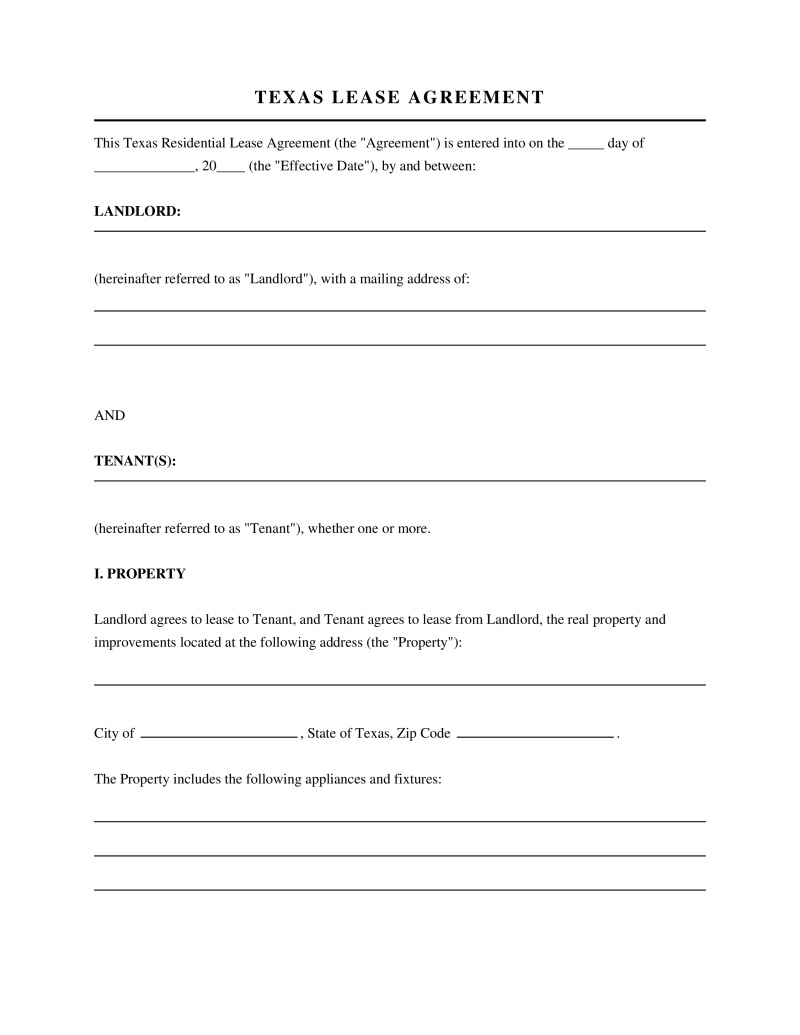
TEXAS LEASE AGREEMENT

This Texas Residential Lease Agreement (the "Agreement") is entered into on (the "Effective Date"), by and between:

LANDLORD:
Name:
(hereinafter referred to as "Landlord"), with a mailing address of:

AND TENANT(S):
Name:

(hereinafter referred to as "Tenant"), whether one or more.

I. PROPERTY

Landlord agrees to lease to Tenant, and Tenant agrees to lease from Landlord, the real property and improvements located at the following address (the "Property"):

The Property includes the following appliances and fixtures:

II. TERM

The term of this Agreement shall be (check one):

III. RENT

1. Rent Amount. Tenant agrees to pay Landlord a monthly rent of $.

2. Due Date. Rent is due on the day of each month.

3. Payment Method. Rent shall be paid by (check all that apply):

Payment instructions:

4. Late Fees. Pursuant to Texas Property Code Section 92.019, Landlord may not charge a late fee until the rent has remained unpaid for two (2) full days after the date the rent was originally due.

If rent is not paid by the day of the month, Tenant shall pay a late fee of (check one):

(Note: Under Texas law, late fees must be reasonable and may not exceed 12% of the amount of rent for a dwelling containing four or fewer units).

5. Returned Checks. If a check is returned for insufficient funds, Tenant shall pay a charge of $ (not to exceed $30.00 per Texas Business & Commerce Code Section 3.506) plus any bank charges incurred by Landlord.

IV. SECURITY DEPOSIT

1. Amount. Tenant agrees to pay a security deposit of $ upon signing this Agreement.

2. Refund and Deductions. In accordance with Texas Property Code Section 92.103, Landlord shall refund the security deposit to Tenant on or before the 30th day after the date the Tenant surrenders the Property.

3. Conditions for Refund.
a. Tenant must provide Landlord with a written forwarding address.
b. No rent shall be due and unpaid.
c. The Property must be cleaned and returned in the same condition as when received, normal wear and tear excepted.

4. Deductions. Landlord may deduct from the security deposit damages and charges for which Tenant is legally liable under this Agreement or as a result of breaching this Agreement. Landlord may not retain any portion of the security deposit to cover normal wear and tear (Texas Property Code Section 92.104).

V. USE OF PROPERTY AND OCCUPANTS

1. Permitted Use. The Property shall be used as a private single-family residence only.

2. Occupants. The Property shall be occupied only by the Tenant(s) listed above and the following additional occupants:

3. Guests. Guests may stay no longer than days without prior written consent of Landlord.

4. Pets. (Check one)

VI. UTILITIES AND SERVICES

Responsibility for payment of utilities and services shall be as follows:

Landlord pays:

Tenant pays:

VII. CONDITION OF PROPERTY AND MAINTENANCE

1. "As Is" Condition. Tenant accepts the Property in its current condition "as is." Tenant acknowledges that they have inspected the Property and that it is in good order and repair, except as noted in the Move-In Inventory form.

2. Landlord's Duty to Repair. Pursuant to Texas Property Code Subchapter B, Landlord shall make a diligent effort to repair or remedy any condition that materially affects the physical health or safety of an ordinary tenant, provided Tenant gives notice of the condition and is not delinquent in rent.

3. Tenant's Responsibilities. Tenant shall keep the Property clean and sanitary. Tenant is responsible for repairing any damage caused by Tenant's negligence or misuse, or that of their guests or pets.

4. Security Devices. Landlord has provided the Property with all security devices required by Texas Property Code Subchapter D, Chapter 92 (e.g., window latches, deadbolts, keyless bolting devices, door viewers, and sliding door security bars). Tenant may not alter or re-key locks without Landlord's consent.

5. Smoke Alarms. Landlord has installed smoke alarms as required by Texas Property Code Subchapter F, Chapter 92. Tenant shall not disconnect or disable smoke alarms.

VIII. RIGHT OF ENTRY

Landlord or Landlord's agents may enter the Property at reasonable times to inspect, make repairs, or show the Property to prospective tenants or buyers. Except in cases of emergency, Landlord shall provide Tenant with hours notice prior to entry.

IX. EARLY TERMINATION RIGHTS (STATUTORY)

1. Military Deployment. Tenant may terminate this Agreement if Tenant enlists or is drafted or commissioned in the U.S. Armed Forces or is ordered to deploy or station change, in accordance with Texas Property Code Section 92.017.

2. Family Violence. Tenant may terminate this Agreement if Tenant provides Landlord with a court order protecting Tenant from family violence, in accordance with Texas Property Code Section 92.016.

3. Sexual Offenses or Stalking. Tenant may terminate this Agreement if Tenant is a victim of sexual offenses or stalking, in accordance with Texas Property Code Section 92.0161.

X. DEFAULT

If Tenant fails to pay rent when due or fails to perform any term of this Agreement, Landlord may terminate this Agreement and proceed with eviction in accordance with Texas Property Code Chapter 24. Landlord shall provide at least three (3) days' written notice to vacate before filing an eviction suit, unless the parties have agreed in writing to a shorter or longer period (Texas Property Code Section 24.005).

XI. DISCLOSURES AND NOTICES

1. Landlord/Agent Identity. Pursuant to Texas Property Code Section 92.201, the name and address of the owner of the Property or the person authorized to act on behalf of the owner for the purpose of service of process and receiving notices is:

Name:
Address:

2. Lead-Based Paint. If the Property was constructed before 1978, Landlord must provide a Lead-Based Paint Disclosure.

Construction Year:

3. Parking Rules. If the Property is in a multi-unit complex, Landlord has provided Tenant with a copy of any applicable towing or parking rules (Texas Property Code Section 92.0131).

XII. GENERAL PROVISIONS

1. Governing Law. This Agreement shall be governed by and construed in accordance with the laws of the State of Texas.

2. Entire Agreement. This Agreement constitutes the entire agreement between the parties and supersedes all prior agreements or understandings.

3. Amendment. No amendment or modification of this Agreement shall be valid unless in writing and signed by both parties.

4. Severability. If any provision of this Agreement is held to be invalid or unenforceable, the remaining provisions shall remain in full force and effect.

5. Waiver. The failure of Landlord to enforce any provision of this Agreement shall not be construed as a waiver or limitation of Landlord's right to subsequently enforce and compel strict compliance with every provision of this Agreement.

XIII. SPECIAL PROVISIONS

Additional terms and conditions:

XIV. SIGNATURES

IN WITNESS WHEREOF, the parties have executed this Agreement on the date first written above.

LANDLORD
Signature: _________________________
Print Name: _______________
Date:
Address: _______________

TENANT
Signature: _________________________
Print Name: _______________
Date:
Address:

What is a Texas Lease Agreement?

A Texas Lease Agreement is a legally binding contract executed between a landlord (lessor) and a tenant (lessee) to establish the terms for renting a residential or commercial property within the state. This document delineates the specific rights, responsibilities, and obligations of all parties involved, ensuring that the arrangement complies with state statutes and local ordinances. It serves as the primary governing instrument for the tenancy, addressing critical details such as rental payments, security deposits, property maintenance, and the duration of occupancy. While oral agreements can be valid for tenancies lasting less than one year, written contracts are standard practice to provide clear legal recourse in the event of a dispute.

Legal Framework and Statutory Governance

The landlord-tenant relationship in Texas is primarily governed by Title 8 of the Texas Property Code, specifically Chapter 92 for residential tenancies. These statutes set forth the minimum standards for habitability, security devices, and the return of security deposits. Additionally, federal laws such as the Fair Housing Act prevent discrimination based on race, color, national origin, religion, sex, familial status, or disability. Unlike some states with strict rent control measures, Texas law generally allows landlords to set rental rates and increase them with proper notice upon lease renewal, provided the terms are not discriminatory or retaliatory.

Mandatory Disclosures and Lease Provisions

To be enforceable and compliant with state law, a Texas Lease Agreement must include specific disclosures and provisions. Failure to include these elements can result in legal penalties or limit the landlord's ability to enforce certain lease terms.

  • Lead-Based Paint Disclosure: Required by federal law for any property constructed before 1978, informing tenants of potential lead hazards.
  • Landlord Identification: The lease must disclose the name and address of the owner or the property manager authorized to receive legal notices.
  • Parking Rules: For multi-unit complexes, landlords must provide a copy of towing or parking rules or include them directly in the lease agreement.
  • Tenant Remedies: The lease must contain language regarding the tenant's right to pursue remedies for conditions that materially affect the physical health or safety of an ordinary tenant, such as the "repair and deduct" statute.
  • Security Device Notice: Texas law has strict requirements regarding the installation of security devices, such as window latches, deadbolts, and peepholes, which must be operational when the tenant takes possession.

Security Deposit Regulations

Under Chapter 92, Subchapter C of the Texas Property Code, specific regulations govern the handling of security deposits. Landlords are required to return the security deposit to the tenant within 30 days after the tenant surrenders the premises. If any portion of the deposit is retained, the landlord must provide a written description and itemized list of all deductions. Deductions are permissible for damages beyond normal wear and tear, unpaid rent, or breach of lease terms. If a landlord acts in bad faith by failing to return the deposit or provide an itemized list, they may be liable for three times the amount of the deposit plus $100 and reasonable attorney's fees.

Rent Payments and Late Fees

Texas statutes place specific limitations on when and how landlords can charge late fees. According to Section 92.019 of the Texas Property Code, a landlord may not charge a late fee unless the rent remains unpaid for at least two full days after the due date. Furthermore, the late fee provision must be included in the written lease, and the fee amount must be reasonable. A fee is generally considered reasonable if it is not more than 12% of the amount of rent for structures with four or fewer units, or 10% for structures with more than four units. This statutory grace period is a critical component of Texas rental law that protects tenants from immediate penalties.

Landlord Right of Entry

Unlike many other states that mandate a specific notice period (such as 24 or 48 hours) before a landlord enters a rental unit, Texas law does not specify a statutory notice period for non-emergency entry. Consequently, the right of entry is largely determined by the terms set forth in the lease agreement. Most standard Texas Lease Agreements include a provision granting the landlord access for inspections, repairs, or showings, typically requiring reasonable notice. In emergency situations, such as a fire or major water leak, landlords are generally permitted to enter the property without prior notice to prevent further damage.

Termination and Eviction Procedures

When a lease violation occurs, such as non-payment of rent, the landlord must follow specific legal procedures to terminate the tenancy. The process begins with a Notice to Vacate. Under Section 24.005 of the Texas Property Code, the landlord must give the tenant at least three days' written notice to vacate the premises before filing a forcible detainer suit (eviction lawsuit), unless the lease specifies a different time period (which can be as short as 24 hours). If the tenant fails to vacate, the landlord must file suit in the Justice of the Peace court in the precinct where the property is located. Self-help evictions, such as changing locks or removing tenant property without a court order, are illegal in Texas.

FAQs

Yes, verbal lease agreements are generally valid in Texas for tenancies lasting one year or less. However, they are difficult to enforce in court due to the lack of written evidence regarding the specific terms agreed upon by both parties.
Texas law does not mandate a specific notice period for entry unless stated in the lease. However, most standard leases require landlords to provide reasonable notice, usually 24 hours, except in cases of emergency.
There is no statutory limit on the amount a landlord can charge for a security deposit in Texas. The amount is determined by the market and the agreement between the landlord and the tenant.
Under Texas Property Code Section 92.019, a landlord cannot charge a late fee until the rent has remained unpaid for at least two full days after the due date.
Yes, but only under specific, strict conditions outlined in the Texas Property Code. The condition must materially affect health or safety, and the tenant must follow precise notice procedures before deducting repair costs from rent.
Yes, the Texas Property Code requires landlords to rekey the security devices on all exterior doors of a residential rental property no later than the seventh day after a new tenant moves in.

Not the form you're looking for?

Try our legal document generator to create a custom document

Community Discussion

Share your experience and help others

0

Comments (0)

Leave a Comment

Your email will not be displayed publicly. It is used for validation purposes only and will never be used to send unwanted emails or sold to third parties.

No comments yet. Be the first to comment!

Legal Notice: Comments are personal opinions and do not constitute legal advice. Always consult a qualified attorney for matters specific to your situation.