South Carolina Lease Agreement Create a South Carolina Lease Agreement

South Carolina Lease Agreement

Updated Dec 11, 2025
0 Comments
1 Downloads

A South Carolina Lease Agreement is a legal contract that sets the rental terms, responsibilities, and conditions both the landlord and tenant agree to when renting property in the state.
Lease Type

Select the lease structure that best fits your rental arrangement. 'Fixed Term' leases have a set end date, while 'Month-to-Month' leases renew automatically each month.

Table of Contents

0% Complete 0/0 Fields

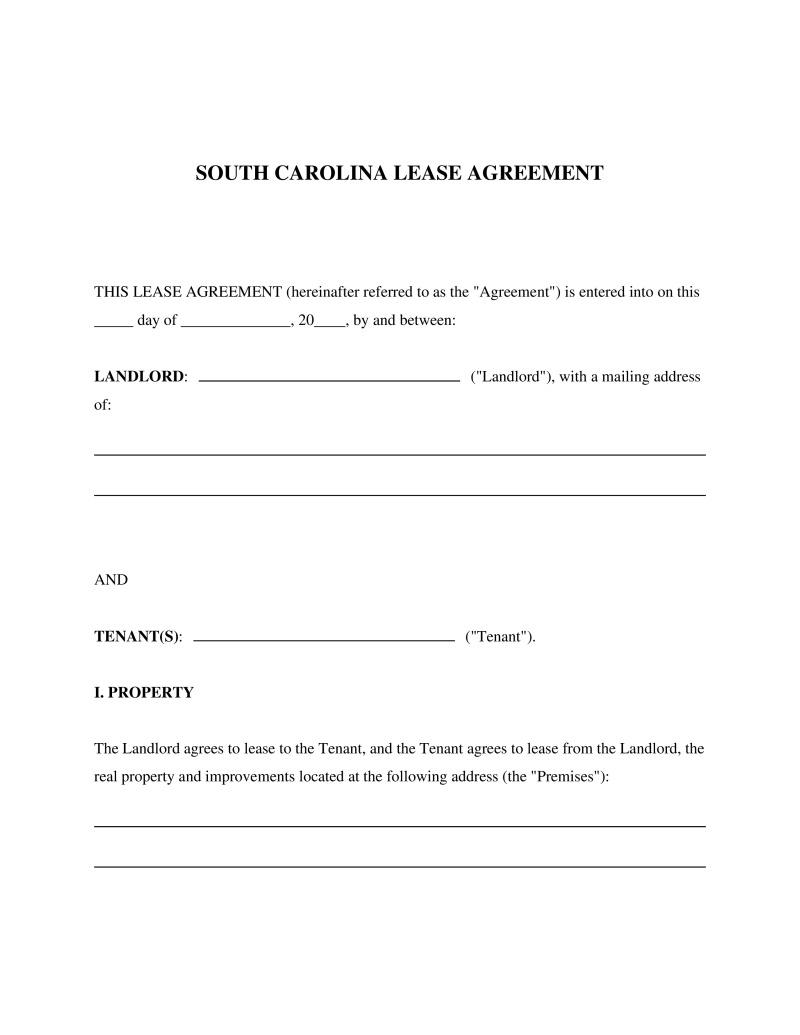
SOUTH CAROLINA LEASE AGREEMENT

THIS LEASE AGREEMENT (hereinafter referred to as the "Agreement") is entered into on this , by and between:

LANDLORD:
Name:
Mailing Address:
("Landlord")

AND TENANT(S):
Name:
("Tenant")

I. PROPERTY

The Landlord agrees to lease to the Tenant, and the Tenant agrees to lease from the Landlord, the real property and improvements located at the following address (the "Premises"):

II. TERM

The term of this Agreement shall be (check one):

III. RENT

The Tenant shall pay to the Landlord the sum of $ per month as Rent for the Term of the Agreement.

The Rent shall be due on the day of each month (the "Due Date").

Rent shall be paid via the following method(s):

IV. SECURITY DEPOSIT

Pursuant to South Carolina Code Section 27-40-410, the Tenant shall pay a security deposit in the amount of $ to the Landlord upon the execution of this Agreement.

1. Return of Deposit: The Landlord shall return the security deposit, less any deductions for accrued rent and damages suffered by the Landlord by reason of the Tenant's noncompliance with Section 27-40-510, within thirty (30) days after the termination of the tenancy and delivery of possession and demand by the Tenant, whichever is later.
2. Itemized List: If any deductions are made, the Landlord shall provide the Tenant with a written itemized list of damages and the amount withheld.
3. Forwarding Address: The Tenant must provide the Landlord in writing with a forwarding address for the return of the security deposit.

V. LATE CHARGES AND RETURNED CHECKS

If Rent is not paid by the day of the month, the Tenant shall pay a late fee of $.

If any check offered by the Tenant to the Landlord in payment of rent or any other amount due under this Agreement is returned for lack of sufficient funds, a "stop payment," or any other reason, the Tenant shall pay to the Landlord a returned check fee of $.

VI. NOTICE OF RENT DEFAULT (S.C. CODE § 27-40-710(B))

IF YOU DO NOT PAY YOUR RENT ON TIME, THIS IS YOUR NOTICE. IF YOU DO NOT PAY YOUR RENT WITHIN FIVE (5) DAYS OF THE DUE DATE, THE LANDLORD CAN START TO HAVE YOU EVICTED. YOU WILL GET NO OTHER NOTICE AS LONG AS YOU LIVE IN THIS RENTAL UNIT.

VII. OCCUPANTS

The Premises shall be occupied only by the Tenant and the following individuals:

VIII. UTILITIES AND SERVICES

The Landlord shall be responsible for providing the following utilities and services:


The Tenant shall be responsible for obtaining and paying for all other utilities and services not listed above.

IX. PETS

X. RIGHT OF ENTRY

Pursuant to South Carolina Code Section 27-40-530:
1. The Tenant shall not unreasonably withhold consent to the Landlord to enter into the dwelling unit in order to inspect the Premises, make necessary or agreed repairs, decorations, alterations, or improvements, supply necessary or agreed services, or exhibit the dwelling unit to prospective or actual purchasers, mortgagees, tenants, workmen, or contractors.
2. The Landlord or Landlord's agent may enter the dwelling unit without consent of the Tenant:
a. At any time in case of emergency, including but not limited to change in weather conditions which pose a likelihood of danger to the property;
b. Between the hours of 9:00 a.m. and 6:00 p.m. for the purpose of providing regularly scheduled periodic services (as defined in the lease), provided the Landlord announces their intent to enter;
c. Between the hours of 8:00 a.m. and 8:00 p.m. for the purpose of providing services requested by the Tenant.
3. Unless the entry is for one of the reasons stated above or is an emergency, the Landlord shall give the Tenant at least twenty-four (24) hours notice of the intent to enter and may enter only at reasonable times.

XI. MAINTENANCE AND REPAIRS

Tenant's Duties: Pursuant to S.C. Code Section 27-40-510, the Tenant shall:
1. Comply with all obligations primarily imposed upon tenants by applicable provisions of building and housing codes materially affecting health and safety;
2. Keep the dwelling unit and that part of the premises that he uses safe and reasonably clean;
3. Dispose from his dwelling unit all ashes, garbage, rubbish, and other waste in a reasonably clean and safe manner;
4. Keep all plumbing fixtures in the dwelling unit or used by the Tenant reasonably clean;
5. Use in a reasonable manner all electrical, plumbing, sanitary, heating, ventilating, air-conditioning, and other facilities and appliances including elevators in the premises;
6. Not deliberately or negligently destroy, deface, damage, impair, or remove any part of the premises or knowingly permit any person to do so;
7. Conduct himself and require other persons on the premises with his consent to conduct themselves in a manner that will not disturb his neighbors' peaceful enjoyment of the premises.

Landlord's Duties: Pursuant to S.C. Code Section 27-40-440, the Landlord shall:
1. Comply with the requirements of applicable building and housing codes materially affecting health and safety;
2. Make all repairs and do whatever is necessary to put and keep the premises in a fit and habitable condition;
3. Keep all common areas of the premises in a reasonably safe condition;
4. Maintain in good and safe working order and condition all electrical, gas, plumbing, sanitary, heating, ventilating, air-conditioning, and other facilities and appliances supplied or required to be supplied by him.

XII. DISCLOSURE OF LANDLORD/AGENT

Pursuant to S.C. Code Section 27-40-420, the Landlord or a person authorized to enter into a rental agreement on his behalf shall disclose to the Tenant in writing at or before the commencement of the tenancy the name and address of an owner of the premises or a person authorized to act on behalf of the owner as agent, inter alia, for purposes of service of process and receiving or receipting notices or demands.

Authorized Person/Agent:
Name:
Address:

Owner:
Name:
Address:

XIII. LEAD-BASED PAINT DISCLOSURE

Housing built before 1978 may contain lead-based paint. Lead from paint, paint chips, and dust can pose health hazards if not managed properly. Lead exposure is especially harmful to young children and pregnant women.

The Premises was built:

XIV. ABANDONMENT

Pursuant to S.C. Code Section 27-40-730, the unexplained absence of a Tenant from a dwelling unit for a period of fifteen (15) days after default in the payment of rent must be construed as abandonment of the dwelling unit. If the Tenant abandons the dwelling unit, the Landlord shall make reasonable efforts to rent it at a fair rental.

XV. GOVERNING LAW

This Agreement shall be governed by and construed in accordance with the laws of the State of South Carolina, specifically the South Carolina Residential Landlord and Tenant Act (Title 27, Chapter 40 of the Code of Laws of South Carolina).

XVI. ENTIRE AGREEMENT

This Agreement constitutes the entire agreement between the parties and supersedes all prior understandings, agreements, or representations. This Agreement may only be modified in writing and signed by both parties.

XVII. ADDITIONAL TERMS AND CONDITIONS

Additional terms and conditions are as follows:

XVIII. SIGNATURES

LANDLORD:
Signature: _________________________
Date:
Print Name: _______________

TENANT:
Signature: _________________________
Date:
Print Name: _______________

What is a South Carolina Lease Agreement?

A South Carolina Lease Agreement is a legally binding contract executed between a landlord (lessor) and a tenant (lessee) regarding the rental of property within the state. This document serves to outline the specific terms and conditions under which the tenant is permitted to occupy the premises, including the monthly rent amount, payment schedule, and duration of the tenancy. By signing this agreement, both parties acknowledge their acceptance of the rules governing the property and their respective responsibilities under state law. It acts as the primary legal record in the event of a dispute, ensuring that the rights of both the property owner and the occupant are protected under the South Carolina Residential Landlord and Tenant Act.

Legal Framework and Statutory Regulations

The governance of residential tenancies in the state is primarily dictated by the South Carolina Residential Landlord and Tenant Act, found in Title 27, Chapter 40 of the South Carolina Code of Laws. This comprehensive statute establishes the minimum obligations for landlords, such as maintaining fit and habitable premises, and for tenants, such as paying rent on time and maintaining the dwelling unit. While the state allows for significant freedom of contract, any provision within a South Carolina Lease Agreement that conflicts with these statutes is generally considered unenforceable. For example, a landlord cannot include clauses that waive the tenant's rights to essential services or authorize the landlord to seize personal property without a court order.

Mandatory Disclosures and Provisions

State and federal laws require specific disclosures to be included in or attached to the lease document. Failure to provide these disclosures can result in legal penalties or potential liability for the landlord.

Lead-Based Paint Disclosure

In compliance with federal law (42 U.S. Code § 4852d), any lease involving a residential structure built prior to 1978 must include a disclosure regarding the presence of lead-based paint. The landlord must provide the tenant with an EPA-approved information pamphlet and a statement warning of the potential health hazards associated with lead exposure.

Identification of Landlord or Agent

According to S.C. Code § 27-40-420, the landlord or a person authorized to enter into the rental agreement must disclose to the tenant in writing the name and address of the owner of the premises or a person authorized to act on behalf of the owner. This ensures the tenant knows whom to contact for service of process or receiving notices and demands.

Unequal Security Deposits

If a landlord owns more than four adjoining dwelling units and imposes different security deposit amounts for different tenants, they must disclose the standards used to calculate these deposits. This transparency is required under S.C. Code § 27-40-410 to prevent discriminatory practices in calculating move-in costs.

Essential Elements of a Valid South Carolina Lease

To ensure the document is legally enforceable and provides adequate protection for both parties, specific elements must be present. Omission of these details can lead to ambiguity and legal challenges.

  • Party Identification: Full legal names of the landlord and all adult tenants responsible for the lease.
  • Property Description: The complete physical address of the rental unit, including unit numbers if applicable.
  • Lease Term: The start and end dates of the tenancy, or a statement indicating a month-to-month arrangement.
  • Rent Details: The exact amount of rent, the due date, acceptable payment methods, and the address where rent must be sent.
  • Security Deposit: The amount of the deposit and the terms regarding its return and potential deductions.
  • Signatures: The dated signatures of the landlord and all tenants.

Security Deposits and Rent Rules

South Carolina law provides specific guidelines regarding financial transactions between landlords and tenants. While there is no statutory limit on the amount a landlord may charge for a security deposit, the return of these funds is strictly regulated. Upon the termination of the tenancy, the landlord has 30 days to return the security deposit to the tenant. If any deductions are made for unpaid rent or damages beyond normal wear and tear, the landlord must provide an itemized list of these deductions alongside the remaining balance.

Regarding rent payments, the state does not mandate a statutory grace period. Rent is legally due on the date specified in the South Carolina Lease Agreement. However, if the landlord intends to charge late fees, the conditions for such fees must be clearly stated in the contract. Additionally, if the lease contains a specific notice regarding non-payment, the landlord may initiate eviction proceedings after five days of non-payment without sending further notice.

Landlord Access and Tenant Privacy

The balance between a tenant's right to quiet enjoyment and a landlord's right to maintain the property is codified in S.C. Code § 27-40-530. A landlord must typically provide at least 24 hours' notice before entering the dwelling unit and may only enter at reasonable times (usually defined as between 9:00 a.m. and 6:00 p.m.) for standard maintenance, inspections, or showing the property to prospective buyers or tenants. In cases of emergency involving potential danger to life or property, the landlord may enter without prior notice or consent. Tenants are prohibited from unreasonably withholding consent for the landlord to enter for legitimate purposes.

FAQs

Yes, verbal rental agreements are generally valid in South Carolina for tenancies of one year or less. However, written agreements are strongly recommended to clearly define terms and prevent future disputes regarding the obligations of either party.
Under South Carolina law, either the landlord or the tenant must provide at least 30 days' written notice to terminate a month-to-month tenancy. This notice is typically required to be given prior to the start of the next rental period.
Generally, a tenant cannot unilaterally withhold rent for repairs without risking eviction. However, under the Residential Landlord and Tenant Act, tenants have specific remedies for essential services, which may involve giving written notice and potentially terminating the lease if the landlord fails to act within 14 days.
South Carolina statutes do not set a specific cap on late fees. However, late fees must be reasonable and clearly outlined in the lease agreement to be enforceable in court.
If a landlord fails to return the security deposit or an itemized list of deductions within 30 days after the lease ends and the tenant provides a forwarding address, the tenant may sue for up to three times the amount wrongfully withheld plus attorney's fees.
No, a standard residential lease agreement does not need to be notarized to be legally binding in South Carolina. It only requires the signatures of the landlord and the tenant.

Not the form you're looking for?

Try our legal document generator to create a custom document

Community Discussion

Share your experience and help others

0

Comments (0)

Leave a Comment

Your email will not be displayed publicly. It is used for validation purposes only and will never be used to send unwanted emails or sold to third parties.

No comments yet. Be the first to comment!

Legal Notice: Comments are personal opinions and do not constitute legal advice. Always consult a qualified attorney for matters specific to your situation.