Rhode Island Lease Agreement Create a Rhode Island Lease Agreement

Rhode Island Lease Agreement

Published Dec 10, 2025
0 Comments
1 Downloads

A Rhode Island Lease Agreement is a legal contract that defines the rental terms, duties, and conditions established between a landlord and tenant for property leased in the state.

Lease Type

Select the lease structure that best fits your rental arrangement. 'Fixed Term' leases have a set end date, while 'Month-to-Month' leases renew automatically each month.

Table of Contents

0% Complete 0/0 Fields

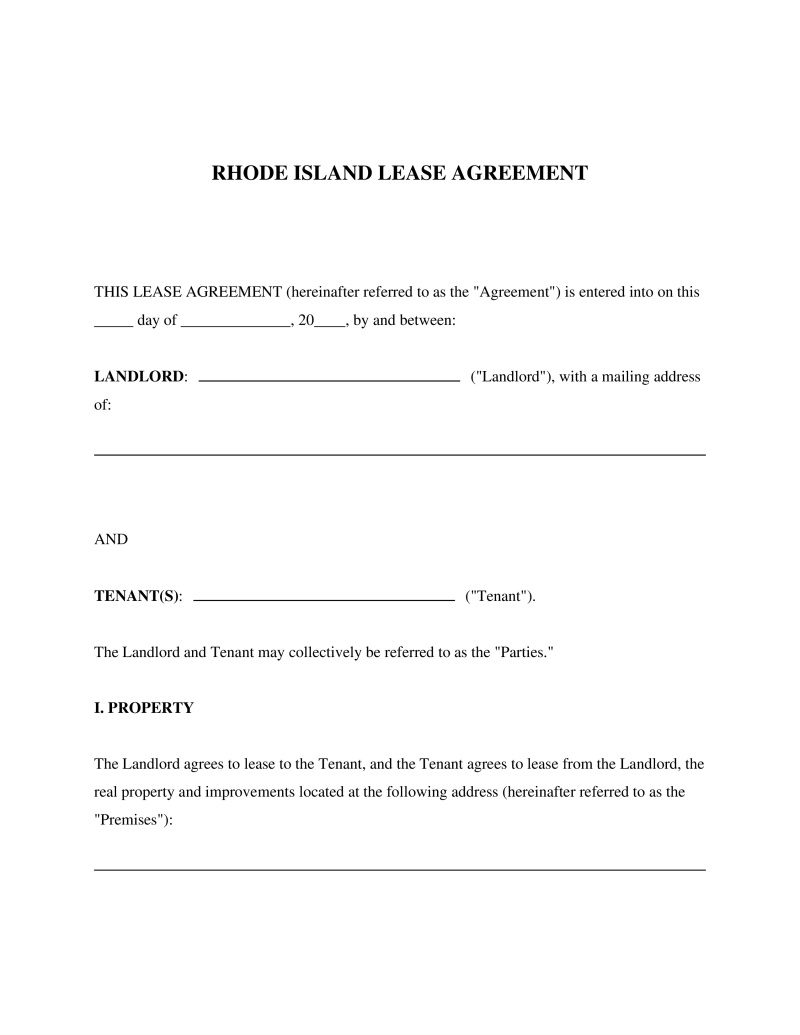
RHODE ISLAND LEASE AGREEMENT

THIS LEASE AGREEMENT (hereinafter referred to as the "Agreement") is entered into on this , by and between:

LANDLORD:
Name:
Mailing Address:
(hereinafter referred to as "Landlord")

AND TENANT(S):
Name:

(hereinafter referred to as "Tenant").

The Landlord and Tenant may collectively be referred to as the "Parties."

I. PROPERTY

The Landlord agrees to lease to the Tenant, and the Tenant agrees to lease from the Landlord, the real property and improvements located at the following address (hereinafter referred to as the "Premises"):

The Premises is described as:

II. TERM

The term of this Agreement shall be (check one):

III. RENT

The Tenant agrees to pay the Landlord rent in the amount of $ per month.

The rent shall be due on the day of each month (the "Due Date").

Rent shall be paid by the following method(s):

Rent shall be paid to the Landlord at the following address:

IV. SECURITY DEPOSIT

Upon execution of this Agreement, the Tenant shall deposit with the Landlord the sum of $ as a security deposit.

*Note: Pursuant to R.I. Gen. Laws § 34-18-19, the security deposit amount may not exceed one (1) month's periodic rent.*

The Landlord shall hold the security deposit for the faithful performance of the Tenant's obligations under this Agreement. The security deposit shall be returned to the Tenant within twenty (20) days after the termination of the tenancy, delivery of possession, and demand by the Tenant, less any deductions for unpaid rent or damages to the Premises beyond normal wear and tear.

If the Landlord retains any portion of the security deposit, the Landlord shall provide the Tenant with a written itemized list of damages and the cost of repairs.

V. LATE CHARGES AND RETURNED CHECKS

If rent is not received by the Landlord within days of the Due Date, the Tenant agrees to pay a late fee of $.

If any check offered by the Tenant to the Landlord in payment of rent or any other amount due under this Agreement is returned for lack of sufficient funds, a "stop payment," or any other reason, the Tenant shall pay to the Landlord a returned check fee of $.

*Note: Pursuant to R.I. Gen. Laws § 34-18-35, if the Tenant is more than fifteen (15) days in arrears in the payment of rent, the Landlord may send a written notice specifying the amount of rent overdue and stating that the rental agreement will terminate if not paid within five (5) days of mailing the notice.*

VI. UTILITIES AND SERVICES

The responsibility for utilities and services shall be allocated as follows:

Electricity:

Gas/Heating Fuel:

Water:

Sewer:

Trash Removal:

Cable/Internet:

Snow Removal:

Lawn Care:

Other:

VII. OCCUPANTS

The Premises shall be occupied only by the Tenant and the following individuals:

Guests staying more than days without the Landlord's written consent shall be considered a breach of this Agreement.

VIII. PETS

IX. USE OF PREMISES

The Premises shall be used and occupied by the Tenant and the Tenant's immediate family exclusively as a private single-family residence. The Tenant shall comply with all sanitary laws, ordinances, rules, and orders of appropriate governmental authorities affecting the cleanliness, occupancy, and preservation of the Premises.

X. CONDITION OF PREMISES

The Tenant stipulates, represents, and warrants that the Tenant has examined the Premises, and that they are at the time of this Lease in good order, repair, and in a safe, clean, and tenantable condition.

XI. MAINTENANCE AND REPAIRS

Landlord's Obligations: Pursuant to R.I. Gen. Laws § 34-18-22, the Landlord shall:

  1. Comply with the requirements of applicable building and housing codes materially affecting health and safety;
  2. Make all repairs and do whatever is necessary to put and keep the premises in a fit and habitable condition;
  3. Keep all common areas of the premises in a clean and safe condition;
  4. Maintain in good and safe working order and condition all electrical, plumbing, sanitary, heating, ventilating, air-conditioning, and other facilities and appliances supplied by the Landlord.

Tenant's Obligations: Pursuant to R.I. Gen. Laws § 34-18-24, the Tenant shall:

  1. Keep that part of the premises that he or she occupies and uses as clean and safe as the condition of the premises permit;
  2. Dispose from his or her dwelling unit all ashes, garbage, rubbish, and other waste in a clean and safe manner;
  3. Keep all plumbing fixtures in the dwelling unit or used by the tenant as clean as their condition permits;
  4. Use in a reasonable manner all electrical, plumbing, sanitary, heating, ventilating, air-conditioning, and other facilities and appliances in the premises;
  5. Not deliberately or negligently destroy, deface, damage, impair, or remove any part of the premises or knowingly permit any person to do so;
  6. Conduct himself or herself and require other persons on the premises with his or her consent to conduct themselves in a manner that will not disturb his or her neighbors' peaceful enjoyment of the premises.

XII. RIGHT OF ENTRY

Pursuant to R.I. Gen. Laws § 34-18-26, the Landlord shall have the right to enter the Premises to inspect the Premises, make necessary or agreed repairs, decorations, alterations, or improvements, supply necessary or agreed services, or exhibit the dwelling unit to prospective or actual purchasers, mortgagees, tenants, workers, or contractors.

Except in case of emergency or unless it is impracticable to do so, the Landlord shall give the Tenant at least two (2) days' notice of the Landlord's intent to enter and may enter only at reasonable times.

XIII. LEAD-BASED PAINT DISCLOSURE

Housing built before 1978 may contain lead-based paint. Lead from paint, paint chips, and dust can pose health hazards if not managed properly. Lead exposure is especially harmful to young children and pregnant women.

The Premises was constructed:

XIV. REQUIRED DISCLOSURES

1. Identification of Landlord and Agent (R.I. Gen. Laws § 34-18-20)

The following person is authorized to manage the Premises:

Name:
Address:

The following person is authorized to receive service of process, notices, and demands:

Name:
Address:

2. Code Violations

The Landlord discloses that the Premises:

XV. ABANDONMENT

If the Tenant vacates the Premises and leaves personal property, the Landlord may store the property and notify the Tenant of the Landlord's intent to dispose of the property after a reasonable time, in accordance with Rhode Island law.

XVI. GOVERNING LAW

This Agreement shall be governed, construed, and interpreted by, through, and under the Laws of the State of Rhode Island, specifically the "Residential Landlord and Tenant Act" (R.I. Gen. Laws Title 34, Chapter 18).

XVII. SEVERABILITY

If any provision of this Agreement or the application thereof shall, for any reason and to any extent, be invalid or unenforceable, neither the remainder of this Agreement nor the application of the provision to other persons, entities, or circumstances shall be affected thereby, but instead shall be enforced to the maximum extent permitted by law.

XVIII. ADDITIONAL PROVISIONS

Additional terms and conditions of this Agreement are:

XIX. ENTIRE AGREEMENT

This Agreement constitutes the sole and entire agreement of the Parties regarding the subject matter contained herein and supersedes all prior and contemporaneous understandings, agreements, representations, and warranties, both written and oral, regarding such subject matter.

IN WITNESS WHEREOF, the Parties have executed this Agreement as of the date first written above.

LANDLORD SIGNATURE
Signature: _________________________
Print Name: _______________
Date:

TENANT SIGNATURE
Signature: _________________________
Print Name: _______________
Date:

What is a Rhode Island Lease Agreement?

A Rhode Island Lease Agreement is a legally binding contract executed between a landlord (lessor) and a tenant (lessee) regarding the rental of property within the state. This document serves to outline the specific terms and conditions of the tenancy, including the duration of the lease, the monthly rent amount, payment schedules, and the responsibilities of both parties regarding maintenance and utilities. It is utilized for both residential and commercial properties to ensure that the arrangement complies with the Rhode Island Residential Landlord and Tenant Act, providing a clear legal framework to resolve potential disputes.

Legal Framework and Statutory Requirements

In Rhode Island, the landlord-tenant relationship is primarily governed by the Rhode Island General Laws, specifically Title 34, Chapter 18, known as the Residential Landlord and Tenant Act. This comprehensive statute standardizes the rights and obligations of both parties, ensuring that lease terms do not violate public policy. While federal laws such as the Fair Housing Act prohibit discrimination based on race, religion, national origin, gender, or disability, state laws provide specific regulations regarding security deposits, eviction procedures, and habitability standards.

Under Rhode Island General Laws § 34-18-19, landlords are strictly limited in the amount they may charge for a security deposit. The statute dictates that a security deposit cannot exceed the equivalent of one month's periodic rent. Furthermore, landlords are required to return the security deposit, minus any itemized deductions for unpaid rent or damages beyond normal wear and tear, within 20 days of the termination of the tenancy and the delivery of possession. Failure to comply with these regulations can result in the landlord being liable for damages equal to twice the amount withheld.

Required Disclosures in Rhode Island

To ensure a Rhode Island Lease Agreement is valid and compliant, landlords must provide specific disclosures to tenants prior to the execution of the contract. These mandates ensure transparency regarding the condition and management of the property.

  • Landlord/Manager Identification: Pursuant to § 34-18-20, the lease must disclose the name and address of the property owner and any person authorized to manage the premises or receive notices on behalf of the owner.
  • Code Violations: Under § 34-18-22.1, if there are any outstanding housing code violations on the property, the landlord must disclose these to potential tenants before the lease is signed.
  • Lead-Based Paint Disclosure: In accordance with federal law (42 U.S. Code § 4852d), landlords renting properties built prior to 1978 must provide a warning statement regarding lead-based paint hazards and an information pamphlet approved by the EPA.

Landlord Access and Tenant Privacy

The state statutes establish a balance between a landlord's right to maintain their property and a tenant's right to quiet enjoyment. According to Rhode Island General Laws § 34-18-26, a landlord is not permitted to abuse the right of access or use it to harass the tenant. Except in cases of emergency or if it is impracticable to do so, the landlord must give the tenant at least two days' notice of their intent to enter the unit. Entry is generally restricted to reasonable times. If a landlord repeatedly makes unlawful entries or lawful entries in an unreasonable manner, the tenant may seek injunctive relief or terminate the rental agreement.

Termination and Eviction Procedures

The process for terminating a tenancy in Rhode Island varies depending on the type of lease and the reason for termination. For month-to-month tenancies, either party must provide at least 30 days' written notice before the intended termination date. For week-to-week tenancies, the notice period is 10 days.

Eviction for non-payment of rent follows a specific timeline outlined in § 34-18-35. If rent is 15 days late, the landlord may send a notice demanding payment within five days. If the tenant fails to pay the full amount within that five-day window, the landlord may proceed with filing an eviction complaint. For other material non-compliance issues, such as violating lease terms regarding pets or noise, the landlord typically issues a notice allowing the tenant 20 days to remedy the breach. If the issue is not corrected, the agreement terminates 30 days after the notice was mailed.

How to Execute a Rhode Island Lease Agreement

Step 1: Negotiate Terms – The landlord and tenant discuss and agree upon the rent amount, security deposit, lease duration, and utility responsibilities.

Step 2: Draft the Agreement – The document is prepared incorporating all agreed-upon terms and mandatory state disclosures, such as the lead paint warning and code violation notice.

Step 3: Conduct Walk-Through – Both parties should inspect the property to document its current condition, often using a move-in checklist to prevent future disputes over damages.

Step 4: Sign and Date – Both the landlord and tenant sign the document. While notarization is not strictly required for standard residential leases, it is recommended for longer-term commercial agreements.

Step 5: Exchange Funds and Keys – The tenant pays the first month's rent and security deposit, and the landlord provides the keys to the premises.

FAQs

Rhode Island law creates a specific 15-day window regarding late rent. While a landlord cannot file for eviction until rent is 15 days late, the lease agreement itself determines when a late fee can be applied, provided the fee is reasonable.
Yes, under specific circumstances defined in § 34-18-30. If a landlord fails to provide essential services like heat or water, or fails to maintain the premises, a tenant may repair the issue and deduct the cost from the rent, provided the cost does not exceed $125 and proper notice was given.
Verbal agreements are generally recognized for tenancies of one year or less. However, they are difficult to enforce in court compared to a written Rhode Island Lease Agreement, which provides clear evidence of the terms agreed upon by both parties.
Landlords in Rhode Island may not demand or receive a security deposit that exceeds the amount of one month's periodic rent. Charging more than this statutory limit is a violation of the Residential Landlord and Tenant Act.
Yes. If a tenant abandons the property or terminates the lease early without legal cause, the landlord is required to make reasonable efforts to re-rent the unit at a fair rental price to mitigate the damages owed by the original tenant.

Not the form you're looking for?

Try our legal document generator to create a custom document

Community Discussion

Share your experience and help others

0

Comments (0)

Leave a Comment

Your email will not be displayed publicly. It is used for validation purposes only and will never be used to send unwanted emails or sold to third parties.

No comments yet. Be the first to comment!

Legal Notice: Comments are personal opinions and do not constitute legal advice. Always consult a qualified attorney for matters specific to your situation.