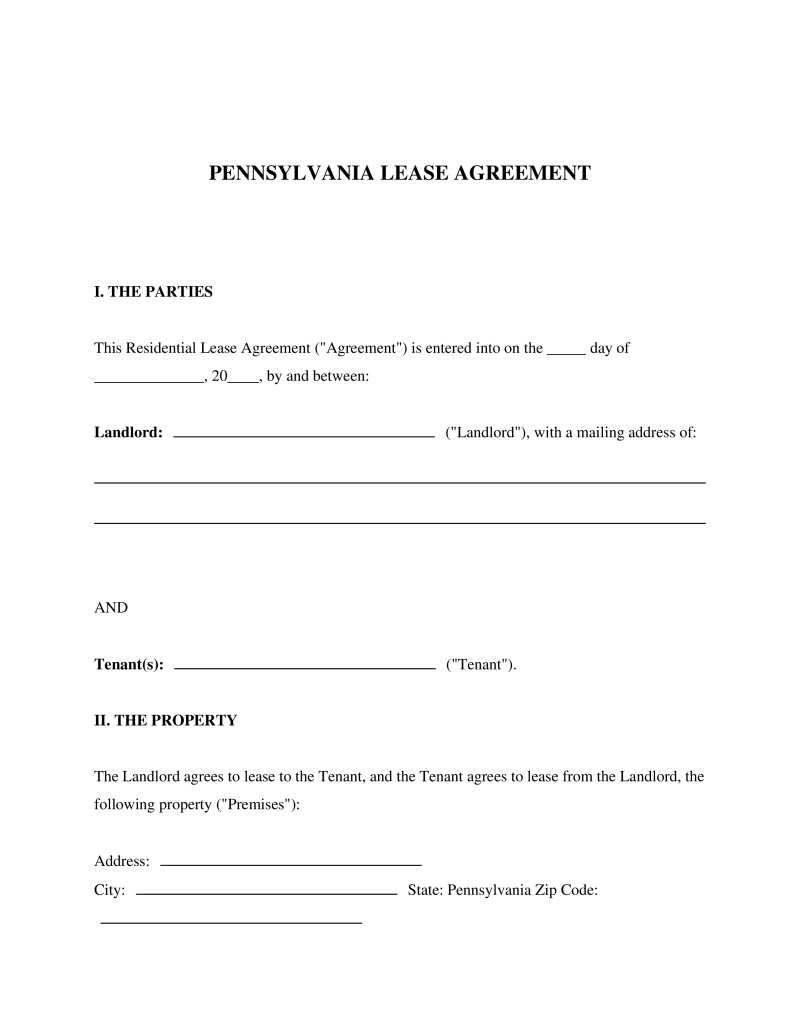
Pennsylvania Lease Agreement
A Pennsylvania Lease Agreement is a legal document that sets the rental terms, responsibilities, and conditions agreed upon by a landlord and tenant for property leased within the state.
Residential Property Type
Select the residential property category that best describes the rental premises.
Use this if the rental property does not fit one of the listed categories.
Table of Contents
What is a Pennsylvania Lease Agreement?
A Pennsylvania Lease Agreement is a legally binding contract executed between a landlord (lessor) and a tenant (lessee) regarding the rental of a residential or commercial property within the Commonwealth of Pennsylvania. This document formalizes the terms and conditions of the tenancy, outlining critical details such as the monthly rent amount, payment due dates, security deposit requirements, and the duration of the lease term. Its primary purpose is to clearly define the rights and responsibilities of both parties to prevent disputes and ensure compliance with state property laws. While oral agreements can be valid for short-term tenancies, a written agreement is standard practice for establishing an enforceable record of the arrangement.
Legal Framework and Statutory Requirements
The Landlord and Tenant Act of 1951 serves as the primary statutory framework governing rental contracts in Pennsylvania. This legislation addresses various aspects of the landlord-tenant relationship, including the recovery of possession, the handling of personal property, and the specific rights of tenants. Additionally, the Pennsylvania Plain Language Consumer Contract Act requires that residential leases be written in a simple, coherent manner using words with common and everyday meanings. This ensures that tenants fully understand the obligations they are assuming before signing the document. Contracts that fail to meet these readability standards may be subject to legal challenges regarding their enforceability.
Security Deposit Regulations
Pennsylvania law imposes strict limitations on the amount a landlord can request as a security deposit. Under the Landlord and Tenant Act, a landlord may not charge more than the equivalent of two months' rent as a security deposit during the first year of the lease. Beginning with the second year of the tenancy, the maximum deposit is capped at one month's rent. If a tenant has occupied the premises for five years or more, the landlord is prohibited from increasing the security deposit amount, even if the monthly rent increases. Furthermore, landlords are required to deposit funds exceeding $100 into an escrow account at a regulated financial institution and must provide the tenant with the name and address of the bank.
Implied Warranty of Habitability
Regardless of the specific terms written in a Pennsylvania Lease Agreement, the state recognizes an Implied Warranty of Habitability. Established through the landmark case Pugh v. Holmes (1979), this legal doctrine mandates that landlords maintain rental properties in a safe and sanitary condition fit for human habitation. Essential services such as heat, water, electricity, and structural integrity must be preserved throughout the lease term. If a landlord fails to make necessary repairs that affect the habitability of the unit, tenants may have legal remedies available, such as the right to withhold rent or the right to repair the defect and deduct the cost from future rent payments, provided specific notification procedures are followed.
Mandatory Disclosures and Provisions
To ensure a Pennsylvania Lease Agreement is valid and compliant with both state and federal regulations, specific disclosures must be included or provided alongside the contract.
- Lead-Based Paint Disclosure: Pursuant to federal law (Title X), landlords must disclose the presence of known lead-based paint hazards for any property built prior to 1978 and provide an EPA-approved information pamphlet.
- Security Deposit Escrow Information: If a security deposit is held in an escrow account, the landlord must notify the tenant in writing of the name and address of the banking institution where the funds are kept.
- Notice to Quit Clauses: The lease should specify the notice period required for lease termination or eviction. While the Landlord and Tenant Act provides default notice periods, these can often be waived or modified within the written agreement.
Eviction and Lease Termination
The process for ending a tenancy is strictly regulated. If a tenant breaches the contract, such as by failing to pay rent or violating property rules, the landlord must usually provide a Notice to Quit before filing a complaint with the Magisterial District Judge.
- The notice period for non-payment of rent is typically 10 days, while the notice for other breaches or end-of-term termination varies between 15 and 30 days depending on the length of the lease term.
Importantly, Pennsylvania law prohibits "self-help" evictions; landlords cannot legally change locks, shut off utilities, or remove a tenant's belongings without a court order.
Frequently Asked Questions
Lease Agreement in other states
Already have a Lease Agreement?
Get it reviewed free — checked against your state's laws in about a minute.
Not the form you're looking for?
Try our legal document generator to create a custom document
Disclaimer: The templates available on this website are provided for general informational purposes only and do not constitute legal advice. They are not intended to be, and should not be interpreted as, compliant with any specific legal, regulatory, or privacy requirements. These templates are not a replacement for professional legal guidance and should not be relied upon for any particular matter or circumstance. Users are strongly encouraged to seek advice from a qualified attorney licensed in their jurisdiction before using, modifying, or relying on any template.
All templates are provided on an "as is," "with all faults," and "as available" basis. The provider disclaims any and all warranties of any kind, whether express, implied, statutory, or otherwise, including without limitation warranties of merchantability, fitness for a particular purpose, title, or non-infringement.
LegalTemplates.com makes no guarantees or representations regarding the accuracy, completeness, expected outcomes, or reliability of the materials contained in these templates or any materials referenced or linked from them.