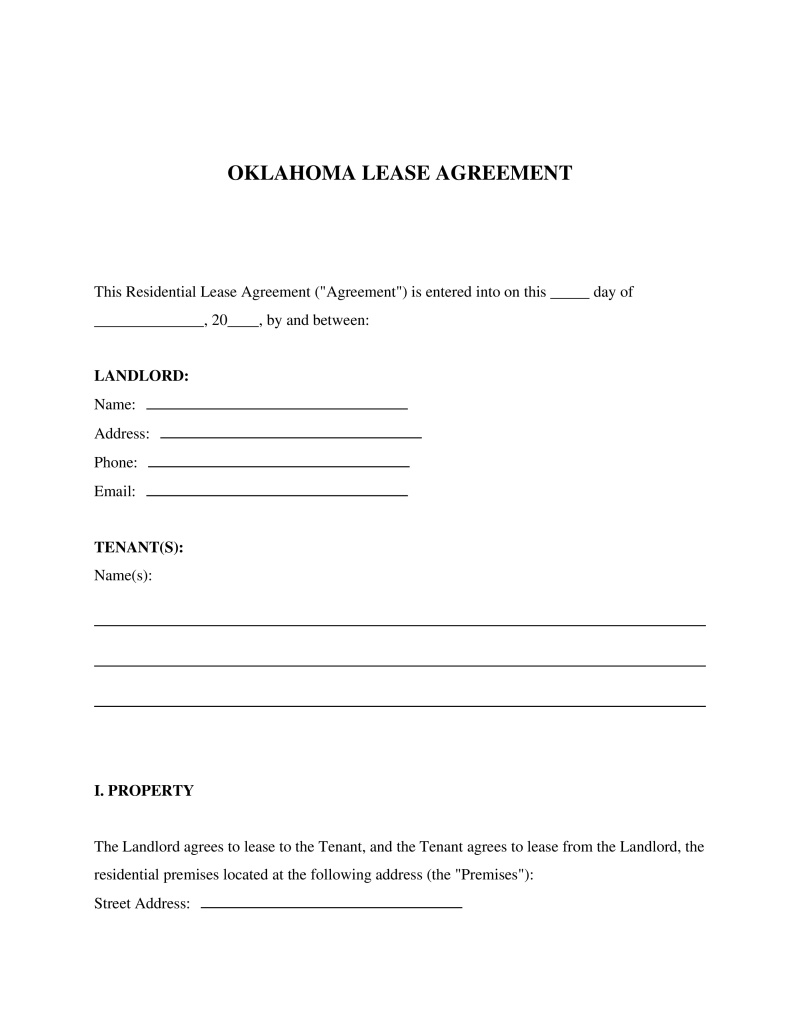
Oklahoma Lease Agreement
An Oklahoma Lease Agreement is a legal document that establishes the rental terms, responsibilities, and conditions agreed to by a landlord and tenant for property leased within the state.
Residential Property Type
Select the residential property category that best describes the rental premises.
Use this if the rental property does not fit one of the listed categories.
Table of Contents
What is a Oklahoma Lease Agreement?
An Oklahoma Lease Agreement is a legally binding contract executed between a landlord (lessor) and a tenant (lessee) for the rental of residential or commercial property within the state. This document outlines the specific terms and conditions governing the tenancy, including the monthly rent amount, payment due dates, security deposit requirements, and the duration of the lease term. The agreement serves to protect the legal rights of both parties by clearly defining their respective obligations and providing a framework for dispute resolution under state law. It is the primary document referenced in legal proceedings regarding property management, evictions, or damages.
Legal Framework and Statutory Regulations
The landlord-tenant relationship in this jurisdiction is primarily governed by the Oklahoma Residential Landlord and Tenant Act, found in Title 41 of the Oklahoma Statutes. This comprehensive body of law establishes the minimum standards for rental agreements and supersedes any lease clauses that attempt to waive statutory rights. For instance, a landlord cannot enforce a provision that waives their duty to maintain the premises in a habitable condition or the tenant's right to due process during eviction proceedings. While the state allows for significant freedom of contract regarding rent and rules, all provisions must align with federal fair housing laws and state health and safety codes.
Required Disclosures in Oklahoma
State and federal laws mandate that landlords provide specific information to tenants before the execution of an Oklahoma Lease Agreement. Failure to include these disclosures can result in legal penalties or render certain parts of the lease unenforceable.
- Flood Disclosure: Under Title 41 § 113a, if the rental premises have been flooded within the past five years, the landlord must clearly disclose this fact in the lease agreement.
- Methamphetamine Contamination: Pursuant to Title 41 § 118, landlords are required to disclose if they have prior knowledge that the property was used in the manufacture of methamphetamine, unless the property has been remediated and certified safe according to state standards.
- Lead-Based Paint: For any property constructed prior to 1978, federal law (42 U.S. Code § 4852d) requires landlords to provide a warning statement and a pamphlet regarding the dangers of lead-based paint.
- Identity of Manager and Owner: The lease must disclose the name and address of the person authorized to manage the premises and the owner or person authorized to act on behalf of the owner for the purpose of service of process and receiving notices.
Security Deposits and Rent Regulations
Oklahoma statutes provide specific guidelines regarding the collection and return of security deposits, although they are less restrictive than some other jurisdictions regarding limits. There is no statutory maximum limit on the amount a landlord may charge for a security deposit. However, the funds must be kept in an escrow account on behalf of the tenant. Upon the termination of the tenancy, the tenant must submit a written demand for the return of the deposit. Once this demand is made, the landlord has 45 days to return the deposit or provide a written itemized list of deductions for accrued rent or damages beyond normal wear and tear. If the landlord fails to comply, they may be liable for the return of the full deposit.
Regarding rent, the state does not impose rent control, allowing landlords to charge market rates. Unless otherwise agreed upon in the lease, rent is payable at the beginning of each month. While there is no statutory grace period for late rent, landlords often include specific terms regarding late fees in the agreement. These fees must be reasonable and clearly stated in the contract to be enforceable.
Landlord Right of Entry
Privacy rights are a critical component of the Oklahoma Lease Agreement. Under the Residential Landlord and Tenant Act, a tenant is entitled to the quiet enjoyment of their home. A landlord may enter the dwelling unit to inspect the premises, make necessary or agreed repairs, supply necessary services, or exhibit the dwelling unit to prospective purchasers or tenants. Except in cases of emergency or if it is impracticable to do so, the landlord must give the tenant at least one day's notice (24 hours) of their intent to enter and may enter only at reasonable times. Entering the property without proper notice or for reasons not permitted by law can be considered harassment and may constitute grounds for the tenant to terminate the lease.
Termination and Eviction Procedures
The process for ending a tenancy depends on the type of lease and the reason for termination. For fixed-term leases, the tenancy typically ends on the expiration date without further notice unless the lease specifies otherwise. For month-to-month tenancies, either party must provide a 30-day written notice to terminate the arrangement.
In cases of non-compliance, specific notice periods apply:
- Non-Payment of Rent: If rent is unpaid when due, the landlord may deliver a written notice demanding payment within five days. If the tenant fails to pay within this window, the landlord may terminate the rental agreement and proceed with an eviction action.
- Lease Violations: For material non-compliance with the lease terms (other than non-payment), the landlord may serve a written notice specifying the acts or omissions constituting the breach. The notice states that the rental agreement will terminate in 15 days if the breach is not remedied within 10 days.
- Immediate Threat: If a tenant causes or threatens to cause imminent and irremediable harm to the premises or persons, the landlord may terminate the rental agreement immediately upon written notice.
Frequently Asked Questions
Already have a Lease Agreement?
Get it reviewed free — checked against your state's laws in about a minute.
Not the form you're looking for?
Try our legal document generator to create a custom document
Disclaimer: The templates available on this website are provided for general informational purposes only and do not constitute legal advice. They are not intended to be, and should not be interpreted as, compliant with any specific legal, regulatory, or privacy requirements. These templates are not a replacement for professional legal guidance and should not be relied upon for any particular matter or circumstance. Users are strongly encouraged to seek advice from a qualified attorney licensed in their jurisdiction before using, modifying, or relying on any template.
All templates are provided on an "as is," "with all faults," and "as available" basis. The provider disclaims any and all warranties of any kind, whether express, implied, statutory, or otherwise, including without limitation warranties of merchantability, fitness for a particular purpose, title, or non-infringement.
LegalTemplates.com makes no guarantees or representations regarding the accuracy, completeness, expected outcomes, or reliability of the materials contained in these templates or any materials referenced or linked from them.