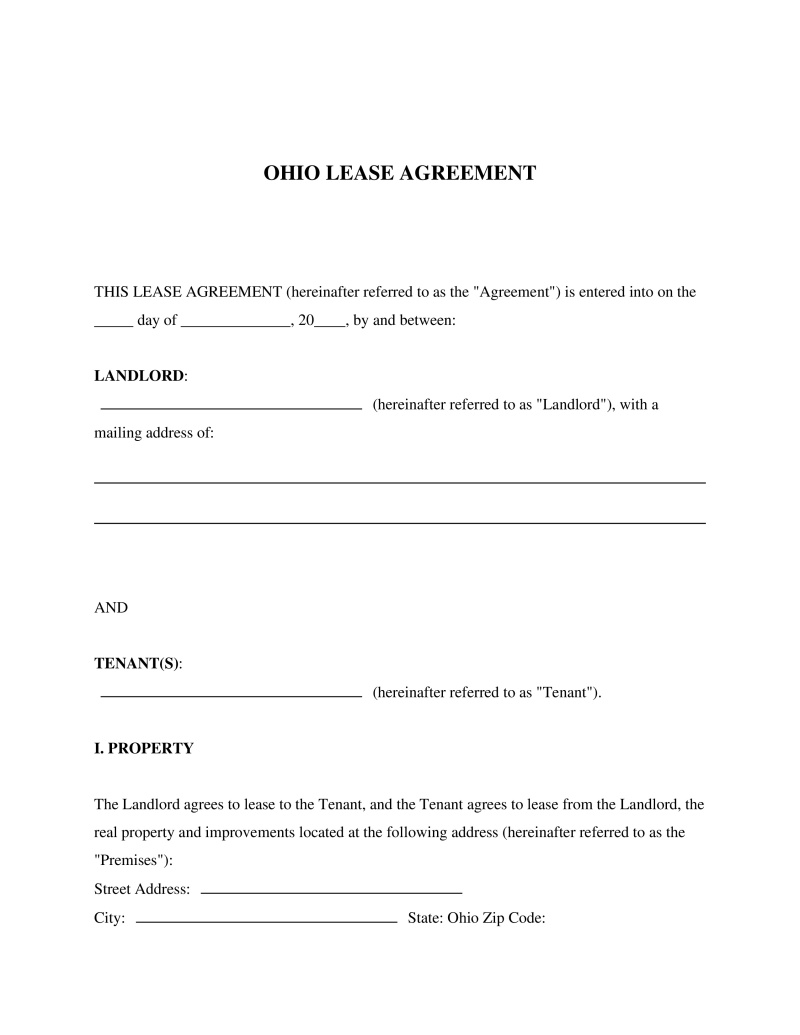
Ohio Lease Agreement
An Ohio Lease Agreement is a legal contract that outlines the rental terms, obligations, and conditions agreed upon by a landlord and tenant when leasing property in Ohio.
Residential Property Type
Select the residential property category that best describes the rental premises.
Use this if the rental property does not fit one of the listed categories.
Table of Contents
What is a Ohio Lease Agreement?
An Ohio Lease Agreement is a legally binding contract executed between a landlord (lessor) and a tenant (lessee) regarding the rental of property within the state of Ohio. This document outlines the specific terms and conditions under which the tenant is granted the right to occupy the premises in exchange for monetary compensation, usually in the form of monthly rent. The agreement serves as the foundational legal instrument for the tenancy, defining the duration of the lease, financial obligations, and the respective rights and responsibilities of both parties to ensure compliance with state property and contract laws.
Legal Framework and Statutes
The landlord-tenant relationship in this jurisdiction is primarily governed by the Ohio Landlord-Tenant Act, which is codified in Chapter 5321 of the Ohio Revised Code (ORC). These statutes establish the minimum duties for both parties, regardless of what is written in the contract. For instance, landlords are legally obligated to maintain the property in a fit and habitable condition, complying with all building, housing, health, and safety codes. Conversely, tenants are required to keep the premises sanitary and refrain from damaging the property.
In addition to state statutes, federal laws such as the Fair Housing Act apply, prohibiting discrimination in housing based on race, color, religion, sex, familial status, national origin, or disability. For residential properties constructed prior to 1978, federal regulations under Title X also mandate that landlords provide a disclosure regarding the presence of lead-based paint and lead-based paint hazards.
Security Deposit Regulations
Ohio law provides specific guidelines regarding security deposits, although it does not impose a statutory limit on the maximum amount a landlord may charge. According to ORC § 5321.16, if a security deposit exceeds the amount of one month's rent, the landlord is required to pay interest on the excess amount at a rate of 5% per annum, provided the tenant remains in possession of the premises for six months or more. Upon the termination of the lease agreement, the landlord has a strict thirty-day window to return the security deposit to the tenant. If any deductions are made for damages beyond normal wear and tear or unpaid rent, an itemized list of these deductions must be provided within that same thirty-day period.
Required Elements of a Valid Ohio Lease Agreement
For a rental contract to be enforceable and legally sound within the state courts, it generally includes specific disclosures and contractual elements. While oral agreements can be valid for short terms, written contracts are standard for clarity and evidence.
- Identification of Parties: Full legal names of the landlord and all adult tenants.
- Property Description: The full address and specific unit number of the rental premises.
- Term of Tenancy: The start date and end date of the lease, or specifications for a month-to-month arrangement.
- Rent Specifics: The total amount due, the due date, acceptable payment methods, and where payment should be sent.
- Owner Disclosure: The name and address of the property owner and any agent authorized to manage the property or receive service of process.
- Lead-Based Paint Disclosure: Required attachment for homes built before 1978.
Landlord Right of Entry
Privacy rights and the landlord's ability to access the property are balanced under Ohio Revised Code § 5321.04. A landlord must provide the tenant with reasonable notice before entering the dwelling unit to inspect the premises, make necessary or agreed repairs, supply services, or show the unit to prospective buyers or tenants. While the statute does not explicitly define "reasonable notice" in hours, twenty-four hours is the standard accepted by Ohio courts, and entry must occur at reasonable times. Exceptions to the notice requirement are made in cases of emergency, such as fire or severe flooding, where immediate access is necessary to protect the property or safety of occupants.
Lease Duration and Notarization
Ohio distinguishes between short-term and long-term lease agreements regarding formal execution requirements. Standard residential leases for one year or less do not require notarization to be valid. However, under the Ohio Statute of Frauds and ORC § 5301.01, any lease agreement with a term exceeding three years must be in writing and acknowledged by the landlord before a notary public or another official authorized to certify acknowledgments. Failure to notarize a lease longer than three years may result in the lease being treated as a month-to-month tenancy in a court of law.
Frequently Asked Questions
Already have a Lease Agreement?
Get it reviewed free — checked against your state's laws in about a minute.
Not the form you're looking for?
Try our legal document generator to create a custom document
Disclaimer: The templates available on this website are provided for general informational purposes only and do not constitute legal advice. They are not intended to be, and should not be interpreted as, compliant with any specific legal, regulatory, or privacy requirements. These templates are not a replacement for professional legal guidance and should not be relied upon for any particular matter or circumstance. Users are strongly encouraged to seek advice from a qualified attorney licensed in their jurisdiction before using, modifying, or relying on any template.
All templates are provided on an "as is," "with all faults," and "as available" basis. The provider disclaims any and all warranties of any kind, whether express, implied, statutory, or otherwise, including without limitation warranties of merchantability, fitness for a particular purpose, title, or non-infringement.
LegalTemplates.com makes no guarantees or representations regarding the accuracy, completeness, expected outcomes, or reliability of the materials contained in these templates or any materials referenced or linked from them.