North Dakota Lease Agreement Create a North Dakota Lease Agreement

North Dakota Lease Agreement

Published Dec 09, 2025
0 Comments
1 Downloads

A North Dakota Lease Agreement is a legal document that details the rental arrangement between a landlord and tenant, including the rules, payment terms, and obligations for leasing property in the state.

Lease Type

Select the lease structure that best fits your rental arrangement. 'Fixed Term' leases have a set end date, while 'Month-to-Month' leases renew automatically each month.

Table of Contents

0% Complete 0/0 Fields

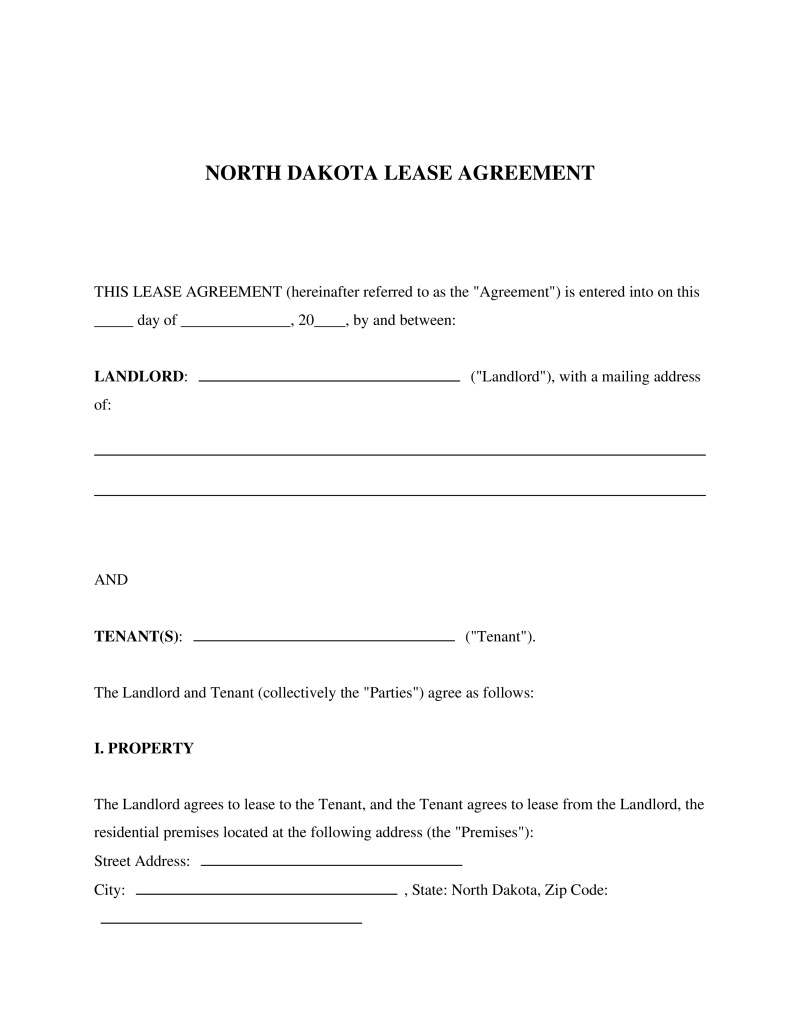
NORTH DAKOTA LEASE AGREEMENT

THIS LEASE AGREEMENT (hereinafter referred to as the "Agreement") is entered into on this , by and between:

LANDLORD:
Name:
Mailing Address:
("Landlord")

AND

TENANT(S):
Name:

("Tenant").

The Landlord and Tenant (collectively the "Parties") agree as follows:

I. PROPERTY

The Landlord agrees to lease to the Tenant, and the Tenant agrees to lease from the Landlord, the residential premises located at the following address (the "Premises"):

Street Address:
City: , State: North Dakota, Zip Code:

The Premises is described as a:

The Premises includes the following furnishings and appliances:

II. TERM OF LEASE

The term of this Agreement shall be (check one):

III. RENT

The Tenant agrees to pay the Landlord rent in the amount of $ per month.

The rent is due on the day of each month.

Rent shall be paid by the following method(s):

Rent payments shall be sent to the following address (if different from Landlord's address above):

IV. LATE FEES AND RETURNED CHECKS

If rent is not received by the Landlord by the day of the month, the Tenant agrees to pay a late fee of:

If a check is returned for insufficient funds (NSF), the Tenant shall pay a fee of $ (not to exceed $40.00 pursuant to N.D.C.C. Section 6-08-16) plus any bank charges incurred by the Landlord.

V. SECURITY DEPOSIT

Upon execution of this Agreement, the Tenant shall deposit with the Landlord the sum of $ as a security deposit.

A. Statutory Limit: Pursuant to N.D.C.C. Section 47-16-07.1, the security deposit shall not exceed the equivalent of one (1) month's rent. However, if the Tenant has a pet, the deposit may not exceed two (2) months' rent. If the Tenant has been convicted of a felony offense as described in the statute, the deposit may not exceed three (3) months' rent.

B. Interest: In accordance with N.D.C.C. Section 47-16-07.1, if the security deposit is held for nine (9) months or longer, the Landlord shall pay interest on the deposit to the Tenant at the rate required by North Dakota law.

C. Return of Deposit: The Landlord shall return the security deposit (and any accrued interest) to the Tenant within thirty (30) days after the termination of the lease and delivery of possession of the Premises to the Landlord.

D. Deductions: The Landlord may deduct from the security deposit only those amounts reasonably necessary to:
1. Remedy Tenant's default in the payment of rent;
2. Repair damages to the Premises caused by the Tenant, exclusive of ordinary wear and tear; and
3. Clean the Premises, if necessary, to return it to the same level of cleanliness it was in at the inception of the tenancy.

VI. MOVE-IN INSPECTION

Pursuant to N.D.C.C. Section 47-16-07.2, the Landlord shall provide the Tenant with a statement describing the condition of the Premises at the time of entering into this Agreement. The Tenant shall sign the statement to acknowledge the condition of the Premises. This statement shall be used as the basis for determining the condition of the Premises at the termination of the tenancy.

VII. UTILITIES AND SERVICES

The Parties agree that utilities and services shall be the responsibility of the following:

Electricity:


Gas/Heat:

Water/Sewer:

Trash Collection:

Cable/Internet:

Snow Removal:

Lawn Care:

VIII. OCCUPANTS AND GUESTS

The Premises shall be occupied only by the Tenant and the following individuals:

Guests may stay on the Premises for a maximum of days within a six-month period. Any guest staying longer than this period requires the written consent of the Landlord.

IX. PETS

X. MAINTENANCE AND REPAIRS

A. Landlord's Obligations: Pursuant to N.D.C.C. Section 47-16-13.1, the Landlord shall put the Premises into a condition fit for human occupation and shall repair all subsequent dilapidations thereof, except that the Tenant must repair all deteriorations or injuries thereto occasioned by the Tenant's want of ordinary care.

B. Tenant's Obligations: The Tenant shall keep the Premises in a clean and sanitary condition and shall properly use and operate all electrical, gas, and plumbing fixtures. The Tenant shall not deliberately or negligently destroy, deface, damage, impair, or remove any part of the Premises.

XI. RIGHT OF ENTRY

In accordance with N.D.C.C. Section 47-16-07.3, the Landlord may enter the Premises only with the consent of the Tenant or in the case of an emergency. The Landlord shall not abuse the right of access or use it to harass the Tenant. Except in cases of emergency or if it is impracticable to do so, the Landlord shall give the Tenant reasonable notice of the intent to enter and enter only at reasonable times.

XII. LEAD-BASED PAINT DISCLOSURE

Housing built before 1978 may contain lead-based paint. Lead from paint, paint chips, and dust can pose health hazards if not managed properly.

The Premises was built:

XIII. DEFAULT AND TERMINATION

If the Tenant fails to pay rent when due or violates any other term of this Agreement, the Landlord may terminate the lease in accordance with North Dakota law.

1. Non-Payment of Rent: If rent is unpaid when due, the Landlord may initiate eviction proceedings after providing three (3) days' written notice to quit pursuant to N.D.C.C. Section 47-32-01.

2. Other Violations: For violations other than non-payment of rent, the Landlord may terminate the tenancy as permitted by law.

XIV. ABANDONMENT

If the Tenant vacates the Premises before the end of the Lease term without notice and fails to pay rent, the Landlord may consider the Premises abandoned. The Landlord may enter the Premises and re-let it. The Tenant shall remain liable for any deficiency in rent until the Lease expires or the Premises is re-let, whichever occurs first.

XV. GOVERNING LAW

This Agreement shall be governed by and construed in accordance with the laws of the State of North Dakota.

XVI. ADDITIONAL TERMS AND CONDITIONS

The Parties agree to the following additional terms:

XVII. ENTIRE AGREEMENT

This Agreement constitutes the entire agreement between the Parties and supersedes all prior understandings, agreements, or representations. This Agreement may only be modified in writing and signed by both Parties.

SIGNATURES

LANDLORD:
Signature: _________________________
Date:
Print Name: _______________

TENANT:
Signature: _________________________
Date:
Print Name: _______________

What is a North Dakota Lease Agreement?

A North Dakota Lease Agreement is a legally binding contract executed between a landlord (lessor) and a tenant (lessee) for the rental of residential or commercial property within the state. This document establishes the terms and conditions of the tenancy, detailing critical elements such as the monthly rent amount, payment due dates, security deposit requirements, and the duration of the occupancy. It serves as the primary governing instrument for the relationship between the property owner and the occupant, ensuring that both parties acknowledge their respective rights and obligations under North Dakota state law. While verbal agreements may be recognized for short-term rentals, a written contract provides necessary evidence and clarity for tenancies exceeding one year.

Legal Framework and Statutory Requirements

The landlord-tenant relationship in North Dakota is primarily governed by the North Dakota Century Code (NDCC), specifically Chapter 47-16. This chapter outlines the leasing of real property and establishes the baseline standards that override conflicting lease terms. Unlike some jurisdictions with strict rent control measures, North Dakota generally operates under principles of freedom of contract, allowing landlords and tenants significant latitude in negotiating terms. However, specific statutory provisions regarding habitability, security deposits, and eviction procedures must be adhered to for the contract to be enforceable.

In addition to state statutes, federal laws such as the Fair Housing Act apply to the North Dakota Lease Agreement. This federal legislation prohibits discrimination in housing based on race, color, national origin, religion, sex, familial status, or disability. Landlords must ensure that their lease terms and screening processes comply with these federal mandates to avoid legal liability.

Security Deposit Regulations

North Dakota law imposes specific limitations on the collection and handling of security deposits, codified in NDCC 47-16-07.1. These funds serve as protection for the landlord against non-payment of rent or damage to the property beyond normal wear and tear.

  • Maximum Amount: Generally, a landlord may not demand a security deposit that exceeds the equivalent of one month's rent. However, if the tenant has a pet, the landlord may request an additional deposit, provided the total does not exceed either two months' rent or $2,500, whichever is less.
  • Deposit Return: Upon termination of the lease, the landlord is required to return the security deposit, or the balance remaining after valid deductions, within 30 days.
  • Itemized Deductions: If any portion of the deposit is withheld, the landlord must provide a written itemization of the damages and the costs incurred to repair them.

Mandatory Disclosures and Elements

To ensure validity and transparency, a standard North Dakota Lease Agreement should contain specific disclosures and data points. While some are mandated by state law, others are required by federal regulation.

  • Move-In Checklist: Under NDCC 47-16-07.2, if a landlord requires a security deposit, they must provide a form describing the condition of the premises at the start of the tenancy. Both parties typically sign this to prevent future disputes regarding damages.
  • Lead-Based Paint Disclosure: For any residential property constructed prior to 1978, federal law requires the landlord to disclose the potential presence of lead-based paint and provide an informational pamphlet to the tenant.
  • Party Identification: The full legal names of all adults residing on the property and the landlord or their authorized agent must be clearly stated.
  • Possession Terms: The agreement must specify the start date and, for fixed-term leases, the end date of the tenancy.

Landlord and Tenant Obligations

The lease agreement formalizes the statutory duties of both parties. The landlord is legally obligated to maintain the premises in a fit and habitable condition. This includes ensuring that vital services such as heating, electricity, and plumbing are functional and that the building complies with health and safety codes. This implied warranty of habitability exists regardless of whether it is explicitly written into the contract.

The tenant is responsible for maintaining the dwelling unit in a reasonably clean and safe condition. Obligations include paying rent on time, not deliberately or negligently destroying property, and respecting the quiet enjoyment of neighbors. The tenant is also usually responsible for minor maintenance tasks, such as changing light bulbs or furnace filters, depending on the specific terms drafted in the agreement.

Termination and Eviction Procedures

The process for ending a tenancy depends on the lease type. For month-to-month arrangements, North Dakota law generally requires at least 30 days' written notice—or one full rental period—from either party to terminate the agreement. If a tenant breaches the lease through non-payment or other violations, the landlord may initiate eviction proceedings. This typically begins with a three-day Notice of Intention to Evict. If the tenant fails to vacate or remedy the situation, the landlord may proceed to court to obtain a judgment for possession.

Frequently Asked Questions

While oral agreements are valid for lease terms of less than one year, a written lease is required for any tenancy lasting longer than one year. It is highly recommended to use a written contract for all tenancies to clearly define duties and prevent disputes.
No, North Dakota law does not mandate a grace period for rent payments. Rent is due on the date specified in the lease, and landlords may consider it late immediately the day after it is due unless the contract states otherwise.
North Dakota law states that a landlord may enter the dwelling unit at reasonable times to inspect, make repairs, or show the property. While the statute does not specify an exact notice period, providing reasonable notice (usually 24 hours) is standard practice unless it is an emergency.
State statutes do not set a specific cap on late fees, but they must be considered reasonable estimates of the damages or costs incurred by the landlord due to late payment. Excessive fees may be challenged in court as unenforceable penalties.
If a landlord fails to return the security deposit or provide an itemized list of deductions within 30 days after the lease ends and the tenant vacates, the landlord may be liable for punitive damages. The tenant may be entitled to up to three times the amount withheld without justification.

Not the form you're looking for?

Try our legal document generator to create a custom document

Community Discussion

Share your experience and help others

0

Comments (0)

Leave a Comment

Your email will not be displayed publicly. It is used for validation purposes only and will never be used to send unwanted emails or sold to third parties.

No comments yet. Be the first to comment!

Legal Notice: Comments are personal opinions and do not constitute legal advice. Always consult a qualified attorney for matters specific to your situation.