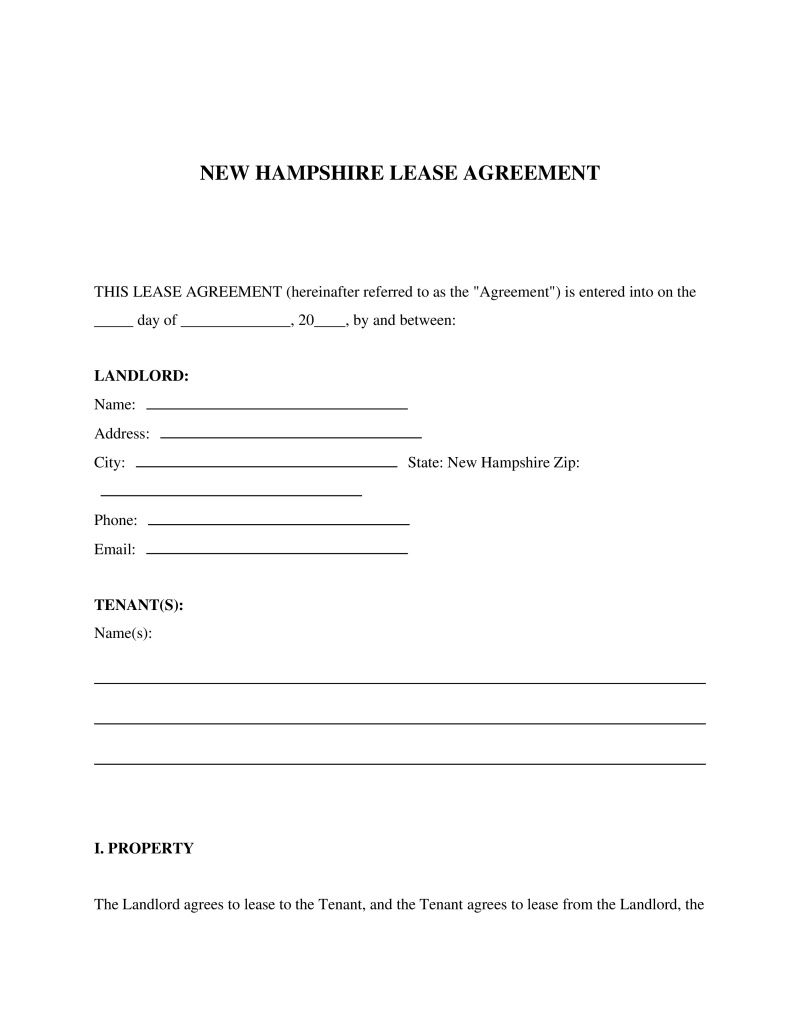
New Hampshire Lease Agreement
A New Hampshire Lease Agreement is a legal document that sets out the rental terms, obligations, and conditions agreed upon by a landlord and tenant for property leased within the state.
Residential Property Type
Select the residential property category that best describes the rental premises.
Use this if the rental property does not fit one of the listed categories.
Table of Contents
What is a New Hampshire Lease Agreement?
A New Hampshire Lease Agreement is a legally binding contract executed between a landlord (lessor) and a tenant (lessee) for the rental of residential or commercial property within the state. This document outlines the specific terms and conditions governing the tenancy, including the monthly rent amount, payment due dates, duration of the lease, and responsibilities regarding utilities and maintenance. The agreement serves to protect the legal rights of both parties by establishing clear expectations and providing a framework for dispute resolution in accordance with New Hampshire landlord-tenant laws. While oral agreements can be valid for short-term tenancies, written contracts are standard for establishing proof of the agreed-upon terms.
Legal Framework and Statutory Requirements
The landlord-tenant relationship in New Hampshire is primarily governed by the New Hampshire Revised Statutes Annotated (RSA). Specifically, RSA Chapter 540 covers actions against tenants, while RSA Chapter 540-A addresses prohibited practices and security deposits. These statutes establish the minimum standards for habitability and the procedural requirements for evictions and deposit handling. Additionally, federal laws such as the Fair Housing Act prohibit discrimination based on race, color, national origin, religion, sex, familial status, or disability.
Under the implied warranty of habitability, landlords must maintain the premises in a safe and sanitary condition. This includes ensuring functioning heat, water, electricity, and structural integrity. Failure to adhere to these statutory obligations can provide tenants with legal grounds to withhold rent or terminate the lease early without penalty. Conversely, tenants are legally obligated to maintain the rental unit in a clean manner and avoid causing damage beyond normal wear and tear.
Security Deposit Regulations
New Hampshire law imposes strict regulations on security deposits to prevent misappropriation of funds. According to RSA 540-A:6, a landlord cannot demand a security deposit that exceeds one month's rent or $100, whichever is greater. This limit applies to most residential units, though exceptions exist for owner-occupied buildings with fewer than six units. Landlords are required to hold these funds in a segregated account and must provide the tenant with a receipt indicating the financial institution where the deposit is held.
If a landlord holds a security deposit for more than one year, they must pay interest on the deposit at a rate equal to the interest rate paid on regular savings accounts at the New Hampshire bank where the funds are deposited. Upon the termination of the tenancy, the landlord has 30 days to return the full deposit or the remaining balance accompanied by an itemized list of deductions for unpaid rent or damages. Failure to comply with these rules can result in the landlord being liable for damages equal to twice the amount of the security deposit.
Mandatory Disclosures and Lease Elements
To ensure a New Hampshire Lease Agreement is valid and compliant with state and federal regulations, specific disclosures and elements must be included. These requirements ensure that the tenant is fully informed of the property's condition and the terms of the financial arrangement.
- Lead-Based Paint Disclosure: For any property built before 1978, federal law requires the landlord to provide a lead paint disclosure form and an EPA-approved information pamphlet.
- Security Deposit Receipt: The landlord must provide a receipt stating the amount of the deposit and the bank where it is stored.
- Move-In Checklist: Under RSA 540-A:6, landlords must provide a statement describing the condition of the rental unit or allow the tenant to inspect and note any existing damages within five days of occupancy.
- Landlord Contact Information: The agreement should list the name, address, and telephone number of the person authorized to manage the premises and receive legal notices.
- General Terms: Clear definitions of rent amount, due date, lease duration, and policies regarding pets, smoking, and subletting.
Landlord Right to Entry
The right to privacy is a significant aspect of New Hampshire tenancy law. While landlords retain ownership of the property, they cannot enter the premises at will once the lease is in effect. RSA 540-A:3 prohibits a landlord from entering a tenant's residence without permission, except in cases of emergency. For routine inspections, maintenance, or showing the unit to prospective tenants, the landlord must provide reasonable notice. While the statute does not define "reasonable" in hours, common practice and legal interpretation generally suggest a minimum of 24 hours notice. Entry must also occur at a reasonable time.
Termination and Eviction Procedures
The process for terminating a tenancy depends on the type of lease and the reason for termination. For non-payment of rent, a landlord must provide a Demand for Rent and an Eviction Notice (Notice to Quit), giving the tenant seven days to pay or vacate. For other lease violations or for termination without specific cause in a month-to-month tenancy, the notice period is typically 30 days. If the tenant fails to vacate after the notice period expires, the landlord must file a Landlord and Tenant Writ with the district court to obtain a Writ of Possession. Self-help evictions, such as changing locks or shutting off utilities, are strictly illegal under RSA 540-A.
Frequently Asked Questions
Already have a Lease Agreement?
Get it reviewed free — checked against your state's laws in about a minute.
Not the form you're looking for?
Try our legal document generator to create a custom document
Disclaimer: The templates available on this website are provided for general informational purposes only and do not constitute legal advice. They are not intended to be, and should not be interpreted as, compliant with any specific legal, regulatory, or privacy requirements. These templates are not a replacement for professional legal guidance and should not be relied upon for any particular matter or circumstance. Users are strongly encouraged to seek advice from a qualified attorney licensed in their jurisdiction before using, modifying, or relying on any template.
All templates are provided on an "as is," "with all faults," and "as available" basis. The provider disclaims any and all warranties of any kind, whether express, implied, statutory, or otherwise, including without limitation warranties of merchantability, fitness for a particular purpose, title, or non-infringement.
LegalTemplates.com makes no guarantees or representations regarding the accuracy, completeness, expected outcomes, or reliability of the materials contained in these templates or any materials referenced or linked from them.