Montana Lease Agreement Create a Montana Lease Agreement

Montana Lease Agreement

Published Dec 07, 2025
0 Comments
1 Downloads

A Montana Lease Agreement is a legal form used to document the rental arrangement between a landlord and tenant, detailing the rules, payment terms, and obligations for renting property within the state.

Lease Type

Select the type of property that this lease applies to from the options provided. This helps clarify the nature of the rental arrangement and can affect lease terms and tenant rights. If your property type is not listed, choose "Other" and specify what it is.

Table of Contents

0% Complete 0/0 Fields

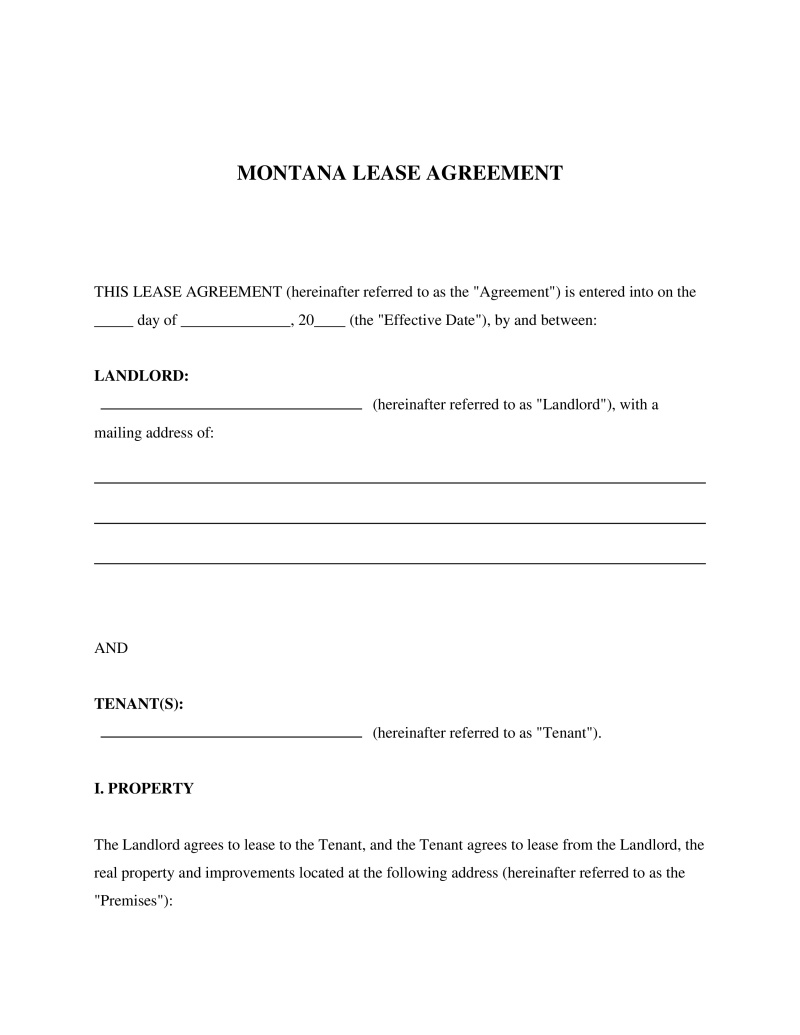
MONTANA LEASE AGREEMENT

THIS LEASE AGREEMENT (hereinafter referred to as the "Agreement") is entered into on the (the "Effective Date"), by and between:

LANDLORD:
(hereinafter referred to as "Landlord"), with a mailing address of:

AND TENANT(S):
(hereinafter referred to as "Tenant").

I. PROPERTY

The Landlord agrees to lease to the Tenant, and the Tenant agrees to lease from the Landlord, the real property and improvements located at the following address (hereinafter referred to as the "Premises"):

II. TERM OF LEASE

The term of this Agreement shall be (check one):

III. RENT

The Tenant shall pay to the Landlord the sum of $ per month as Rent for the Term of the Agreement.

The Rent shall be due on the day of each month (the "Due Date").

Rent shall be paid by the following method(s):

Rent payments shall be sent to the following address:

IV. LATE CHARGES AND RETURNED CHECKS

If Rent is not paid within days of the Due Date, the Tenant shall pay a late charge of $.

If any check offered by the Tenant to the Landlord in payment of rent or any other amount due under this Agreement is returned for lack of sufficient funds, a "stop payment," or any other reason, the Tenant shall pay to the Landlord a returned check fee of $.

V. SECURITY DEPOSIT

Upon the execution of this Agreement, the Tenant shall pay to the Landlord a security deposit in the amount of $ (the "Security Deposit").

A. Purpose: The Security Deposit shall be held by the Landlord as security for the faithful performance by the Tenant of all terms and conditions of this Agreement.

B. Return of Deposit (MCA 70-25-202):
1. If there are no damages to the Premises, no cleaning required, and no unpaid rent or utilities, the Landlord shall return the Security Deposit to the Tenant within ten (10) days after the Tenant vacates the Premises.
2. If there are deductions for damages, cleaning, or unpaid rent, the Landlord shall provide the Tenant with a written list of the damages and cleaning charges and return the balance of the Security Deposit, if any, within thirty (30) days after the Tenant vacates the Premises.

C. Deductions: The Landlord may deduct from the Security Deposit specifically for:
1. Damages to the Premises caused by the Tenant, guests, or licensees, excluding ordinary wear and tear.
2. Unpaid rent, late charges, and utilities.
3. Cleaning expenses required to restore the Premises to its condition at the commencement of the tenancy.

VI. MOVE-IN INSPECTION AND CONDITION OF PREMISES

Pursuant to MCA 70-25-206, the Landlord shall furnish the Tenant with a separate written statement of the present condition of the Premises. The Tenant has the right to inspect the Premises to verify the validity of the statement.

The Tenant acknowledges that they have inspected the Premises and accepts them in "AS IS" condition, except for the following existing defects:

VII. USE OF PREMISES

The Premises shall be used and occupied by the Tenant(s) and the following minor children/occupants exclusively as a private single-family residence:

No part of the Premises shall be used at any time during the term of this Agreement by the Tenant for the purpose of carrying on any business, profession, or trade of any kind, or for any purpose other than as a private single-family residence.

VIII. UTILITIES AND SERVICES

The parties agree that utilities and services shall be the responsibility of the following parties:

Electricity:

Gas/Heating:

Water:

Sewer:

Trash Removal:

Cable/Internet:

Snow Removal:

Lawn Care:

IX. PETS

X. MAINTENANCE AND REPAIR

A. Landlord's Obligations (MCA 70-24-303): The Landlord shall:
1. Comply with the requirements of applicable building and housing codes materially affecting health and safety.
2. Make repairs and do whatever is necessary to put and keep the Premises in a fit and habitable condition.
3. Keep all common areas of the Premises in a clean and safe condition.
4. Maintain in good and safe working order and condition all electrical, plumbing, sanitary, heating, ventilating, air-conditioning, and other facilities and appliances.

B. Tenant's Obligations (MCA 70-24-321): The Tenant shall:
1. Keep the part of the Premises that the Tenant occupies and uses as clean and safe as the condition of the Premises permits.
2. Dispose of all ashes, garbage, rubbish, and other waste in a clean and safe manner.
3. Keep all plumbing fixtures in the dwelling unit or used by the Tenant as clean as their condition permits.
4. Use in a reasonable manner all electrical, plumbing, sanitary, heating, ventilating, air-conditioning, and other facilities and appliances.
5. Not deliberately or negligently destroy, deface, damage, impair, or remove any part of the Premises or permit any person to do so.

XI. RIGHT OF ENTRY

Pursuant to MCA 70-24-312, the Landlord may enter the Premises to inspect the Premises, make necessary or agreed repairs, decorations, alterations, or improvements, supply necessary or agreed services, or exhibit the dwelling unit to prospective or actual purchasers, mortgagees, tenants, workmen, or contractors.

Except in the case of an emergency or unless it is impracticable to do so, the Landlord shall give the Tenant at least twenty-four (24) hours' notice of the intent to enter and may enter only at reasonable times.

XII. REQUIRED MONTANA DISCLOSURES

A. MOLD DISCLOSURE (MCA 70-16-703):

The Landlord provides the following disclosure regarding mold:

"MOLD DISCLOSURE: There are many types of mold. Inhabitable properties are not, and cannot be, constructed to exclude mold. Moisture is one of the most significant factors contributing to mold growth. Information concerning the presence of mold can only be available through a physical inspection and sampling by a qualified professional. Landlord is not a qualified inspector and cannot verify that the property is free of mold or present risk to inhabitants. Tenant acknowledges that the Landlord has provided this disclosure and Tenant hereby waives any decision to hold the Landlord liable for any mold-related damages."

B. LEAD-BASED PAINT DISCLOSURE:

Housing built before 1978 may contain lead-based paint. Lead from paint, paint chips, and dust can pose health hazards if not managed properly. Lead exposure is especially harmful to young children and pregnant women.

Check one:

C. METHAMPHETAMINE DISCLOSURE (MCA 75-10-1305):

The Landlord certifies that to the best of their knowledge:

D. AUTHORIZED MANAGER (MCA 70-24-301):

The following person is authorized to manage the Premises and authorized to act for and on behalf of the owner for the purpose of service of process and receiving and receipting for notices and demands:

Name:
Address:

XIII. DEFAULT AND TERMINATION

A. Failure to Pay Rent: If Rent is unpaid when due and the Tenant fails to pay Rent within three (3) days after written notice by the Landlord of nonpayment and the Landlord's intention to terminate the Agreement, the Landlord may terminate the Agreement (MCA 70-24-422).

B. Noncompliance: If there is a noncompliance by the Tenant with the Agreement or with MCA 70-24-321 affecting health and safety, the Landlord may deliver a written notice to the Tenant specifying the acts and omissions constituting the breach and that the Agreement will terminate upon a date not less than fourteen (14) days after receipt of the notice. If the breach is remediable by repairs, the payment of damages, or otherwise and the Tenant adequately remedies the breach before the date specified in the notice, the Agreement shall not terminate.

XIV. GOVERNING LAW

This Agreement shall be governed, construed, and interpreted by, through, and under the Laws of the State of Montana.

XV. ENTIRE AGREEMENT

This Agreement constitutes the entire agreement between the parties and supersedes any prior understanding or representation of any kind preceding the date of this Agreement. There are no other promises, conditions, understandings, or other agreements, whether oral or written, relating to the subject matter of this Agreement.

XVI. ADDITIONAL TERMS AND CONDITIONS

Additional provisions:

XVII. SIGNATURES

IN WITNESS WHEREOF, the Landlord and Tenant have executed this Agreement as of the day and year first above written.

LANDLORD:
Signature: _________________________
Date:
Print Name: _______________

TENANT:
Signature: _________________________
Date:
Print Name: _______________

What is a Montana Lease Agreement?

A Montana Lease Agreement is a legally binding contract entered into by a landlord and a tenant to outline the terms and conditions regarding the rental of a residential or commercial property. This document serves as the foundation of the tenancy, establishing critical details such as the monthly rent amount, payment due dates, the duration of the lease, and the responsibilities of each party regarding maintenance and utilities. While state law recognizes oral rental agreements for short durations, a written contract is the standard instrument used to provide clear evidence of the agreement and protect both parties in the event of legal disputes or misunderstandings.

Legal Framework and Statutory Regulations

The landlord-tenant relationship in Montana is primarily governed by the Montana Residential Landlord and Tenant Act of 1977, which is codified in Title 70, Chapter 24 of the Montana Code Annotated (MCA). This comprehensive set of statutes defines the rights and obligations of both landlords and tenants, ensuring that rental practices within the state remain fair and consistent. Additionally, federal laws such as the Fair Housing Act prohibit discrimination in housing based on race, color, national origin, religion, sex, familial status, or disability.

Under Montana law, provisions included in a lease that waive or modify the tenant's rights established by the Act are generally unenforceable. For example, a landlord cannot include a clause that exculpates them from liability for negligence. Furthermore, the Uniform Residential Landlord and Tenant Act (URLTA) influences the interpretation of these statutes, promoting uniformity in landlord-tenant law across jurisdictions that have adopted similar measures.

Mandatory Disclosures in Montana

To ensure a Montana Lease Agreement is compliant with state and federal regulations, specific disclosures must be provided to the tenant before the tenancy begins. Failure to include these disclosures can result in legal penalties or limit the landlord's ability to make deductions from security deposits.

  • Mold Disclosure: Per MCA 70-16-703, landlords must provide a specific statement regarding the presence of mold. This disclosure informs the tenant that mold may be present and that the landlord is not liable for mold damages unless they knowingly concealed a known condition.
  • Lead-Based Paint Disclosure: For any property built prior to 1978, federal law requires landlords to provide a disclosure form and an information pamphlet regarding the potential hazards of lead-based paint.
  • Move-In Checklist: According to MCA 70-25-206, if a security deposit is collected, the landlord must provide a separate written statement of the present condition of the premises. This document is crucial for determining damages upon move-out.
  • Management Information: The lease must disclose the name and address of the property manager and the owner or a person authorized to act on their behalf for service of process (MCA 70-24-301).

Security Deposit Regulations

Security deposits are a common source of friction in rental relationships, and Montana statutes provide strict guidelines on how they must be handled. Unlike some states, Montana does not set a statutory limit on the maximum amount a landlord can charge for a security deposit. However, the management and return of these funds are tightly regulated under the Montana Security Deposits Act (MCA Title 70, Chapter 25).

Landlords are permitted to deduct funds from the deposit for unpaid rent, late charges, utilities, and damages beyond normal wear and tear. They may also deduct for cleaning costs, provided that the cleaning instructions were given to the tenant at the time the lease was signed. The timeline for returning the deposit depends on the condition of the unit upon surrender. If there are no deductions, the deposit must be returned within 10 days. If there are deductions, the landlord has 30 days to return the balance along with a detailed itemized list of damages.

Landlord Access and Tenant Privacy

The Montana Lease Agreement generally includes provisions regarding the landlord's right to enter the rental unit. State law balances the landlord's need to maintain the property with the tenant's right to quiet enjoyment. Under MCA 70-24-312, a landlord must provide at least 24 hours of notice before entering the premises for non-emergency reasons, such as inspections, repairs, or showing the unit to prospective tenants. Entry must occur at reasonable times. In the event of an emergency, such as a fire or significant water leak, the notice requirement is waived, and the landlord may enter immediately to preserve the property.

Required Elements of a Valid Montana Lease Agreement

For a rental contract to be legally enforceable in Montana, it must contain specific components that clearly define the arrangement. Omissions of these key elements can lead to ambiguity and potential unenforceability in court.

  • Identification of Parties: The full legal names of the landlord and all adult tenants responsible for the lease.
  • Property Description: The complete physical address of the rental unit, including unit numbers where applicable.
  • Lease Term: The start and end dates of the tenancy, or a statement indicating a month-to-month arrangement.
  • Rent Details: The amount of rent, the due date, acceptable payment methods, and the address where rent should be sent.
  • Security Deposit Terms: The amount of the deposit and the conditions for its return.
  • Signatures: The document must be signed and dated by the landlord and all tenants named in the agreement.

Termination and Eviction Procedures

The lease outlines the procedures for ending the tenancy. For month-to-month agreements, either party must generally provide at least 30 days' written notice to terminate the arrangement. If a tenant violates the lease terms, the notice periods for eviction vary based on the offense. For non-payment of rent, a landlord may issue a 3-day notice to pay or quit. For unauthorized pets or persons, a 3-day notice to cure is typically required. If the tenant engages in illegal activity or creates a significant hazard, the lease may be terminated with a 3-day unconditional quit notice, requiring the tenant to vacate without the option to correct the behavior.

Frequently Asked Questions

While oral agreements are legal for tenancies of one year or less, a written Montana Lease Agreement is highly recommended to clearly define duties and prevent disputes.
No, Montana state law does not impose a statutory cap on the amount a landlord can charge for a security deposit, though market conditions usually dictate reasonable amounts.
A landlord may only enter without notice in an emergency. For routine maintenance or inspections, the law requires at least 24 hours of notice to the tenant.
In Montana, either the landlord or the tenant must provide at least 30 days of written notice to terminate a month-to-month tenancy.
Montana statutes do not specifically cap late fees, but they must be reasonable and clearly outlined in the rental contract to be enforceable.
If there are no deductions, the deposit must be mailed within 10 days. If deductions are made for damages or cleaning, the landlord has 30 days to provide the balance and an itemized list.

Not the form you're looking for?

Try our legal document generator to create a custom document

Community Discussion

Share your experience and help others

0

Comments (0)

Leave a Comment

Your email will not be displayed publicly. It is used for validation purposes only and will never be used to send unwanted emails or sold to third parties.

No comments yet. Be the first to comment!

Legal Notice: Comments are personal opinions and do not constitute legal advice. Always consult a qualified attorney for matters specific to your situation.