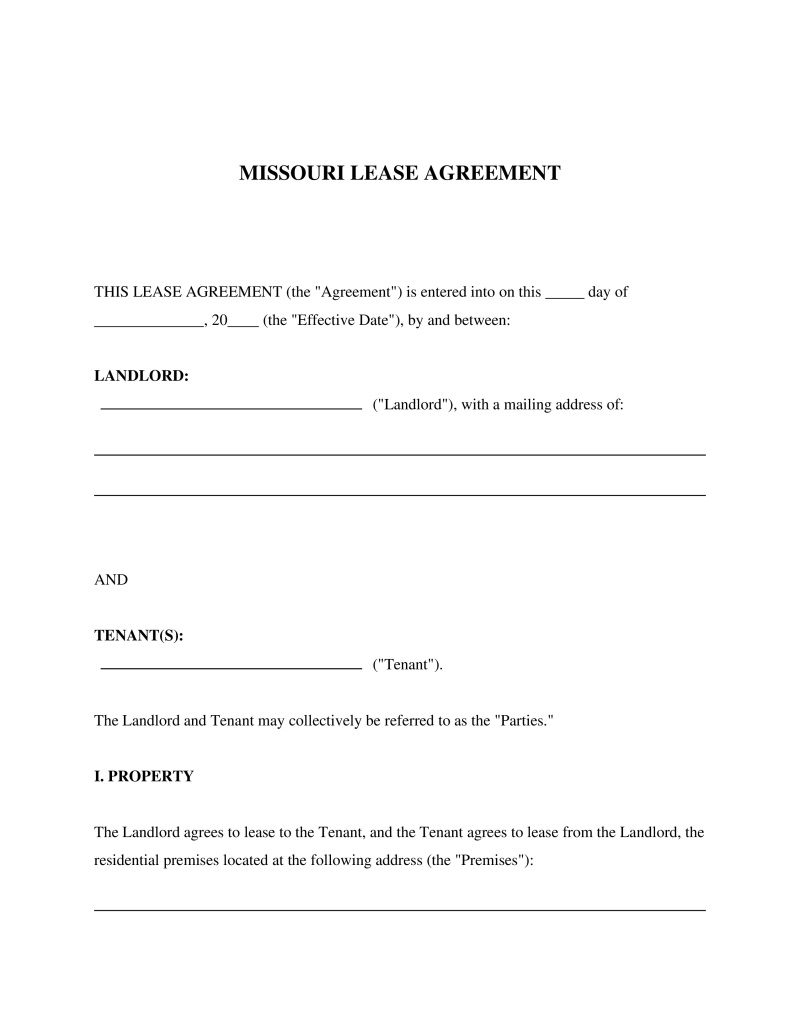
Missouri Lease Agreement
A Missouri Lease Agreement is a legal contract that outlines the rental terms, responsibilities, and conditions agreed to by a landlord and tenant for property located in Missouri.
Residential Property Type
Select the residential property category that best describes the rental premises.
Use this if the rental property does not fit one of the listed categories.
Table of Contents
What is a Missouri Lease Agreement?
A Missouri Lease Agreement is a legally binding contract executed between a landlord (lessor) and a tenant (lessee) to define the terms of a rental arrangement for real property within the state. This document establishes the rights and obligations of both parties, specifying critical details such as the monthly rental amount, the duration of the tenancy, security deposit requirements, and rules regarding property maintenance. It serves as the primary governing instrument for the landlord-tenant relationship and provides the legal basis for dispute resolution in the event of a breach of contract. While oral agreements can be valid for tenancies of less than one year, a written contract is standard practice to ensure enforceability and clarity under Missouri state law.
Legal Framework and Statutes
The landlord-tenant relationship in this jurisdiction is primarily governed by the Missouri Revised Statutes (MRS), specifically Chapters 441, 534, and 535. These statutes outline the procedures for creating tenancies, handling security deposits, and executing evictions. Unlike some jurisdictions with strict rent control ordinances, Missouri law prohibits cities and counties from enacting rent control policies, allowing landlords to set market rates freely. Furthermore, the state enforces the implied warranty of habitability, which requires landlords to maintain premises in a condition fit for human habitation, regardless of specific lease terms. Federal laws, such as the Fair Housing Act, also apply, prohibiting discrimination based on race, color, national origin, religion, sex, familial status, or disability.
Security Deposit Regulations
One of the most regulated aspects of a Missouri Lease Agreement is the collection and return of security deposits. According to Missouri Revised Statute § 535.300, a landlord cannot charge a security deposit that exceeds the equivalent of two months' rent. This cap is strictly enforced to protect tenants from excessive upfront costs. Upon the termination of the lease, the landlord is required to return the deposit, or the remaining balance, within 30 days. If any portion of the deposit is withheld to cover damages beyond normal wear and tear, the landlord must provide the tenant with a written, itemized list of these damages. Failure to comply with these return protocols can result in the landlord being liable for up to twice the amount of the wrongfully withheld deposit.
Required Disclosures and Elements
For a rental contract to be valid and compliant with state and federal regulations, specific disclosures and elements must be included. While Missouri has fewer mandatory disclosures than some coastal states, certain information is non-negotiable for the protection of all parties involved.
Key Components of a Valid Agreement
- Identification of Parties: The full legal names of the landlord and all adult tenants responsible for the lease.
- Property Description: The physical address and unit number of the rental premises.
- Methamphetamine Disclosure: Under MRS § 441.236, landlords must disclose if they have prior knowledge that the property was used for methamphetamine production, specifically if the production involved certain controlled substances.
- Lead-Based Paint Disclosure: Pursuant to federal law, for any housing built prior to 1978, the landlord must provide a warning statement and information regarding lead-based paint hazards.
- Management Information: The name and address of the person authorized to manage the premises and receive legal notices.
Rights and Obligations of Parties
The lease agreement delineates specific duties for both the lessor and the lessee. Tenants are generally entitled to the "quiet enjoyment" of the property, meaning they can reside without unreasonable interference from the landlord. However, Missouri law does not specify a mandatory notice period for landlord entry, meaning the lease itself should define reasonable notice (typically 24 hours) for inspections or repairs. Tenants are obligated to pay rent on the agreed-upon date, keep the premises sanitary, and avoid engaging in illegal activities on the property. Landlords must adhere to building and housing codes, make necessary repairs to keep the unit habitable, and follow due process for evictions. Self-help evictions, such as changing locks or shutting off utilities without a court order, are illegal in Missouri.
How to Execute a Missouri Lease Agreement
Finalizing a rental contract involves several procedural steps to ensure the document is legally binding and accurately reflects the condition of the property.
- Step 1: Application and Screening - The landlord collects a rental application to verify the tenant's income, credit history, and rental background. This step often establishes the financial viability of the potential tenant.
- Step 2: Drafting the Agreement - The landlord prepares the document, ensuring all state-specific clauses regarding security deposits, late fees, and lease duration are included.
- Step 3: Property Inspection - Both parties should conduct a walkthrough of the premises. While not strictly mandated by statute for all leases, creating a move-in checklist is highly recommended to document existing damages and avoid security deposit disputes later.
- Step 4: Signing and Dating - All parties must sign the document. In Missouri, notarization is not required for standard residential leases, but providing a copy of the fully executed agreement to the tenant is standard legal practice.
Termination and Eviction Procedures
The conclusion of a tenancy is governed by the terms of the lease and state statutes. For month-to-month tenancies, MRS § 441.060 requires at least one month's written notice from either party to terminate the arrangement. Fixed-term leases typically expire on the date specified in the contract without the need for additional notice, unless the lease contains an automatic renewal clause. In cases of non-payment of rent, Missouri is distinct in that landlords can file for a "Rent and Possession" suit immediately after a missed payment, without a statutory grace period or a requirement to provide a specific notice to pay or quit, unless the lease states otherwise. For other lease violations, a 10-day notice is generally required before eviction proceedings can commence.
Already have a Lease Agreement?
Get it reviewed free — checked against your state's laws in about a minute.
Not the form you're looking for?
Try our legal document generator to create a custom document
Disclaimer: The templates available on this website are provided for general informational purposes only and do not constitute legal advice. They are not intended to be, and should not be interpreted as, compliant with any specific legal, regulatory, or privacy requirements. These templates are not a replacement for professional legal guidance and should not be relied upon for any particular matter or circumstance. Users are strongly encouraged to seek advice from a qualified attorney licensed in their jurisdiction before using, modifying, or relying on any template.
All templates are provided on an "as is," "with all faults," and "as available" basis. The provider disclaims any and all warranties of any kind, whether express, implied, statutory, or otherwise, including without limitation warranties of merchantability, fitness for a particular purpose, title, or non-infringement.
LegalTemplates.com makes no guarantees or representations regarding the accuracy, completeness, expected outcomes, or reliability of the materials contained in these templates or any materials referenced or linked from them.