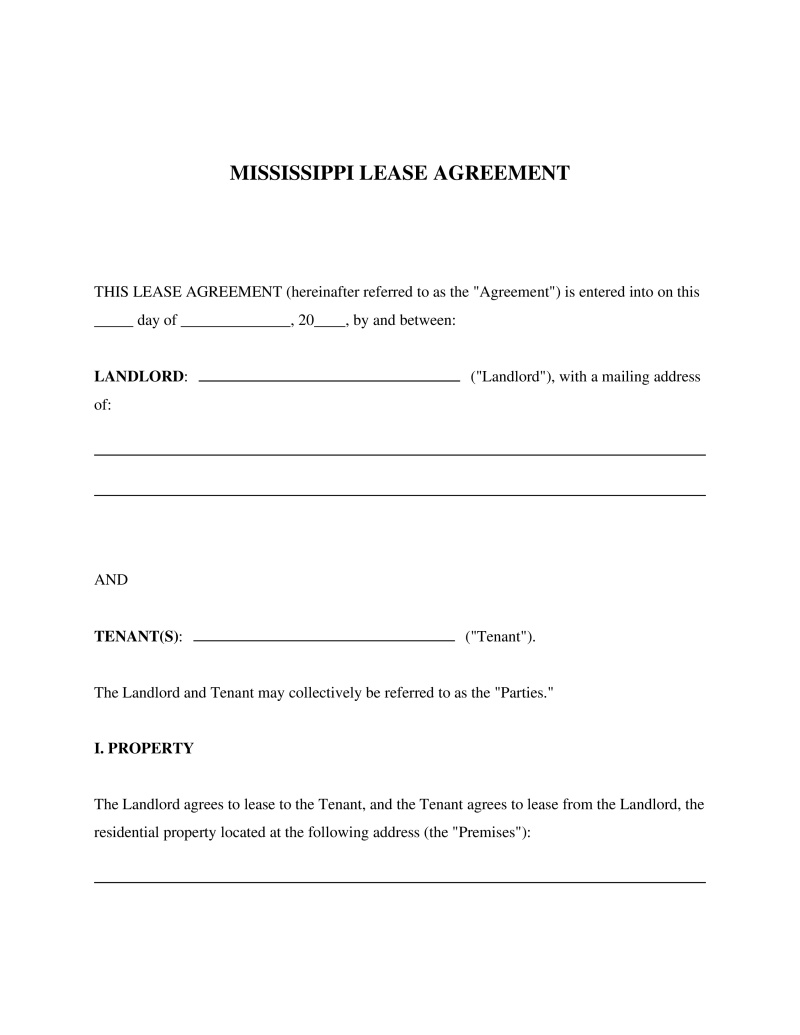
Mississippi Lease Agreement
A Mississippi Lease Agreement is a legal document that establishes the rental terms, duties, and expectations between a landlord and tenant for property leased in Mississippi.
Residential Property Type
Select the residential property category that best describes the rental premises.
Use this if the rental property does not fit one of the listed categories.
Table of Contents
What is a Mississippi Lease Agreement?
A Mississippi Lease Agreement is a legally binding contract executed between a landlord (lessor) and a tenant (lessee) for the rental of residential or commercial property within the state. This document outlines the specific terms of the tenancy, including the duration of the lease, monthly rent amount, security deposit requirements, and the responsibilities regarding maintenance and utilities. By signing this agreement, both parties consent to adhere to the stipulations set forth, which serves as the primary legal instrument for resolving disputes and ensuring compliance with the Mississippi Residential Landlord and Tenant Act.
Legal Framework and Statutory Requirements
The landlord-tenant relationship in Mississippi is primarily governed by Title 89, Chapter 8 of the Mississippi Code Annotated, known as the Residential Landlord and Tenant Act. This legislation establishes the minimum standards for rental agreements and overrides any lease provisions that attempt to waive a tenant's statutory rights. For instance, while landlords have broad discretion in drafting lease terms, they cannot enforce clauses that contradict state laws regarding security deposit returns or the implied warranty of habitability.
Federal laws also play a significant role in the validity of a Mississippi Lease Agreement. The Fair Housing Act prohibits discrimination based on race, color, national origin, religion, sex, familial status, or disability. Additionally, for buildings constructed prior to 1978, federal regulations mandate the inclusion of a Lead-Based Paint Disclosure to inform tenants of potential health risks associated with lead exposure.
Security Deposits and Rent Regulations
Mississippi law provides specific guidelines regarding financial transactions between landlords and tenants. Unlike some jurisdictions, Mississippi does not impose a statutory limit on the maximum amount a landlord may charge for a security deposit. However, the state is strict regarding the return of these funds. According to Miss. Code Ann. § 89-8-21, a landlord must return the security deposit, less any reasonable deductions for damages beyond normal wear and tear, within 45 days of the termination of the tenancy.
Regarding rent, the state does not enforce rent control measures, allowing landlords to set rental rates at their discretion. Furthermore, there is no statutory grace period for rent payments; rent is considered late immediately after the due date unless the lease agreement specifies otherwise. Consequently, the document must clearly state the due date and the specific conditions under which late fees will be applied.
Required Elements of a Valid Mississippi Lease Agreement
To ensure enforceability in a court of law, a lease agreement in Mississippi must contain specific components. Missing or vague information can lead to legal ambiguities during eviction proceedings or damage claims.
- Party Identification: Full legal names of the landlord and all adult tenants.
- Property Description: The physical address and unit number of the premises.
- Term of Tenancy: Clear start and end dates for fixed-term leases, or commencement dates for month-to-month arrangements.
- Financial Terms: The exact rent amount, due date, acceptable payment methods, and security deposit amount.
- Lead-Based Paint Disclosure: Required for properties built before 1978 under 42 U.S. Code § 4852d.
- Notice Address: An address where the tenant can send official legal notices to the landlord.
Termination and Eviction Procedures
The lease agreement dictates the protocol for ending a tenancy, but it must align with state statutes. for a standard termination of a month-to-month tenancy, Mississippi requires a written notice of at least 30 days from the landlord or the tenant. For fixed-term leases, the tenancy typically terminates automatically upon the expiration date unless a renewal clause is activated.
In cases of non-payment of rent, the landlord may issue a 3-Day Notice to Pay or Quit. If the tenant fails to pay the outstanding rent within three days, the landlord may proceed with eviction filings. For lease violations other than non-payment, such as unauthorized pets or property damage, a 30-Day Notice to Cure or Quit is generally required, giving the tenant time to rectify the issue before the lease is terminated.
How to Execute a Mississippi Lease Agreement
Completing a rental contract involves several distinct stages to ensure all parties understand their obligations and the document is legally sound.
- Step 1: Negotiation of Terms – The landlord and tenant discuss the rent amount, lease duration, pet policies, and utility responsibilities.
- Step 2: Tenant Screening – The landlord typically conducts a background and credit check using a rental application to verify the tenant's ability to pay.
- Step 3: Drafting the Agreement – The terms agreed upon are transcribed into the lease document, incorporating all necessary disclosures required by Mississippi and federal law.
- Step 4: Walk-Through Inspection – Both parties inspect the property to document pre-existing damages, often utilizing a move-in checklist to protect the security deposit.
- Step 5: Signing and Payment – The landlord and tenant sign the document. The tenant pays the first month's rent and security deposit, and the landlord provides the keys to the premises.
Already have a Lease Agreement?
Get it reviewed free — checked against your state's laws in about a minute.
Not the form you're looking for?
Try our legal document generator to create a custom document
Disclaimer: The templates available on this website are provided for general informational purposes only and do not constitute legal advice. They are not intended to be, and should not be interpreted as, compliant with any specific legal, regulatory, or privacy requirements. These templates are not a replacement for professional legal guidance and should not be relied upon for any particular matter or circumstance. Users are strongly encouraged to seek advice from a qualified attorney licensed in their jurisdiction before using, modifying, or relying on any template.
All templates are provided on an "as is," "with all faults," and "as available" basis. The provider disclaims any and all warranties of any kind, whether express, implied, statutory, or otherwise, including without limitation warranties of merchantability, fitness for a particular purpose, title, or non-infringement.
LegalTemplates.com makes no guarantees or representations regarding the accuracy, completeness, expected outcomes, or reliability of the materials contained in these templates or any materials referenced or linked from them.