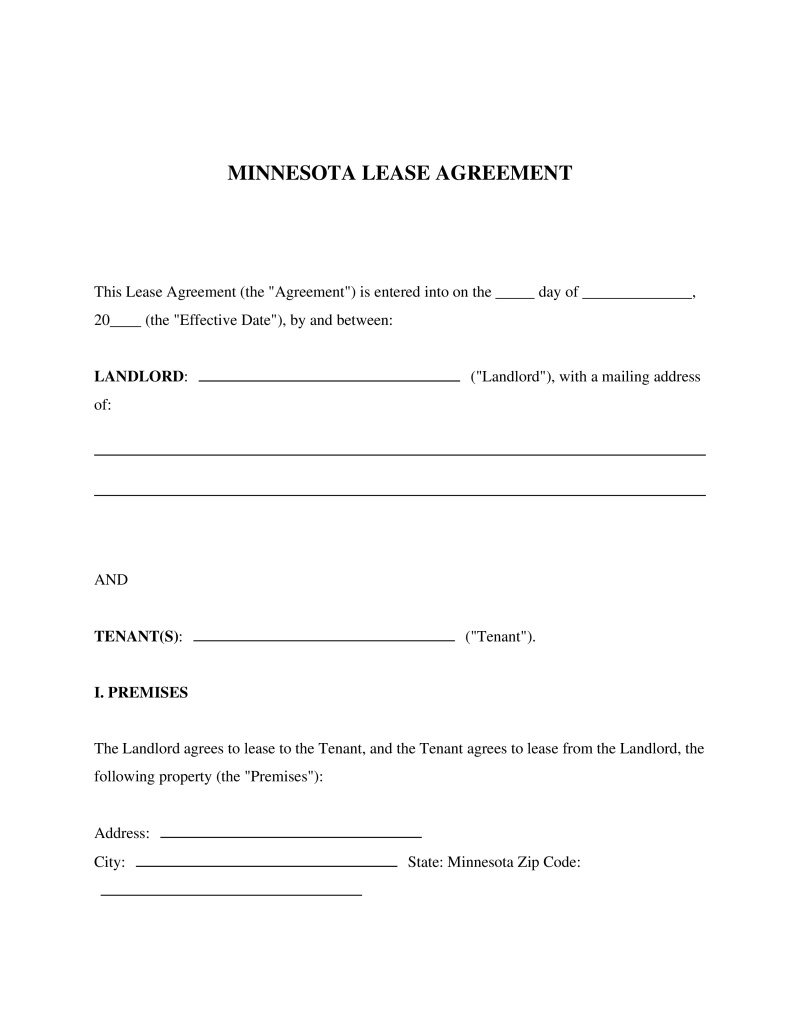
Minnesota Lease Agreement
A Minnesota Lease Agreement is a legal contract that sets the rules, rental terms, and responsibilities agreed upon by a landlord and tenant when leasing property in Minnesota.
Residential Property Type
Select the residential property category that best describes the rental premises.
Use this if the rental property does not fit one of the listed categories.
Table of Contents
What is a Minnesota Lease Agreement?
A Minnesota Lease Agreement is a legally binding contract executed between a landlord (lessor) and a tenant (lessee) regarding the rental of residential or commercial property within the state. This document establishes the terms and conditions of the tenancy, including the payment of rent, the duration of the occupancy, security deposit requirements, and the specific rules governing the use of the premises. Its primary purpose is to define the rights and responsibilities of both parties, ensuring compliance with state statutes and providing a clear framework for dispute resolution. While oral agreements can be valid for tenancies lasting less than one year, a written contract is standard practice to protect the interests of all involved parties.
Legal Framework and Statutory Requirements
Landlord-tenant relationships in the state are primarily governed by Minnesota Statutes Chapter 504B. Unlike some jurisdictions that rely heavily on common law, Minnesota has codified extensive regulations concerning the rental process. These statutes cover a wide range of issues, from the application process and screening fees to eviction proceedings and the return of security deposits. Federal laws, such as the Fair Housing Act, also apply, prohibiting discrimination based on race, color, national origin, religion, sex, familial status, or disability. Additionally, the Minnesota Human Rights Act expands these protections to include creed, marital status, status with regard to public assistance, and sexual orientation.
Security Deposits and Interest Rates
One of the distinctive features of a Minnesota Lease Agreement is the regulation surrounding security deposits. According to Minnesota Statutes Section 504B.178, landlords are required to hold security deposits in a manner that protects the funds from creditors. Uniquely, Minnesota law mandates that landlords pay simple non-compounded interest on the security deposit held. The specific interest rate has fluctuated over time based on statutory amendments; currently, the rate is set at 1% per annum. Upon the termination of the tenancy, the landlord must return the deposit, plus accrued interest, within three weeks (21 days). If any portion is withheld to cover unpaid rent or damages beyond normal wear and tear, the landlord must provide a written statement detailing the specific reasons for the withholding.
Mandatory Disclosures
To ensure transparency, state law requires landlords to provide specific disclosures within or alongside the rental contract. Failure to include these can lead to legal complications or penalties.
- Financial Distress: If the property has received a notice of cancellation of contract for deed or a notice of mortgage foreclosure sale, the landlord must disclose this status to prospective tenants before the lease is signed.
- Outstanding Inspection Orders: Landlords must disclose any outstanding citations or orders issued by health, housing, or fire inspectors regarding the condition of the property.
- Late Fees: A landlord cannot charge a late fee unless it is agreed upon in writing. Furthermore, the late fee cannot exceed 8% of the overdue rent payment.
- Lead-Based Paint: For any housing built prior to 1978, federal law requires the landlord to provide a lead-based paint disclosure and an informational pamphlet.
Required Elements of a Valid Minnesota Lease Agreement
While the content of a lease can vary based on the specific property and the needs of the landlord, certain elements are essential for the document to be considered valid and enforceable in a court of law.
- Identification of Parties: The full legal names of the landlord and all adult tenants who will occupy the unit.
- Property Description: The full address of the rental unit, including the unit number if applicable.
- Term of Tenancy: Clear start and end dates for the lease, or a statement indicating a month-to-month arrangement.
- Rent Specifics: The amount of rent, the due date, acceptable payment methods, and the address where rent should be sent.
- Signatures: The document must be signed and dated by the landlord and all tenants.
- Covenants of Habitability: Although often implied, the lease should reflect the landlord's duty to keep the premises fit for the use intended and in reasonable repair.
Landlord Access and Tenant Privacy
The balance between a landlord's right to manage their property and a tenant's right to privacy is strictly regulated. Under Minnesota Statutes Section 504B.211, a landlord may only enter the premises for a reasonable business purpose and must make a good faith effort to give the tenant reasonable notice before entry. Reasonable business purposes include showing the unit to prospective tenants or buyers, performing maintenance, or investigating lease violations. The statute does not define "reasonable notice" in hours, but 24 hours is the generally accepted standard. Exceptions to the notice requirement are made for emergencies where immediate entry is necessary to prevent injury to persons or property.
Frequently Asked Questions
Already have a Lease Agreement?
Get it reviewed free — checked against your state's laws in about a minute.
Not the form you're looking for?
Try our legal document generator to create a custom document
Disclaimer: The templates available on this website are provided for general informational purposes only and do not constitute legal advice. They are not intended to be, and should not be interpreted as, compliant with any specific legal, regulatory, or privacy requirements. These templates are not a replacement for professional legal guidance and should not be relied upon for any particular matter or circumstance. Users are strongly encouraged to seek advice from a qualified attorney licensed in their jurisdiction before using, modifying, or relying on any template.
All templates are provided on an "as is," "with all faults," and "as available" basis. The provider disclaims any and all warranties of any kind, whether express, implied, statutory, or otherwise, including without limitation warranties of merchantability, fitness for a particular purpose, title, or non-infringement.
LegalTemplates.com makes no guarantees or representations regarding the accuracy, completeness, expected outcomes, or reliability of the materials contained in these templates or any materials referenced or linked from them.