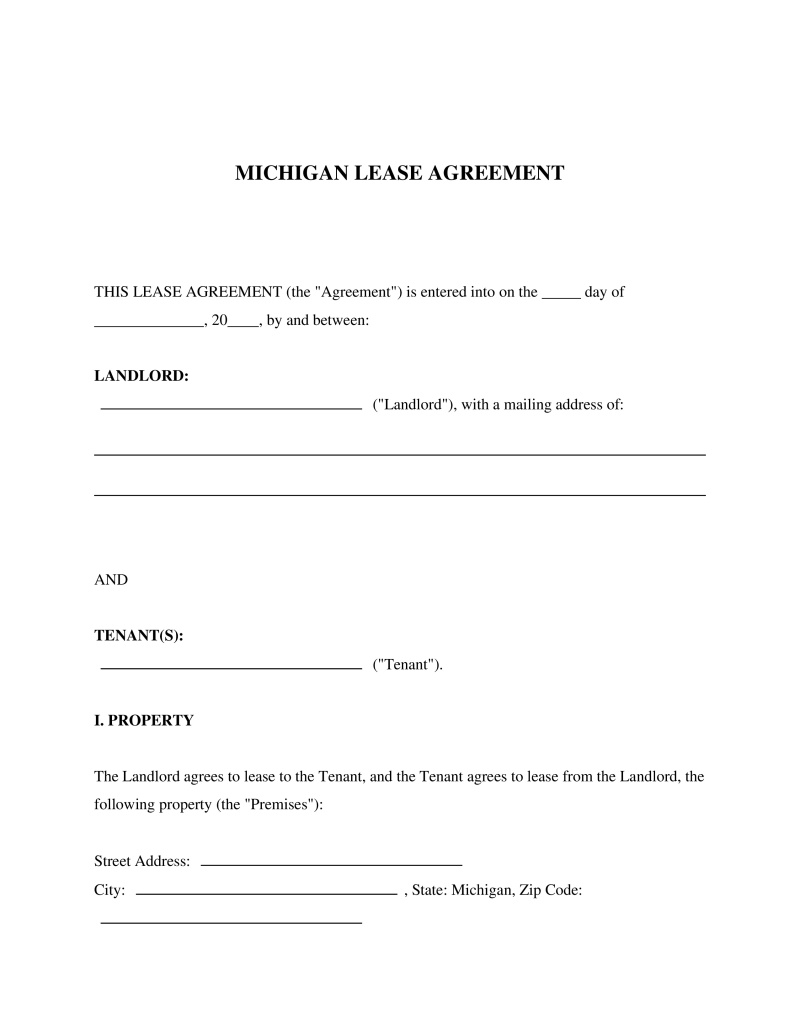
Michigan Lease Agreement
A Michigan Power of Attorney Form is a legal document that lets someone appoint an agent to handle defined legal or financial matters in their stead.
Residential Property Type
Select the residential property category that best describes the rental premises.
Use this if the rental property does not fit one of the listed categories.
Table of Contents
What is a Michigan Lease Agreement?
A Michigan Lease Agreement is a legally binding contract executed between a landlord (lessor) and a tenant (lessee) to establish the terms for renting a residential or commercial property within the state. This document delineates the rights and responsibilities of both parties, specifying critical details such as the monthly rent amount, payment due dates, security deposit stipulations, and the duration of the tenancy. To be enforceable in a court of law, the agreement must adhere to specific state statutes, including the Michigan Truth in Renting Act, which governs the inclusion of mandatory disclosures and prohibits clauses that violate tenant rights.
Legal Framework and Statutory Requirements
The landlord-tenant relationship in Michigan is governed by a complex framework of state statutes and common law. The central piece of legislation is the Truth in Renting Act (MCL 554.631 et seq.). This act serves to prevent the inclusion of illegal or unenforceable clauses in rental agreements. Under this law, a lease cannot require a tenant to waive their rights to a security deposit, exempt the landlord from liability for their own negligence, or waive the tenant's right to a trial by jury.
Furthermore, the Landlord and Tenant Relationships Act (MCL 554.601 et seq.) regulates security deposits, inventory checklists, and damage claims. Federal laws also apply, specifically regarding discrimination under the Fair Housing Act and environmental disclosures under the Residential Lead-Based Paint Hazard Reduction Act for properties built prior to 1978. Failure to comply with these statutory requirements can render specific provisions void or result in financial penalties for the landlord.
Security Deposit Regulations
Michigan law imposes strict limits and procedural requirements regarding security deposits. A landlord may not charge a security deposit that exceeds one and one-half times the monthly rent. This cap includes any prepaid rent, cleaning fees, or damage deposits, but excludes the first month's rent. Upon receiving the deposit, the landlord acts as a custodian and must deposit the funds into a regulated financial institution.
A critical component of the security deposit process is the inventory checklist. At the commencement of the tenancy, the landlord must provide two copies of an inventory checklist referencing the condition of the property. The tenant has seven days to note the condition of the items on the checklist and return a copy to the landlord. This process protects both parties by documenting pre-existing damages, ensuring that tenants are not wrongfully charged for issues present before their occupancy.
Mandatory Disclosures and Notices
For a Michigan Lease Agreement to be valid and compliant, it must contain specific notices and disclosures required by state and federal law. Omitting these elements can lead to legal complications during eviction proceedings or disputes over damages.
Truth in Renting Notice
Every residential lease must prominently display a specific notice in 12-point type (or larger). This notice informs tenants that the agreement must comply with the Truth in Renting Act and advises them to seek legal counsel if they question the legality of any provision.
Domestic Violence Protection Notice
Under MCL 554.601b, the lease must contain a statement informing tenants of their right to be released from rental obligations if they or their child have a reasonable apprehension of present danger from domestic violence, sexual assault, or stalking. This provision allows victims to terminate their lease early without penalty, provided they follow specific notification procedures.
Required Elements of a Valid Michigan Lease Agreement
While the specific terms of a rental contract can vary based on the property type and the preferences of the parties involved, a comprehensive Michigan Lease Agreement generally includes the following essential elements to ensure clarity and legal enforceability:
- Identification of Parties: The full legal names of the landlord and all adult tenants who will occupy the premises.
- Property Description: The complete address of the rental unit, including building number and unit number if applicable.
- Term of Tenancy: The start and end dates of the lease, or specifications for a month-to-month arrangement.
- Rent Details: The amount of rent, the due date, acceptable payment methods, and the address where payment should be sent.
- Security Deposit Terms: The amount of the deposit, the name and address of the financial institution where it is held, and the conditions for its return.
- Utility Responsibilities: A clear breakdown of which utilities (water, electricity, gas, trash) are paid by the landlord and which are the responsibility of the tenant.
- Signatures: The dated signatures of the landlord and all named tenants.
Termination and Eviction Procedures
The process for terminating a tenancy in Michigan depends on the reason for termination and the type of lease. For non-payment of rent, a landlord must provide a 7-Day Notice to Quit (Demand for Possession). This gives the tenant seven days to either pay the overdue rent or vacate the property. If the tenant engages in illegal drug activity on the premises, a 24-hour notice may be issued in certain jurisdictions following a police report.
For standard lease terminations where no breach has occurred, such as ending a month-to-month tenancy, either party must generally provide at least 30 days' notice. If a tenant refuses to leave after the notice period expires or after a lease violation, the landlord cannot forcibly remove them or shut off utilities. Instead, the landlord must file a complaint with the district court to obtain a judgment of possession and, if necessary, an order of eviction executed by a court officer.
Frequently Asked Questions
Already have a Lease Agreement?
Get it reviewed free — checked against your state's laws in about a minute.
Not the form you're looking for?
Try our legal document generator to create a custom document
Disclaimer: The templates available on this website are provided for general informational purposes only and do not constitute legal advice. They are not intended to be, and should not be interpreted as, compliant with any specific legal, regulatory, or privacy requirements. These templates are not a replacement for professional legal guidance and should not be relied upon for any particular matter or circumstance. Users are strongly encouraged to seek advice from a qualified attorney licensed in their jurisdiction before using, modifying, or relying on any template.
All templates are provided on an "as is," "with all faults," and "as available" basis. The provider disclaims any and all warranties of any kind, whether express, implied, statutory, or otherwise, including without limitation warranties of merchantability, fitness for a particular purpose, title, or non-infringement.
LegalTemplates.com makes no guarantees or representations regarding the accuracy, completeness, expected outcomes, or reliability of the materials contained in these templates or any materials referenced or linked from them.