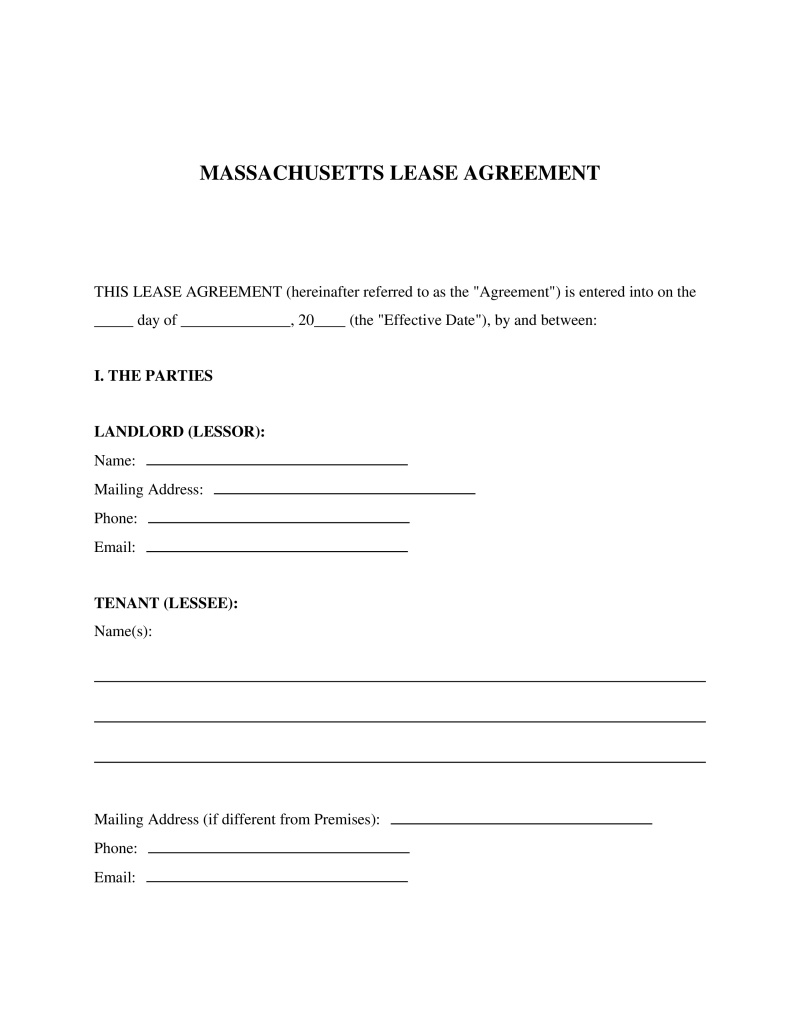
Massachusetts Lease Agreement
A Massachusetts Power of Attorney Form is a legal tool that enables a person to give a trusted agent the authority to manage selected financial or legal tasks in their place.
Residential Property Type
Select the residential property category that best describes the rental premises.
Use this if the rental property does not fit one of the listed categories.
Table of Contents
What is a Massachusetts Lease Agreement?
A Massachusetts Lease Agreement is a legally binding contract executed between a landlord (lessor) and a tenant (lessee) regarding the rental of property within the Commonwealth of Massachusetts. This document formalizes the terms of the tenancy, outlining the rights and obligations of both parties, including the payment of rent, the duration of the occupancy, and the rules governing the use of the premises. It serves as the primary legal instrument for resolving disputes and ensures that the rental arrangement complies with state statutes, specifically those found in the Massachusetts General Laws. While oral agreements can create a tenancy-at-will, a written contract provides greater security and clarity for fixed-term tenancies.
Legal Framework and Statutory Requirements
The landlord-tenant relationship in Massachusetts is governed by a complex framework of state statutes, primarily Massachusetts General Laws (M.G.L.) Chapter 186. Unlike some jurisdictions that favor freedom of contract in residential leases, Massachusetts imposes strict statutory requirements that cannot be waived by the tenant. Any clause in a lease that attempts to waive a tenant's statutory rights, such as the warranty of habitability or the right to due process in eviction, is considered void and unenforceable. The state enforces a strict Warranty of Habitability under the State Sanitary Code (105 CMR 410.000), which mandates that all rental units must meet minimum standards of health and safety regardless of what the lease document states.
Required Disclosures and Addenda
For a Massachusetts Lease Agreement to be fully compliant, specific disclosures must be provided to the tenant at the time of signing. Failure to provide these documents can expose the landlord to significant liability and potential fines.
- Lead-Based Paint Disclosure: For any property constructed before 1978, the landlord must provide a Tenant Lead Law Notification and Certification Form. This is a requirement under both the Massachusetts Lead Law and federal regulations.
- Statement of Condition: If a security deposit is collected, the landlord must provide a written statement describing the condition of the unit within 10 days of the tenancy beginning. This document protects both parties by documenting pre-existing damage.
- Security Deposit Receipt: Landlords must provide a receipt indicating the amount of the deposit, the name of the bank where it is held, and the account number. This must be done within 30 days of receiving the funds.
Security Deposits and Financial Regulations
Massachusetts maintains some of the strictest security deposit laws in the United States under M.G.L. c. 186, § 15B. A landlord may not demand an amount exceeding one month's rent for a security deposit, and an additional amount equal to one month's rent may be requested for the last month's rent. Crucially, security deposits must be held in a separate, interest-bearing account in a bank located within the Commonwealth, protected from the landlord's creditors. The landlord is required to pay the tenant interest on the security deposit and last month's rent annually. Violations of these financial statutes, such as commingling funds or failing to provide interest, can result in the landlord being liable for three times the amount of the deposit plus attorney's fees.
Required Elements of a Valid Massachusetts Lease Agreement
To ensure the document is enforceable in a court of law, specific components must be present within the written agreement. Omission of these details can lead to ambiguity and legal challenges.
- Identification of Parties: The full legal names of all adult tenants and the landlord or property manager.
- Property Description: The complete physical address of the rental unit, including apartment number.
- Term of Tenancy: Clear start and end dates for the lease, distinguishing it from a tenancy-at-will.
- Rent Specifics: The total amount due, the due date, acceptable payment methods, and details regarding any grace periods.
- Security Deposit Terms: Disclosure of the bank name and location where funds are held, as required by law.
- Utility Responsibility: A clear designation of which party is responsible for water, electricity, gas, and heat. Note that landlords can only charge for water if the unit is separately metered and water conservation devices are installed.
- Signatures: Dated signatures of all legal adults occupying the premises and the landlord.
Landlord Access and Tenant Privacy
While Massachusetts law does not specify an exact notification period for landlord entry in non-emergency situations, the standard practice established by case law and common usage is reasonable notice, typically interpreted as 24 hours. A Massachusetts Lease Agreement usually includes a clause specifying the notice period required before a landlord may enter the premises for repairs, inspections, or showings. However, landlords are permitted immediate access without notice in the event of an emergency, such as a burst pipe or fire. Tenants have a right to quiet enjoyment, and landlords are prohibited from abusing their right of access to harass the tenant.
Late Fees and Eviction Protocols
State law regulates how and when landlords can penalize tenants for late rent. A landlord cannot charge a late fee until the rent is at least 30 days overdue. Any clause in a lease imposing a penalty before this 30-day period is illegal and unenforceable. Regarding eviction, the lease outlines the grounds for termination, but the process must follow strict legal procedures. Landlords cannot perform "self-help" evictions, such as changing locks or shutting off utilities. They must obtain a court order through the summary process eviction generally initiated by a Notice to Quit.
Frequently Asked Questions
Already have a Lease Agreement?
Get it reviewed free — checked against your state's laws in about a minute.
Not the form you're looking for?
Try our legal document generator to create a custom document
Disclaimer: The templates available on this website are provided for general informational purposes only and do not constitute legal advice. They are not intended to be, and should not be interpreted as, compliant with any specific legal, regulatory, or privacy requirements. These templates are not a replacement for professional legal guidance and should not be relied upon for any particular matter or circumstance. Users are strongly encouraged to seek advice from a qualified attorney licensed in their jurisdiction before using, modifying, or relying on any template.
All templates are provided on an "as is," "with all faults," and "as available" basis. The provider disclaims any and all warranties of any kind, whether express, implied, statutory, or otherwise, including without limitation warranties of merchantability, fitness for a particular purpose, title, or non-infringement.
LegalTemplates.com makes no guarantees or representations regarding the accuracy, completeness, expected outcomes, or reliability of the materials contained in these templates or any materials referenced or linked from them.