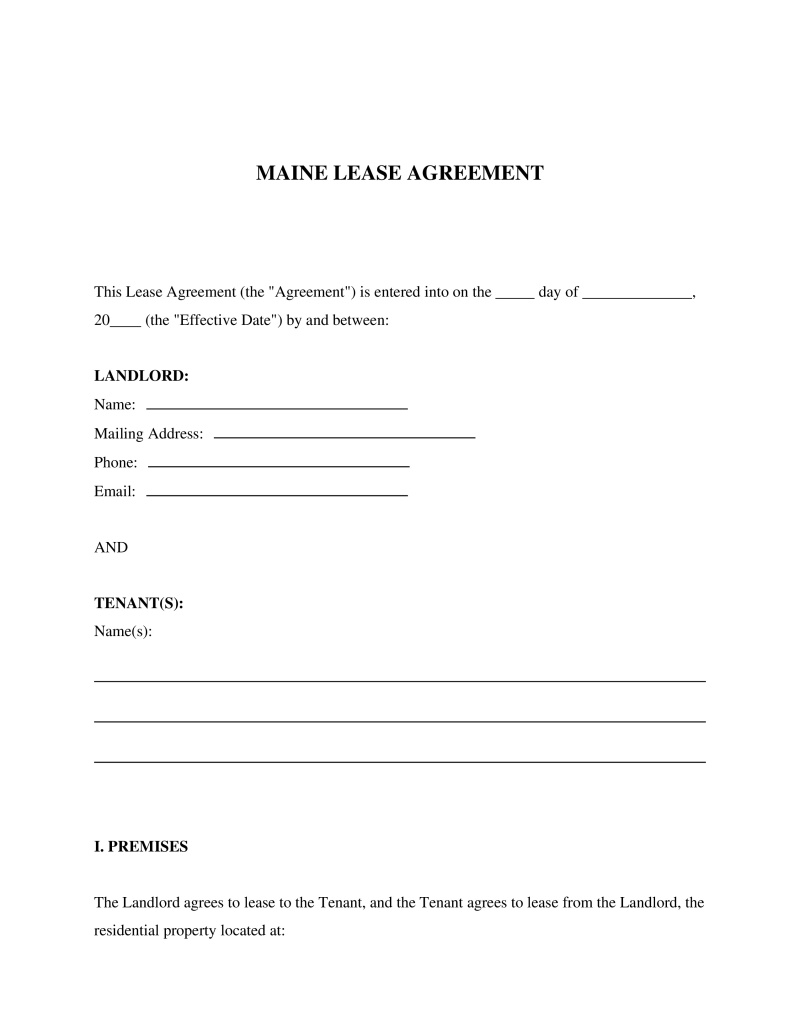
Maine Lease Agreement
A Maine Lease Agreement is a legally binding contract that details the rental terms, responsibilities, and obligations agreed upon by a landlord and tenant when leasing property in Maine.
Residential Property Type
Select the residential property category that best describes the rental premises.
Use this if the rental property does not fit one of the listed categories.
Table of Contents
What is a Maine Lease Agreement?
A Maine Lease Agreement is a legally binding contract entered into between a landlord (lessor) and a tenant (lessee) for the rental of residential or commercial property within the state. This document outlines the specific terms and conditions of the tenancy, including the duration of the lease, the monthly rent amount, security deposit requirements, and the respective responsibilities regarding utilities and maintenance. The agreement serves to protect the legal rights of both parties by establishing a clear framework for the rental relationship, and it must adhere to the regulations set forth in the Maine Revised Statutes, specifically Title 14, Chapter 710, which governs rental property and landlord-tenant relations.
Legal Framework and Statutory Requirements
In Maine, the landlord-tenant relationship is heavily regulated by state statutes to ensure fair practices and safe housing standards. The primary body of law governing these agreements is found in the Maine Revised Statutes Annotated (M.R.S.A.), Title 14. Under the implied warranty of habitability (14 M.R.S.A. § 6021), landlords are legally obligated to provide a dwelling that is fit for human habitation. This means the property must be safe, sanitary, and free from defects that could endanger the health or safety of the occupants. Provisions in a lease that attempt to waive this warranty are considered void and unenforceable.
Furthermore, Maine law dictates specific procedures for the handling of security deposits under 14 M.R.S.A. § 6031-6038. Landlords are prohibited from charging a security deposit that exceeds the equivalent of two months' rent. These funds must be held in a dedicated bank account protected from the landlord's creditors. Upon the termination of the lease, the landlord must return the deposit, minus any deductions for unpaid rent or damages beyond normal wear and tear, within a specific timeframe depending on the type of tenancy.
Mandatory Disclosures in Maine
Unlike some jurisdictions that require minimal disclosures, a Maine Lease Agreement must include several specific notifications to be legally compliant. Failure to provide these disclosures can result in financial penalties or the inability to enforce certain lease terms.
- Radon Disclosure: Under 14 M.R.S.A. § 6030-D, landlords must test for radon every ten years. They are required to disclose the most recent test results to potential tenants before a lease is signed.
- Bedbug Disclosure: Pursuant to 14 M.R.S.A. § 6021-A, landlords must inform prospective tenants if the rental unit or adjacent units are currently infested with bedbugs or have been treated for such an infestation. Landlords are also prohibited from renting a unit known to have an active infestation.
- Energy Efficiency Disclosure: Landlords must provide a residential energy efficiency disclosure statement that outlines the energy consumption and costs associated with the unit, in accordance with 14 M.R.S.A. § 6030-C.
- Smoking Policy: A landlord must disclose whether smoking is prohibited on the premises, allowed in certain areas, or allowed everywhere, as per 14 M.R.S.A. § 6030-E.
- Lead-Based Paint: For any property built prior to 1978, federal law requires the landlord to provide a lead paint disclosure and an EPA-approved information pamphlet.
Landlord Access and Tenant Privacy
The state of Maine balances the landlord's right to maintain the property with the tenant's right to quiet enjoyment. According to 14 M.R.S.A. § 6025, a landlord may enter the dwelling unit to inspect the premises, make necessary repairs, or show the unit to prospective buyers or tenants. However, except in cases of emergency, the landlord must provide reasonable notice before entry.
Maine statute defines "reasonable notice" as at least 24 hours. Furthermore, entry must occur at reasonable times. If a landlord repeatedly enters the property without proper notice or harasses the tenant, the tenant may have legal grounds to terminate the lease or seek damages. Conversely, tenants cannot unreasonably withhold consent for the landlord to enter for legitimate purposes.
How to Execute a Maine Lease Agreement
Creating and finalizing a rental contract in Maine involves several critical steps to ensure the document is valid and enforceable. Following a structured process helps prevent future disputes.
- Step 1: Tenant Screening – Before drafting the agreement, the landlord typically requires the potential tenant to complete a rental application. This allows for background checks, credit verification, and reference checks to ensure the tenant can meet financial obligations.
- Step 2: Drafting the Agreement – The landlord prepares the lease document, ensuring all state-specific clauses regarding rent, security deposits, and house rules are included. The document should clearly state the start and end dates of the tenancy.
- Step 3: Providing Disclosures – The landlord must attach all mandatory disclosure forms, such as the radon gas warning, energy efficiency statement, and lead paint disclosure (if applicable), to the lease for the tenant to review.
- Step 4: Walk-Through Inspection – Both parties should conduct a move-in inspection to document the current condition of the property. This establishes a baseline for the return of the security deposit later.
- Step 5: Signing and Payment – Both the landlord and tenant sign the Maine Lease Agreement. At this time, the tenant typically pays the first month's rent and the security deposit.
Late Fees and Grace Periods
Maine statutes impose strict limits on late fees to protect tenants from excessive charges. Under 14 M.R.S.A. § 6028, a landlord cannot impose a late fee until the rent remains unpaid for 15 days after the due date. This establishes a mandatory statutory grace period. Furthermore, the penalty for late payment cannot exceed 4% of the monthly rent amount. If a lease agreement contains terms that violate these limits, those specific terms are unenforceable in court.
FAQs
Already have a Lease Agreement?
Get it reviewed free — checked against your state's laws in about a minute.
Not the form you're looking for?
Try our legal document generator to create a custom document
Disclaimer: The templates available on this website are provided for general informational purposes only and do not constitute legal advice. They are not intended to be, and should not be interpreted as, compliant with any specific legal, regulatory, or privacy requirements. These templates are not a replacement for professional legal guidance and should not be relied upon for any particular matter or circumstance. Users are strongly encouraged to seek advice from a qualified attorney licensed in their jurisdiction before using, modifying, or relying on any template.
All templates are provided on an "as is," "with all faults," and "as available" basis. The provider disclaims any and all warranties of any kind, whether express, implied, statutory, or otherwise, including without limitation warranties of merchantability, fitness for a particular purpose, title, or non-infringement.
LegalTemplates.com makes no guarantees or representations regarding the accuracy, completeness, expected outcomes, or reliability of the materials contained in these templates or any materials referenced or linked from them.