Louisiana Lease Agreement
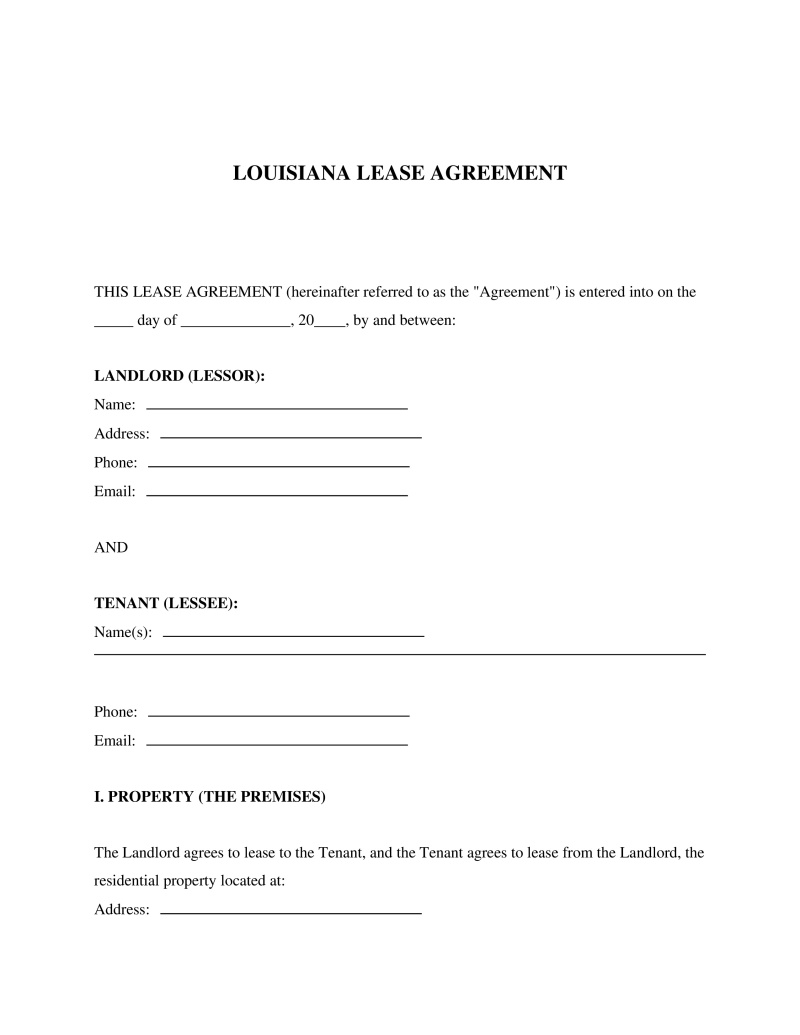
A Louisiana Lease Agreement is a legally binding contract that clearly defines the rental terms, payment obligations, and responsibilities of both the landlord and tenant for property leased in Louisiana.
Residential Property Type
Select the residential property category that best describes the rental premises.
Use this if the rental property does not fit one of the listed categories.
Table of Contents
What is a Louisiana Lease Agreement?
A Louisiana Lease Agreement is a legally binding contract between a landlord, referred to as the lessor, and a tenant, known as the lessee, that outlines the terms for renting a property. This document establishes the rights and obligations of both parties regarding the occupation of residential or commercial premises in exchange for rent payments. Because Louisiana operates under a civil law system derived from the Napoleonic Code rather than the common law system used in the other 49 states, the terminology and statutory requirements within these agreements differ significantly from other jurisdictions. The agreement serves to protect the interests of both parties by clearly defining parameters such as rental rates, duration of tenancy, and property maintenance responsibilities.
Legal Framework and Civil Code Governance
The legal foundation for a Louisiana Lease Agreement is found primarily in the Louisiana Civil Code, specifically Title IX, "Of Lease." Unlike common law states where case law heavily influences interpretation, Louisiana relies on the codified statutes to dictate the relationship between lessor and lessee. Key articles within the Civil Code address the delivery of the property, the warranty of habitability, and the liability for damages. Additionally, the Louisiana Revised Statutes contain specific provisions regarding security deposits and eviction procedures that supersede general contract principles.
Essential Elements of a Valid Lease
For a lease to be legally enforceable in Louisiana, it must contain three essential components: the thing (the property), the rent (the price), and the consent of the parties. While oral leases are recognized under state law, written agreements are standard practice to ensure all terms are explicitly understood. The document must accurately describe the premises and state the specific duration of the lease, whether it is for a fixed term or a month-to-month arrangement. If the duration is not agreed upon, the Civil Code applies default terms based on the type of property and the manner in which rent is paid.
Required Disclosures and Content
Drafting a compliant document involves including specific elements mandated by state and federal law. While Louisiana has fewer statutory disclosure requirements than some states, certain information is critical for validity and compliance.
- Full legal names and signatures of the lessor and lessee
- Legal description or physical address of the premises
- Agreed-upon rent amount, due date, and payment methods
- Security deposit amount and terms of return
- Federal Lead-Based Paint Disclosure (required for buildings erected before 1978)
- Terms regarding the waiver of notice to vacate (if applicable)
Security Deposits and Return Procedures
The handling of security deposits is strictly regulated under Louisiana Revised Statutes 9:3251. This statute dictates that a landlord must return the security deposit to the tenant within one month after the lease terminates and the tenant vacates the premises. If the landlord retains any portion of the deposit to cover damages or unpaid rent, they must provide an itemized statement explaining the deductions. Failure to comply with this requirement can result in the landlord being liable for actual damages or two hundred dollars, whichever is greater, in addition to attorney fees and costs.
Tenant Rights: Repair and Deduct
One specific right afforded to tenants in this state is the "repair and deduct" remedy outlined in Louisiana Civil Code Article 2694. If a landlord fails to make necessary repairs that are their responsibility after receiving proper notice from the tenant, the tenant may arrange for the repairs to be made. The tenant may then deduct the reasonable price of these repairs from the rent payment. However, this right is contingent upon the repairs being indispensable and the cost being reasonable in relation to the value of the rent.
Eviction and Lease Termination
The process for terminating a Louisiana Lease Agreement varies based on the type of lease. For fixed-term leases, the agreement ends automatically upon the expiration date without the need for notice. For indeterminate (month-to-month) leases, Civil Code Article 2728 requires a written notice of at least ten calendar days before the end of the month to terminate the tenancy. In cases of non-payment or lease violations, the landlord must generally provide a five-day notice to vacate before filing eviction proceedings, although many standard lease templates include a clause waiving this specific notice requirement.
Frequently Asked Questions
Lease Agreement in other states
Already have a Lease Agreement?
Get it reviewed free — checked against your state's laws in about a minute.
Not the form you're looking for?
Try our legal document generator to create a custom document
Disclaimer: The templates available on this website are provided for general informational purposes only and do not constitute legal advice. They are not intended to be, and should not be interpreted as, compliant with any specific legal, regulatory, or privacy requirements. These templates are not a replacement for professional legal guidance and should not be relied upon for any particular matter or circumstance. Users are strongly encouraged to seek advice from a qualified attorney licensed in their jurisdiction before using, modifying, or relying on any template.
All templates are provided on an "as is," "with all faults," and "as available" basis. The provider disclaims any and all warranties of any kind, whether express, implied, statutory, or otherwise, including without limitation warranties of merchantability, fitness for a particular purpose, title, or non-infringement.
LegalTemplates.com makes no guarantees or representations regarding the accuracy, completeness, expected outcomes, or reliability of the materials contained in these templates or any materials referenced or linked from them.